★
Loading archive…
Loading archive…
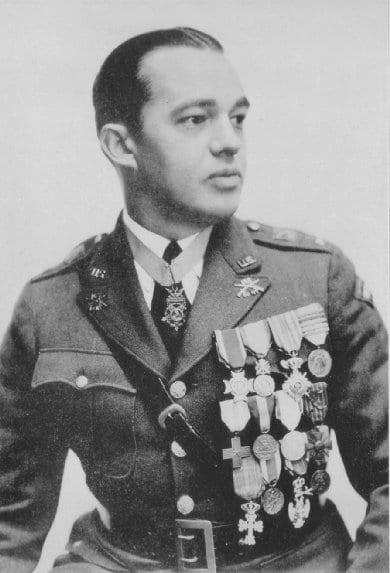
Second Lieutenant, U.S. Army
Support & adopt this hero ↓
How much courage does it take to keep fighting after being wounded again and again? For Sergeant Richard William O’Neill, the answer was simple: as long as his men needed him, he would not abandon the fight. On 30 July 1918, amid the brutal fighting along France’s Ourcq River, O’Neill displayed extraordinary courage, attacking an enemy force of approximately 25 German soldiers, continuing despite multiple wounds, and refusing evacuation until he had delivered vital battlefield intelligence to his battalion commander. His extraordinary actions earned him the United States Medal of Honor and secured his place among the most remarkable American heroes of the First World War.
Born on 28 August 1898 in New York City, Richard William O’Neill entered military service with the 69th New York National Guard Infantry Regiment. His early military experience included service during the Mexican Border Campaign of 1916 and 1917, when American forces mobilised along the southern frontier during the crisis involving revolutionary Mexico. This experience prepared him for the far greater challenges that awaited him overseas.
When the United States entered the First World War, the 69th New York Infantry was reorganised and redesignated as the 165th Infantry Regiment, becoming part of the famous 42nd Infantry Division, widely known as the Rainbow Division. The division fought across some of the most demanding battlefields of the Western Front, where American soldiers faced determined German resistance, devastating artillery bombardments and relentless infantry attacks. O’Neill served with Company D, 165th Infantry Regiment, earning a reputation for determination and leadership under fire.
His defining moment came on 30 July 1918 during the fighting near the Ourcq River in France. As American forces advanced against German positions, O’Neill moved ahead of the assaulting line and attacked an enemy detachment of approximately 25 men. What followed was a desperate hand-to-hand encounter. Although he sustained pistol wounds during the fighting, he refused to stop. He continued advancing, leading his detachment despite receiving additional wounds and suffering considerable blood loss.
Eventually, his physical condition became so serious that he could no longer remain in the fight. Yet even as he was being evacuated, O’Neill demonstrated that his commitment to his fellow soldiers went beyond personal survival. He insisted that he be taken first to his battalion commander so that he could report valuable information concerning German positions and the disposition of American troops. Only after delivering this intelligence did he accept evacuation.
It was an extraordinary demonstration of courage, initiative and devotion to duty. O’Neill had not simply fought against overwhelming odds. He had continued to lead while wounded and placed the safety and operational needs of his fellow soldiers ahead of his own suffering. For this exceptional act of heroism, he was awarded the Medal of Honor, the highest military decoration of the United States.
His bravery also attracted international recognition. France awarded him the prestigious Médaille militaire and the Croix de Guerre. His collection of wartime honours additionally included decorations associated with Italy, Montenegro, Portugal, Romania and Serbia, reflecting the international recognition of American military service during the Allied victory. His American and New York State honours further commemorated his service during the Mexican Border Campaign and the First World War.
O’Neill later continued his military career as a commissioned officer, ultimately attaining the rank of first lieutenant. His life represented a remarkable journey from a young New York National Guardsman to a decorated American combat veteran whose actions had been recognised by multiple Allied nations.
Richard William O’Neill died on 9 April 1982 in Hawthorne, New York. He was laid to rest at Gate of Heaven Cemetery, leaving behind a legacy defined by extraordinary courage and an unwavering sense of responsibility to those serving alongside him.
The story of Richard W. O’Neill is not simply the story of a Medal of Honor recipient. It is the story of a soldier who refused to surrender when wounded, a leader who continued serving his men when his own strength was failing, and a man who understood that the lives of his fellow soldiers mattered more than his personal safety. His actions at the Ourcq River remain a powerful reminder that true heroism is measured not only by what a soldier accomplishes in battle, but also by the sacrifices he is willing to make for others.
Become the named supporter for this profile and edit the tribute biography and portrait (Owner account required). Proceeds help keep the archive online.
$25 USD / year — annual sponsorship renewal. Keeps the page online and, where enabled, the family anniversary remembrance emails active.