★
Loading archive…
Loading archive…
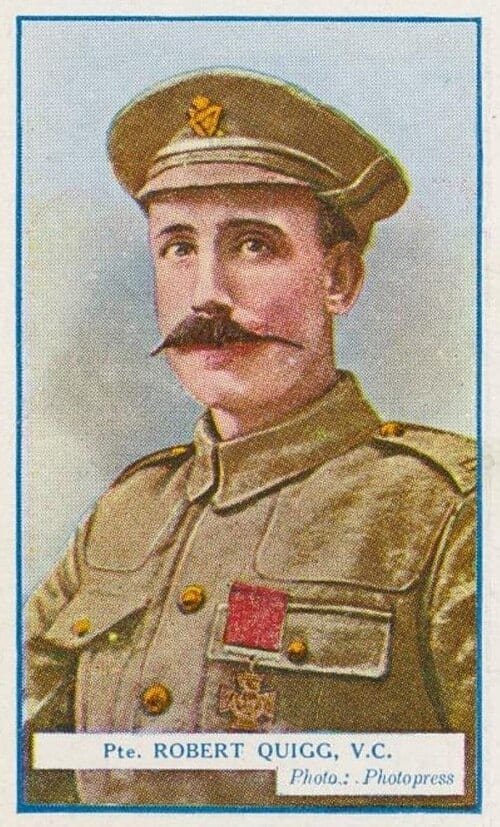
Sergeant, British Army
Support & adopt this hero ↓
Seven journeys into no man's land. Seven wounded soldiers rescued under relentless enemy fire. And one missing officer whom he never found. This is the extraordinary story of Sergeant Robert Quigg VC, the Irish soldier whose selfless courage during the Battle of the Somme earned him the Victoria Cross, Britain's highest military award for gallantry.
Born on 28 February 1885 near Bushmills, County Antrim, Robert Quigg grew up close to the Giant's Causeway and worked on the Macnaghten family estate. When the First World War erupted, he enlisted in the 12th Battalion, Royal Irish Rifles, part of the 36th (Ulster) Division. Serving as batman to Lieutenant Sir Edward Harry Macnaghten, Quigg would soon find himself at the centre of one of the war's most devastating battles.
On 1 July 1916, the opening day of the Battle of the Somme, Quigg advanced with his platoon three times against heavily defended German positions near Hamel. Machine-gun fire tore through the attacking ranks, leaving numerous soldiers dead or wounded. When Quigg learned that Lieutenant Macnaghten was missing, he made an extraordinary decision. Rather than remain behind the relative safety of British lines, he ventured into no man's land to search for his officer.
What followed became one of the Somme's most remarkable acts of individual courage. For seven hours, Quigg repeatedly crawled through shellfire and machine-gun fire, searching among the wounded. Seven times he ventured out, and seven times he returned carrying or dragging a wounded comrade to safety. On his final journey, he pulled a soldier back on a waterproof sheet from within yards of the German wire. Exhaustion finally forced him to stop. Tragically, Lieutenant Macnaghten was never found.
For his extraordinary bravery, Private Robert Quigg was awarded the Victoria Cross. His official citation, published in the London Gazette, Issue 29740, Supplement, page 8871, in September 1916, praised his "most conspicuous bravery" and documented his seven rescue journeys. King George V personally presented him with the Victoria Cross at York Cottage, Sandringham, on 8 January 1917.
Quigg's courage also received international recognition. The Russian Empire awarded him the Medal of St George, 4th Class, formally recorded in the London Gazette, Issue 29945, Supplement, pages 1602–1603, on 15 February 1917. The same announcement granted British permission to wear the foreign decoration.
His military service continued beyond the Somme, including duties in Mesopotamia and Egypt and later service with the Royal Ulster Rifles. His campaign honours included the 1914–15 Star, British War Medal and Victory Medal, while his subsequent operational service was recognised by the General Service Medal with Iraq clasp. He also received the King George V Silver Jubilee Medal in 1935, King George VI Coronation Medal in 1937 and Queen Elizabeth II Coronation Medal in 1953. His surviving medal group is documented by the Royal Irish regimental museum and Victoria Cross Online.
Following a serious accident in 1926, Quigg's military career was curtailed. He later returned to civilian life and maintained his connection to the Bushmills area. He died on 14 May 1955 at Ballycastle, County Antrim, aged 70, and was buried with full military honours at Billy Parish Churchyard.
More than a century after his heroic actions, Robert Quigg's courage continues to inspire. On 28 June 2016, Queen Elizabeth II unveiled a memorial statue in Bushmills commemorating his extraordinary sacrifice and humanity. Seven stones incorporated into the memorial represent the seven wounded soldiers he rescued.
Robert Quigg never found the officer he went into battle to save. Instead, he saved seven other lives. His legacy is a reminder that the greatest courage is not measured by the enemy defeated, but by the lives a soldier is willing to risk everything to protect.
Become the named supporter for this profile and edit the tribute biography and portrait (Owner account required). Proceeds help keep the archive online.
$25 USD / year — annual sponsorship renewal. Keeps the page online and, where enabled, the family anniversary remembrance emails active.