★
Loading archive…
Loading archive…
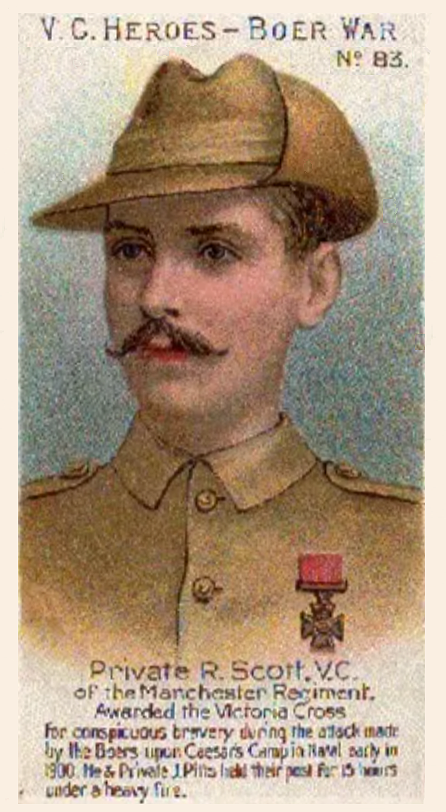
Regimental Quartermaster Sergeant, British Army
Support & adopt this hero ↓For fifteen hours, under relentless enemy fire, two British soldiers held a position that seemed impossible to defend. With no food, no water and enemy fighters occupying neighbouring defences, they refused to surrender their ground. One of those men was Robert Scott, a former Lancashire cotton-mill worker whose extraordinary courage during the Second Boer War earned him the Victoria Cross.
Born on 4 June 1874 in Haslingden, Lancashire, Robert Scott enlisted in the British Army's Manchester Regiment on 2 February 1895. Serving with the 1st Battalion, he deployed to South Africa and endured the Siege of Ladysmith, one of the defining struggles of the Boer War. On 6 January 1900, his courage would be tested in circumstances that would secure his place in British military history.
During the fierce Boer assault on Caesar's Camp, Private Scott and Private James Pitts defended a stone-built position known as a sangar. Their comrades on the left had been shot down, and Boer troops occupied nearby positions. Despite being exposed to devastating rifle fire, the two men maintained their defence for fifteen hours without food or water. Scott was wounded, but the position remained in British hands until the attackers were driven back.
Their remarkable stand was officially recognised in The London Gazette on 26 July 1901, which recorded that they "held their post for fifteen hours without food or water." Both men were awarded the Victoria Cross, Britain's highest military decoration for gallantry in the presence of the enemy. On 8 June 1902, Lord Kitchener personally presented their Victoria Crosses at Pretoria. Scott's South African campaign service was also recognised by the Queen's South Africa Medal, with clasps for Elandslaagte, Defence of Ladysmith and Belfast, and the King's South Africa Medal, with clasps for South Africa 1901 and South Africa 1902.
But Scott's story did not end at Ladysmith. He returned to military service in 1904, eventually becoming a Regimental Quartermaster Sergeant. During the First World War, he performed essential regimental duties with the Manchester Regiment's reserve organisation. After retiring from the Army in 1923, he settled in Northern Ireland. When the Second World War began, Scott, already in his sixties, returned to uniform with the Royal Air Force, serving in ground-support and security duties.
His surviving medal record reflects a lifetime of service across generations. Alongside his Victoria Cross and Boer War campaign medals, it records the War Medal 1939–1945, King George VI Coronation Medal of 1937, Queen Elizabeth II Coronation Medal of 1953, and George V issues of the Army Long Service and Good Conduct Medal and Meritorious Service Medal. These honours are documented in David J. Biggins's Elandslaagte medal-roll research, which identifies Scott by his original Manchester Regiment service number, 4535.
Robert Scott died in February 1961 at Downpatrick, Northern Ireland, aged 86, and was buried at Christ Church Cemetery, Kilkeel. His Victoria Cross and medal group were preserved by the Manchester Regiment and are associated with its regimental museum collection.
From the cotton mills of Lancashire to the desperate defences of Ladysmith, Robert Scott's life demonstrated that courage is measured not by rank or recognition, but by the determination to stand firm when everything seems lost. His fifteen-hour defence at Caesar's Camp remains an enduring example of steadfastness, sacrifice and extraordinary British military gallantry.
Become the named supporter for this profile and edit the tribute biography and portrait (Owner account required). Proceeds help keep the archive online.
$25 USD / year — annual sponsorship renewal. Keeps the page online and, where enabled, the family anniversary remembrance emails active.