★
Loading archive…
Loading archive…

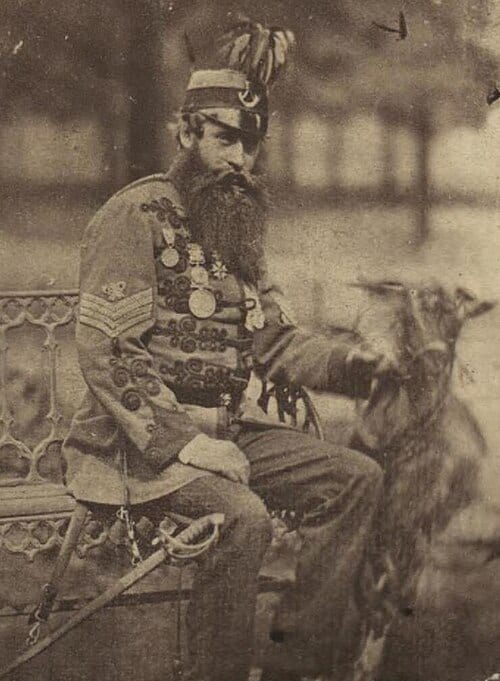
With Russian guns commanding the approaches to Sevastopol, a wounded British officer lay helpless beyond the safety of his own lines. One Welsh soldier volunteered to go back into danger to bring him home. His name was Robert Shields, and his extraordinary courage would earn him the Victoria Cross, Britain's highest award for gallantry.
Born in Cardiff, Wales, in 1827, Robert Shields enlisted in the British Army's 23rd Regiment of Foot, the Royal Welch Fusiliers, on 9 April 1847. His military service took him to the Crimean War, where he endured the bitter conditions of the Crimean campaign and fought at Inkermann. Yet it was an act of humanity amid the destruction of war that would secure his place in British military history.
On 8 September 1855, during the final British assault on the Great Redan at Sevastopol, Lieutenant and Adjutant Dyneley lay severely wounded beyond the British trenches. With enemy fire threatening anyone who ventured forward, Shields volunteered to leave the protection of the fifth parallel and attempt a rescue. Working alongside Assistant Surgeon Henry Thomas Sylvester, he helped recover the wounded officer from the exposed battlefield. Despite their courage, Dyneley's injuries proved fatal.
Shields's gallantry was recognized in The London Gazette of 24 February 1857, Issue 21971, page 659. The Victoria Cross citation specifically commended him for volunteering to go forward after the Redan assault to bring in Lieutenant Dyneley. Although serving as a private during the rescue, Shields was promoted to corporal the following day and was identified by that rank in the official announcement.
His Crimean War service also attracted international recognition. He received the French Légion d'honneur, Chevalier (Fifth Class), recorded in The London Gazette of 4 August 1856, Issue 21909. His campaign service was further recognized by the Crimea Medal with Inkermann and Sebastopol clasps and the Turkish Crimea Medal, as documented by the Victoria Cross and George Cross Association.
On 26 June 1857, Shields stood before Queen Victoria at Hyde Park, London, during the first-ever Victoria Cross investiture. Among the earliest recipients of the newly established decoration, the soldier from Cardiff became part of an enduring chapter in British military history.
After leaving the Army in December 1856, Shields worked as a park ranger in London's Regent's Park. In 1864, he travelled to Bombay, India, to work as an overseer for the Back Bay Reclamation Company. His life ended there on 23 December 1864, when he was approximately 37 years old. He was buried in an unmarked grave in Bombay.
Robert Shields VC is remembered not for capturing an enemy position, but for risking his life to save another. His story remains a powerful reminder that the greatest courage on a battlefield is sometimes found not in taking a life, but in trying to save one.
Become the named supporter for this profile and edit the tribute biography and portrait (Owner account required). Proceeds help keep the archive online.
$25 USD / year — annual sponsorship renewal. Keeps the page online and, where enabled, the family anniversary remembrance emails active.