★
Loading archive…
Loading archive…
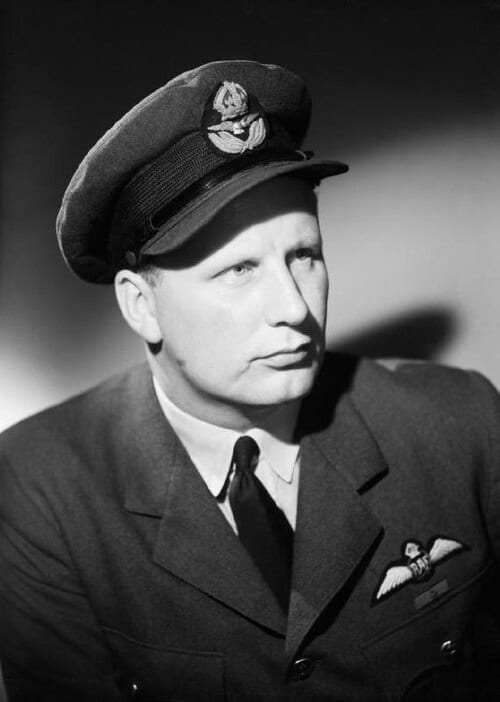
Wing commander, Royal Air Force
Support & adopt this hero ↓
Flying through gunfire, he bombed and brought his crew home.
Roderick Alastair Brook Learoyd was born at Folkestone, Kent, on 5 February 1913, the son of an Army officer. Educated at Wellington College and the Chelsea College of Aeronautical and Automobile Engineering, he spent two years fruit farming in Argentina and also worked as a motor engineer before returning to Britain. He joined the Royal Air Force in March 1936 and received a short-service commission as an acting pilot officer on 18 May. After training at Hamble and Wittering, he joined No. 49 Squadron at Worthy Down in December 1936, flying Hawker Hinds.
The squadron moved to Scampton in 1938 and converted to Handley Page Hampdens. Learoyd flew on the North Sea reconnaissance of 3 September 1939, the day Britain entered the Second World War, and subsequently took part in bombing operations over Germany. On 12 August 1940, as an acting flight lieutenant, he attacked the Dortmund-Ems Canal at extremely low altitude despite concentrated gunfire, then brought his damaged bomber and crew home. His Victoria Cross was announced on 20 August and presented at Buckingham Palace on 9 September 1940. It was Bomber Command's first VC of the war.
After the award, Learoyd temporarily left operations to serve as personal assistant to Air Chief Marshal Sir Robert Brooke-Popham. He returned to command No. 83 Squadron at Scampton on 28 February 1941, before moving to instructional work at No. 14 Operational Training Unit, Cottesmore, in June. He held wartime wing commander rank. On 19 December 1941 he took command of No. 44 (Rhodesia) Squadron at Waddington as it introduced the Avro Lancaster into operational service. He was its commander when John Nettleton led the Augsburg raid in April 1942.
In May 1942 Learoyd moved to No. 25 Operational Training Unit at Finningley. From January 1943 he undertook Air Ministry public-relations work, including appearances at factories and RAF stations, followed by further training postings. In May 1945 he joined No. 48 Squadron, flying Dakotas, and subsequently served with No. 1314 Flight at Accra in West Africa. He was demobilised on 14 October 1946 and entered the RAF Reserve.
His civilian career included airline operations work and service with the Malayan Civil Aviation Department. From 1947 to 1950 he flew governors of Malaya, then returned to Britain to work in the tractor and road-construction industry. In 1953 he became an export sales manager in the motor industry, subsequently working overseas, before retiring in 1978. He relinquished his reserve commission on 5 February 1958 with permission to retain the rank of wing commander. Learoyd died at Rustington, West Sussex, on 24 January 1996, aged 82; his ashes were interred at Worthing Crematorium.
Official Victoria Cross citation The London Gazette, 20 August 1940, issue 34927, page 5090.
Air Ministry, 20th August, 1940.
ROYAL AIR FORCE.
The KING has been graciously pleased to confer the Victoria Cross on the undermentioned officer, in recognition of most conspicuous bravery:
Acting Flight Lieutenant Roderick Alastair Brook LEAROYD (37860).
This officer, as first pilot of a Hampden aircraft, has repeatedly shown the highest conception of his duty and complete indifference to personal danger in making attacks at the lowest altitudes regardless of opposition. On the night of 12th August, 1940, he was detailed to attack a special objective on the Dortmund-Ems Canal. He had attacked this objective on a previous occasion and was well aware of the risks entailed. To achieve success it was necessary to approach from a direction well known to the enemy, through a lane of especially disposed anti-aircraft defences, and in the face of the most intense point blank fire from guns of all calibres. The reception of the preceding aircraft might well have deterred the stoutest heart, all being hit and two lost. Flight Lieutenant Learoyd nevertheless made his attack at 150 feet, his aircraft being repeatedly hit and large pieces of the main planes torn away. He was almost blinded by the glare of many searchlights at close range but pressed home this attack with the greatest resolution and skill. He subsequently brought his wrecked aircraft home and, as the landing flaps were inoperative and the undercarriage indicators out of action, waited for dawn in the vicinity of his aerodrome before landing, which he accomplished without causing injury to his crew or further damage to the aircraft. The high courage, skill and determination, which this officer has invariably displayed on many occasions in the face of the enemy, sets an example which is unsurpassed.
Become the named supporter for this profile and edit the tribute biography and portrait (Owner account required). Proceeds help keep the archive online.
$25 USD / year — annual sponsorship renewal. Keeps the page online and, where enabled, the family anniversary remembrance emails active.