★
Loading archive…
Loading archive…

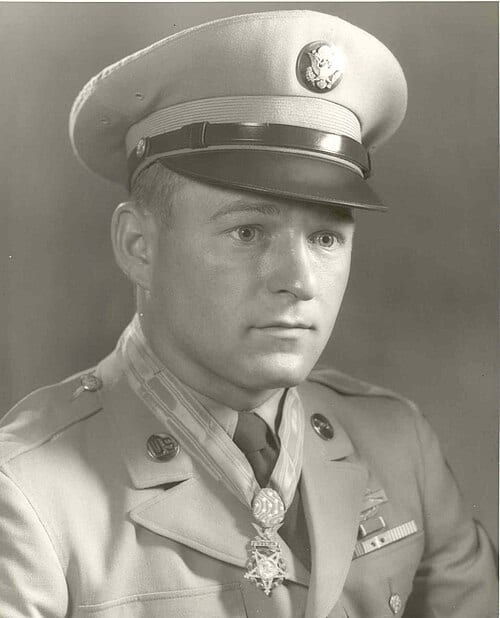
On a frozen Korean hillside, one American soldier charged an enemy stronghold three times, fighting almost alone against overwhelming fire. But his greatest act of courage came when he turned back to save the wounded. His name was Ronald Eugene Rosser, and his extraordinary bravery would earn him the Medal of Honor and a permanent place among the heroes of the Korean War.
Born on 24 October 1929 in Columbus, Ohio, Ronald Eugene Rosser grew up in the Crooksville and Roseville area as the eldest son in a family of seventeen children. Hardship shaped his early life, and responsibility came long before adulthood. At seventeen, he enlisted in the United States Army in 1946, qualified as a paratrooper, and served with occupation forces in Japan and Germany. Returning to civilian life in 1949, he worked in the coal mines of Ohio. His military career might have ended there, but the Korean War brought a devastating personal tragedy. In February 1951, his younger brother Richard was killed in combat. Grief and a determination to avenge his brother led Rosser to reenlist and volunteer for service in Korea.
On 12 January 1952, Corporal Rosser was serving as a forward observer with the Heavy Mortar Company, 38th Infantry Regiment, 2nd Infantry Division, near Ponggilli, Korea. His unit was attempting to capture a heavily fortified enemy hill when intense machine-gun, rifle, artillery, and mortar fire brought the assault to a halt. With American soldiers pinned down and casualties mounting, Rosser made a decision that would define his legacy.
Handing his radio to an assistant, Rosser seized his carbine and a grenade and charged directly into the enemy defenses. He fought through bunkers and trenches, eliminating enemy positions before running out of ammunition. Rather than withdraw, he returned for fresh supplies and attacked again. When his ammunition was exhausted a second time, he launched a third assault. His official Medal of Honor citation, recorded in Department of the Army General Orders No. 67, dated 7 July 1952, credited him with single-handedly killing at least thirteen enemy soldiers during the action.
Yet the most remarkable chapter of that battle was still unfolding. As the American troops began withdrawing, Rosser, himself wounded, repeatedly crossed exposed ground under enemy fire to help evacuate comrades who were more seriously injured. His actions demonstrated that extraordinary battlefield courage was not measured only by the enemy positions he destroyed, but also by the lives he risked his own to save.
On 27 June 1952, President Harry S. Truman personally presented Rosser with the Medal of Honor at the White House. The Purple Heart recognized his combat wounds, while his broader military record included the Army Commendation Medal, Army Good Conduct Medal, World War II Victory Medal, Army of Occupation Medal, National Defense Service Medal, and decorations recognizing his Korean service. His Medal of Honor citation remains one of the Korean War's most powerful accounts of individual courage and devotion to fellow soldiers.
Rosser continued serving in the Army after Korea, including another assignment on the Korean Peninsula, and eventually rose to sergeant first class. Tragedy struck his family again when another younger brother, Gary, a United States Marine, was killed during the Vietnam War. Rosser sought to return to combat, but his request was denied. He retired from the Army in 1968, closing a military career shaped by service, sacrifice, and the loss of two brothers.
Recognition of his courage continued long after the guns of Korea fell silent. On 27 July 2014, the Republic of Korea honoured Rosser with the Taeguk class of its Order of Military Merit, one of South Korea's highest military distinctions, acknowledging his exceptional service during the Korean War. The honour symbolized the lasting gratitude of a nation whose freedom he had helped defend.
In retirement, Rosser earned a college degree, worked in education and other civilian roles, supported veterans, and dedicated himself to teaching younger generations about courage and sacrifice. He also helped preserve the memory of his fallen brothers. Over time, his understanding of heroism moved beyond the desire for revenge that had first taken him to Korea. He increasingly emphasized the men he had saved and the comrades whose sacrifices could never be forgotten.
Ronald Eugene Rosser died on 26 August 2020 in Bumpus Mills, Tennessee, aged ninety. From the coalfields of Ohio to the frozen hills of Korea, his journey became an unforgettable story of grief, determination, brotherhood, and selfless courage. His Medal of Honor commemorated what he accomplished in battle, but his lasting legacy rests in the lives he saved and the generations he inspired. He was a soldier who charged into deadly fire, and a hero who refused to leave his wounded comrades behind.
Become the named supporter for this profile and edit the tribute biography and portrait (Owner account required). Proceeds help keep the archive online.
$25 USD / year — annual sponsorship renewal. Keeps the page online and, where enabled, the family anniversary remembrance emails active.