★
Loading archive…
Loading archive…
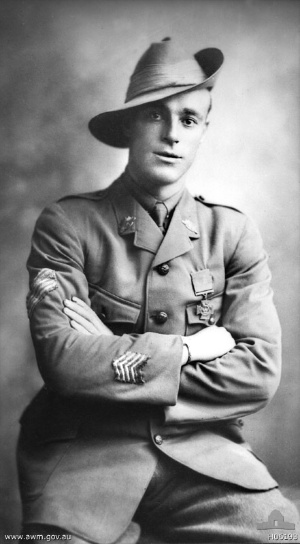
Warrant Officer Class One, Australian Army
Support & adopt this hero ↓
He stormed enemy gun posts and saved the advancing soldiers.
Reginald Roy Inwood was born at Adelaide on 14 July 1890. Before the First World War he worked as a miner at Broken Hill and in Tasmania, and at a eucalyptus distilling plant on Kangaroo Island. He enlisted in the Australian Imperial Force in August 1914 and sailed with the 10th Battalion that October.
Inwood served at Gallipoli and on the Western Front. During the fighting around Polygon Wood in September 1917, he repeatedly attacked enemy strongpoints, captured machine guns and prisoners, and removed obstacles to the advance. On one occasion he went forward alone, bombed a machine-gun post and captured its crew. His initiative and courage earned the Victoria Cross.
He advanced through the non-commissioned ranks and left his battalion in May 1918. He embarked for Australia on 24 August and was discharged in December 1919. After the war he moved to Adelaide, where he worked for the city council from 1928 to 1955.
Inwood enlisted again in September 1939. His Second World War duties included provost and military detention work in Australia. Promoted to warrant officer class one in November 1943, he held that rank until medical discharge on 30 November 1944. His later campaign and service medals recognised this additional period of military service.
He maintained ties with the 10th Battalion and attended commemorations with fellow veterans. Inwood died in Adelaide on 23 October 1971 and was buried with military honours in the AIF section of West Terrace Cemetery.
Official Victoria Cross citation
For most conspicuous bravery and devotion to duty during the advance to the second objective. He moved forward through our barrage alone to an enemy strong post and captured it, together with nine prisoners, killing several of the enemy. During the evening he volunteered for a special all-night patrol, which went out six hundred yards in front of our line, and there - by his coolness and sound judgment - obtained and sent back very valuable information as to the enemy’s movements. In the early morning of the 21st September, Pte. Inwood located a machine gun which was causing several casualties. He went out alone and bombed the gun and team, killing all but one, whom he brought in as a prisoner with the gun.
Fourth Supplement to The London Gazette of 23 November 1917. 26 November 1917, Numb. 30400, p. 12330
Become the named supporter for this profile and edit the tribute biography and portrait (Owner account required). Proceeds help keep the archive online.
$25 USD / year — annual sponsorship renewal. Keeps the page online and, where enabled, the family anniversary remembrance emails active.