★
Loading archive…
Loading archive…
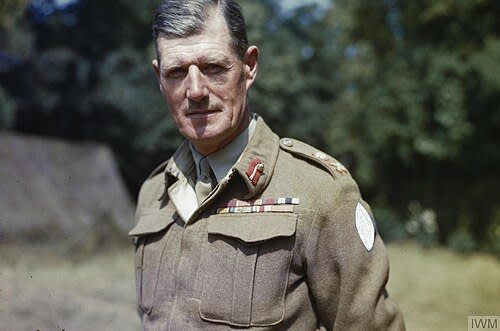
General, British Army
Support & adopt this hero ↓
Before General Sir John Tredinnick Crocker commanded tens of thousands of British and Canadian troops on D-Day, he had already faced the enemy at distances measured in yards. During the First World War, with German troops closing to within 30 yards of his machine guns, the young officer stood between the weapons directing their fire, then covered a withdrawal with bombs and rifle fire. More than twenty-five years later, that same soldier would command I Corps during the Allied invasion of Normandy, with responsibility for Sword Beach, Juno Beach and the airborne forces protecting the eastern flank. Crocker's journey from private soldier to full general was one of the most remarkable British Army careers of the twentieth century.
John Tredinnick Crocker was born in Catford, London, on 4 January 1896. He did not enter military life through the traditional route of a professional officer. In November 1915, during the First World War, he enlisted as a private in the Artists Rifles, a unit widely used to prepare potential officers. He was commissioned as a temporary second lieutenant in the Machine Gun Corps on 26 January 1917 and joined the 174th Machine Gun Company of the 59th Division on the Western Front. There he learned warfare at its most unforgiving, serving through the fighting around Passchendaele and the German offensives of 1918.
Crocker's courage quickly separated him from the ordinary run of junior officers. His Military Cross was announced during the First World War and its citation was published in The London Gazette in April 1918. The citation described how, while commanding a machine-gun section, Crocker remained with his battery until it was destroyed. Instead of withdrawing, he went forward, recovered two guns and moved them into position to support infantry whose situation had become uncertain. It was an early demonstration of qualities that would define his later command style: calmness under pressure, determination, and an instinct to move toward a crisis rather than away from it.
Only months later came an even more extraordinary action and the Distinguished Service Order. Crocker's DSO citation, published in The London Gazette on 26 July 1918, recorded that while commanding four machine guns he broke up two powerful enemy attacks and held his position from morning until dusk. The following day, after being outflanked, he stood between two machine guns and directed their fire against enemy troops who had advanced to within 30 yards. He then helped cover the withdrawal with bombs and rifle fire, established another position and continued fighting when threatened with encirclement again. The citation ended with a judgment that captured the impression Crocker had made on those around him: "His example throughout was magnificent."
His First World War service also brought the British War Medal and Victory Medal, while The London Gazette of 30 December 1918 recorded him among personnel of the Machine Gun Corps Mentioned in Despatches. His name appeared as Temporary Second Lieutenant J. T. Crocker, DSO, MC, 59th Battalion. The bronze oak leaf on his Victory Medal ribbon therefore represents an officially documented Mention in Despatches rather than a later attribution.
After the war Crocker briefly attempted a civilian legal career, but soldiering proved impossible to leave behind. He returned to the Regular Army, served with the Middlesex Regiment and then moved into the Royal Tank Corps. That decision placed him at the centre of Britain's developing ideas about mechanised and armoured warfare. He served in India, attended Staff College at Quetta, worked with the influential armoured theorist Percy Hobart and later served as a senior staff officer under Alan Brooke. By the eve of the Second World War, Crocker had become one of the British Army's most experienced officers in the employment of armour.
The Second World War transformed Crocker from an armoured specialist into a senior battlefield commander. In 1940 he commanded the 3rd Armoured Brigade during the Battle of France before returning to Britain and taking command of the newly formed 6th Armoured Division. Promotion followed rapidly. He commanded XI Corps and then IX Corps, which went to Tunisia as part of the British First Army. His North African service established his entitlement to the Africa Star with the 1st Army clasp, represented on the undress ribbon by the Arabic numeral 1. His Tunisian command also formed part of the progression of honours within the Order of the Bath that would eventually culminate in its highest class.
Yet it was Normandy that placed John Crocker permanently in the history of D-Day. In 1943 he was selected to command British I Corps for Operation Overlord. On 6 June 1944 his command included the British 3rd Infantry Division landing on Sword Beach, the Canadian 3rd Infantry Division landing on Juno Beach, and the 6th Airborne Division operating east of the River Orne. Crocker's headquarters therefore had to coordinate seaborne assault forces, armour, artillery and airborne troops across one of the most complex sectors of the invasion. His corps then fought through the prolonged struggle for Caen and continued into the campaign across North-West Europe.
The Crown's assessment of Crocker's performance in Normandy was unequivocal. On 28 September 1944, The London Gazette announced his appointment as a Knight Commander of the Military Division of the Order of the British Empire , specifically "in recognition of gallant and distinguished services in Normandy." This was not simply a routine seniority honour. The official announcement directly connected his KBE to his leadership during the Normandy campaign.
Crocker continued commanding I Corps as the Allied armies pushed through France, Belgium and the Netherlands. His North-West European service produced further official recognition. He was Mentioned in Despatches for his wartime command, including the Gazette notice of 8 November 1945, which named Lieutenant-General Sir John T. Crocker among officers recognised for gallant and distinguished service in North-West Europe . These wartime mentions are represented on his War Medal 1939-1945 ribbon by the bronze oak leaf emblem. His Second World War campaign record is also reflected by the 1939-1945 Star, Africa Star with 1st Army distinction, France and Germany Star, Defence Medal and War Medal 1939-1945.
The Netherlands also honoured Crocker for his contribution to the liberation of North-West Europe. British archival records identify the distinction precisely as Grand Officer of the Order of Orange-Nassau with Swords , the military form of the Dutch order. The National Archives preserves the award recommendation under Crocker's name and rank, providing unusually strong documentary confirmation of the foreign honour represented at the end of his ribbon rack.
His wartime achievements were followed by some of the highest appointments available to a British general. Crocker became General Officer Commanding-in-Chief Southern Command and was promoted to full General in March 1947. In the Birthday Honours of June 1947, King George VI advanced him to Knight Commander of the Order of the Bath . The official Gazette names General Sir John Tredinnick Crocker, KBE, CB, DSO, MC, as one of the officers promoted to the Military Division's second class.
Only a year later came the highest grade of that order. On 10 June 1948, Crocker was promoted to Knight Grand Cross of the Order of the Bath , or GCB. The London Gazette records him as the sole Army officer appointed an Ordinary Member of the Military Division of the First Class in that notice. It was an extraordinary progression for a man who had entered the Army as a private little more than three decades earlier.
His career reached its final peak in 1950 when he became Adjutant-General to the Forces, one of the British Army's most senior appointments. Before that he had served as Commander-in-Chief, Middle East Land Forces during the difficult closing years of Britain's mandate in Palestine. He remained Adjutant-General until his retirement in September 1953. His influence continued beyond field command, particularly through the development of British Army training and armoured doctrine for the postwar era.
Crocker's final ribbon rack tells that career in compressed form: the Knight Grand Cross of the Order of the Bath, Knight Commander of the Order of the British Empire, Distinguished Service Order, Military Cross, British War Medal, Victory Medal with Mention in Despatches emblem, 1939-1945 Star, Africa Star with 1st Army distinction, France and Germany Star, Defence Medal, War Medal 1939-1945 with Mention in Despatches emblem, and the Dutch Grand Officer of the Order of Orange-Nassau with Swords. The sequence spans trench warfare, the development of armoured forces, Tunisia, D-Day, Normandy and the liberation of North-West Europe.
What makes General Sir John Tredinnick Crocker especially compelling is the distance between the two defining images of his military life. In the first, he was a young Machine Gun Corps officer standing between his guns while enemy soldiers closed to 30 yards. In the second, he was a lieutenant-general studying maps and reports while British, Canadian and airborne formations fought across an entire corps front in Normandy. The scale of command had changed beyond recognition, but the essential quality had not. When the situation became difficult, Crocker remained where responsibility was greatest.
After leaving the Army he continued in public service, including work as Vice-Chairman of the Imperial War Graves Commission and later as Lord Lieutenant of Middlesex. He died in London on 9 March 1963, aged sixty-seven. Today General Sir John Tredinnick Crocker GCB, KBE, DSO, MC deserves to be remembered not simply as another British general of the Second World War, but as a decorated First World War machine-gun officer, an early professional of armoured warfare, the commander of I Corps on D-Day, and one of the soldiers whose career connected the trenches of 1917 with the mechanised battlefields of Normandy.
Become the named supporter for this profile and edit the tribute biography and portrait (Owner account required). Proceeds help keep the archive online.
$25 USD / year — annual sponsorship renewal. Keeps the page online and, where enabled, the family anniversary remembrance emails active.