★
Loading archive…
Loading archive…

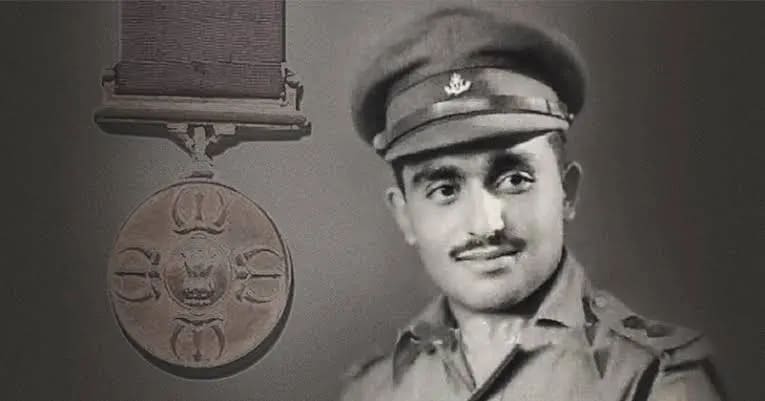
With one arm in a plaster cast, he refused to stay behind. Outnumbered, surrounded, and under relentless attack, Major Somnath Sharma chose duty over safety and made the ultimate sacrifice to defend Kashmir. His extraordinary courage during India's first war after independence earned him the Param Vir Chakra (PVC), the nation's highest award for gallantry, and established him as the first recipient of this prestigious honour.
Major Somnath Sharma was born on 31 January 1923 in Dadh, Kangra District, Punjab Province, British India, into a distinguished military family. His father, Major General Amar Nath Sharma, served in the Indian Army, and military service became a defining tradition within the family. Educated at the Prince of Wales Royal Indian Military College and later commissioned from the Royal Military Academy Sandhurst, Sharma joined the 8th Battalion, 19th Hyderabad Regiment, which later became the 4th Battalion, Kumaon Regiment after Indian independence.
During the Second World War, Sharma served with distinction in the Burma Campaign, gaining valuable combat experience against Japanese forces. His wartime service was recognised with the 1939–1945 Star, Burma Star, War Medal 1939–1945, and India Service Medal 1939–1945. Following India's independence in 1947, he also received the Indian Independence Medal as the nation established its own armed forces.
His defining moment came on 3 November 1947 during the Battle of Badgam in Jammu and Kashmir. Despite recovering from a fractured arm that remained in a plaster cast, Major Sharma insisted on leading D Company, 4 Kumaon, into battle. His company was tasked with protecting the approaches to Srinagar Airport, a position that proved vital to the defence of the Kashmir Valley. Soon after taking up position, his men were attacked by several hundred tribal raiders supported by Pakistani irregulars. Greatly outnumbered and under intense fire from all directions, Sharma moved fearlessly across the battlefield, encouraging his soldiers, distributing ammunition, and directing the defence while exposing himself to constant enemy fire.
As casualties mounted and the enemy closed in, Major Sharma refused every opportunity to withdraw. His final radio message became one of the most celebrated declarations in Indian military history: "The enemy are only 50 yards from us. We are heavily outnumbered. We are under devastating fire. I shall not withdraw an inch but will fight to the last man and the last round." Moments later, he was killed when an enemy mortar shell exploded beside his position. His company's determined stand delayed the attackers long enough for Indian reinforcements to secure Srinagar Airport, a decisive achievement that helped prevent the fall of the Kashmir Valley during the opening stages of the conflict.
For his supreme courage, inspirational leadership, and unwavering devotion to duty, Major Somnath Sharma was posthumously awarded the Param Vir Chakra (PVC), becoming the first recipient of India's highest decoration for gallantry. His steadfast leadership at Badgam remains one of the defining moments in the history of the Indian Army and continues to serve as a benchmark of courage under impossible circumstances.
Major Somnath Sharma was only 24 years old when he made the ultimate sacrifice. His fearless stand at Badgam changed the course of the battle and helped secure one of independent India's most strategic victories. More than seven decades later, his legacy continues to inspire generations of soldiers and citizens alike, standing as a timeless symbol of courage, selfless service, and unwavering devotion to the nation.