★
Loading archive…
Loading archive…
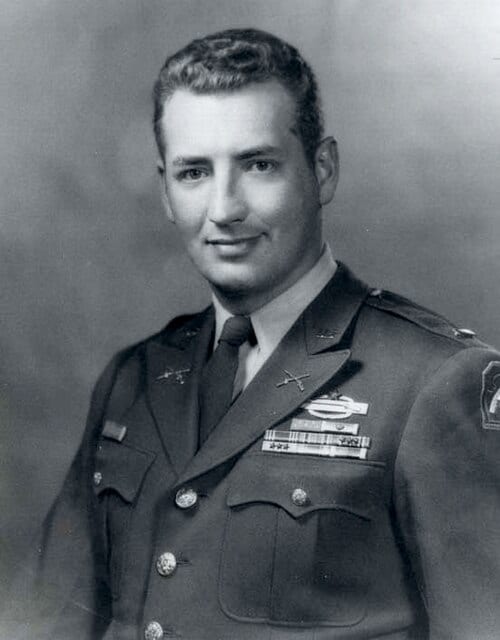
Lieutenant Colonel, U.S. Army
Support & adopt this hero ↓
At Sesim-ni, Korea, on 4 February 1951, Stanley Taylor Adams faced an enemy force threatening to overwhelm his position. Rather than retreat, he fixed his bayonet, rallied his men and led a charge against overwhelming odds. Wounded, knocked down repeatedly by exploding grenades and surrounded by enemy troops, Adams continued fighting until the attack was broken. His extraordinary leadership and courage would earn him the United States' highest military decoration, the Medal of Honor.
Born on 9 May 1922 in De Soto, Kansas, Stanley Taylor Adams entered the United States Army in 1942. During World War II, he served in North Africa and Italy, fighting against German and Italian forces and sustaining wounds in combat. Following the war, he served with the Allied occupation forces in Japan. When the Korean War began in 1950, Adams deployed to South Korea with Company A, 1st Battalion, 19th Infantry Regiment, 24th Infantry Division.
His defining moment came near Sesim-ni on 4 February 1951. Adams was leading a platoon holding an exposed outpost approximately 200 yards ahead of his company when an estimated 250 enemy soldiers launched a determined attack. As approximately 150 hostile troops advanced, Adams ordered his men to fix bayonets and personally led 13 soldiers in a countercharge. Struck in the leg by an enemy bullet and knocked down four times by grenade blasts, he repeatedly rose and continued directing the assault. Fighting at close quarters with his bayonet and rifle butt, he helped drive back the enemy after nearly an hour of fierce combat. When his battalion received orders to withdraw, Adams remained behind to provide covering fire for his men.
The official Medal of Honor citation, published in Department of the Army General Orders No. 66 on 2 August 1951, recognized his conspicuous gallantry and intrepidity above and beyond the call of duty. It specifically praised his "superb leadership, incredible courage, and consummate devotion to duty." President Harry S. Truman personally presented the Medal of Honor to Adams at the White House on 5 July 1951.
Adams' Bronze Star Medal record reflects two distinct recognitions. His first Bronze Star was awarded retroactively in 1947 for qualifying World War II combat infantry service. A second Bronze Star recognized meritorious service with the 24th Infantry Division during its difficult opening Korean campaign from 2 July to 15 September 1950, a recognition recorded in the division's official history. His Purple Heart, with one bronze oak-leaf cluster, reflects two awards for wounds sustained in combat.
Commissioned as an officer shortly after receiving the Medal of Honor, Adams continued his military career through the Vietnam War, becoming one of the relatively few American servicemen to serve in World War II, Korea and Vietnam. He ultimately retired from the United States Army in 1970 with the rank of Lieutenant Colonel. Following his military career, he worked as an administrator with the Internal Revenue Service and later settled in Oregon.
Stanley Taylor Adams died on 19 April 1999. His legacy is defined not simply by the Medal of Honor he received, but by the courage, determination and devotion to his fellow soldiers that he demonstrated throughout a lifetime of service. His actions at Sesim-ni remain a remarkable example of American infantry leadership and battlefield heroism.
Medal of Honor citation
M/Sgt. Adams, Company A, distinguished himself by conspicuous gallantry and intrepidity above and beyond the call of duty in action against an enemy. At approximately 0100 hours M/Sgt. Adams' platoon, holding an outpost some 200 yards ahead of his company, came under a determined attack by an estimated 250 enemy troops. Intense small-arms, machine-gun, and mortar fire from three sides pressed the platoon back against the main line of resistance. Observing approximately 150 hostile troops silhouetted against the skyline advancing against his platoon, M/Sgt. Adams leaped to his feet, urged his men to fix bayonets, and he, with 13 members of his platoon, charged this hostile force with indomitable courage. Within 50 yards of the enemy M/Sgt. Adams was knocked to the ground when pierced in the leg by an enemy bullet. He jumped to his feet and, ignoring his wound, continued on to close with the enemy when he was knocked down four times from the concussion of grenades which had bounced off his body. Shouting orders he charged the enemy positions and engaged them in hand-to-hand combat where man after man fell before his terrific onslaught with bayonet and rifle butt. After nearly an hour of vicious action M/Sgt. Adams and his comrades routed the fanatical foe, killing over 50 and forcing the remainder to withdraw. Upon receiving orders that his battalion was moving back he provided cover fire while his men withdrew. M/Sgt. Adams' superb leadership, incredible courage, and consummate devotion to duty so inspired his comrades that the enemy attack was completely thwarted, saving his battalion from possible disaster. His sustained personal bravery and indomitable fighting spirit against overwhelming odds reflect the utmost glory upon himself and uphold the finest traditions of the infantry and the military service.
Become the named supporter for this profile and edit the tribute biography and portrait (Owner account required). Proceeds help keep the archive online.
$25 USD / year — annual sponsorship renewal. Keeps the page online and, where enabled, the family anniversary remembrance emails active.