★
Loading archive…
Loading archive…
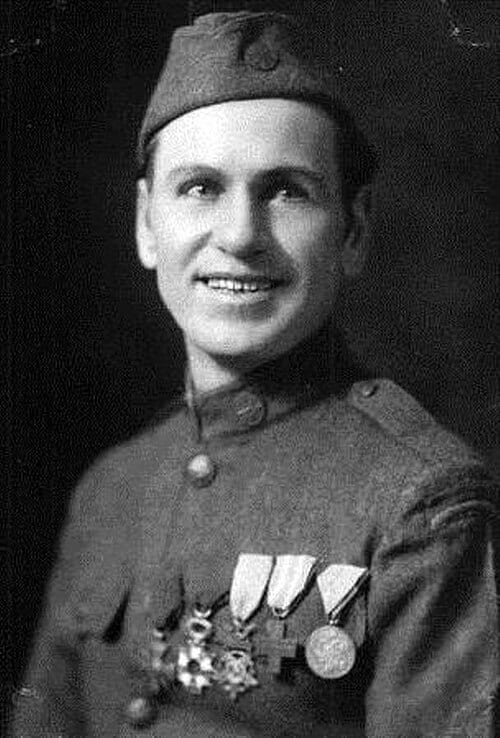
Private, U.S. Army
Support & adopt this hero ↓
Shot in both legs. Surrounded by German soldiers. His comrades dead or wounded. Yet one American private refused to surrender. On October 16, 1918, amid the brutal fighting of World War I, Thomas Croft Neibaur made a stand so extraordinary that it would earn him the Medal of Honor and a permanent place among America's greatest war heroes.
Born on May 17, 1898, in Sharon, Idaho, Thomas Croft Neibaur grew up in the American West before enlisting in the Idaho National Guard in 1917. He eventually joined Company M, 167th Infantry Regiment, 42nd "Rainbow" Division, serving with the American Expeditionary Forces in France. His unit fought through some of the First World War's fiercest campaigns, including the Champagne-Marne, Aisne-Marne, Saint-Mihiel, and Meuse-Argonne offensives.
His defining moment came near Landres-et-Saint-Georges, France, during the struggle for Côte de Châtillon, a heavily defended position along Germany's formidable Kriemhilde Line. Neibaur and his automatic rifle squad were ordered forward to bring flanking fire against enemy machine-gun positions. As he reached a ridge and prepared to engage the enemy, German machine-gun fire struck him in both legs.
What followed became one of the most remarkable individual acts of courage of the First World War.
With his fellow soldiers killed or wounded and a German counterattack rapidly approaching, Neibaur continued firing his automatic rifle despite his injuries. His resistance helped halt the enemy advance. When four German soldiers attacked him at close quarters, he killed them. Then, although severely wounded and exposed to fire from both sides, he advanced among the remaining enemy troops and captured eleven prisoners at pistol point, bringing them back to American lines.
His extraordinary stand unfolded in full view of his battalion. The official Medal of Honor citation credited his personal courage with playing a decisive role in stopping the German counterattack. For his actions on October 16, 1918, Neibaur received the United States Medal of Honor, personally presented by General John J. Pershing at Chaumont, France, on February 9, 1919.
His wartime service and sacrifice brought further recognition. The Purple Heart acknowledged his combat wounds, while the World War I Victory Medal, with five battle clasps for Champagne-Marne, Aisne-Marne, Saint-Mihiel, Meuse-Argonne, and Defensive Sector, reflected his campaign service.
His bravery also earned international distinction. France honored him with the Legion of Honour and the Croix de Guerre 1914–1918, the latter traditionally recorded with a bronze citation star. Italy recognized him with the Croce al Merito di Guerra, or War Merit Cross, while Montenegro awarded him its Silver Medal for Military Bravery. Together, these foreign distinctions reflected the esteem in which this American infantryman was held by Allied nations.
Neibaur became the first soldier from Idaho and the first member of The Church of Jesus Christ of Latter-day Saints to receive the Medal of Honor. Yet the glory of the battlefield did not guarantee an easy life afterward. His wounds left lasting consequences, and the economic hardships of the Great Depression brought further struggles. The soldier who had faced overwhelming enemy forces in France would confront another difficult battle in civilian life.
Thomas Croft Neibaur died on December 23, 1942, at the age of 44, in Walla Walla, Washington. He was laid to rest in Sugar City Cemetery, Idaho, where his memory continues to be honored.
His legacy is not simply the story of a soldier who defeated four attackers and captured eleven prisoners. It is the story of a young man who, wounded and nearly alone, refused to abandon his position when everything seemed lost. More than a century later, Thomas Croft Neibaur's courage remains an enduring example of determination, sacrifice, and heroism under fire.
Medal of Honor citation
On the afternoon of 16 October 1918, when the Cote-de-Chatillion had just been gained after bitter fighting and the summit of the strong bulwark in the Kriemhilde Stellung was being organized, Pvt. Neibaur was sent out on patrol with his automatic rifle squad to enfilade enemy machine-gun nests. As he gained the ridge, he set up his automatic rifle and was directly thereafter wounded in both legs by fire from a hostile machine gun on his flank. The advance wave of the enemy troops, counterattacking, had about gained the ridge, and although practically cut off and surrounded, the remainder of his detachment being killed or wounded, this gallant soldier kept his automatic rifle in operation to such effect that by his own efforts and by fire from the skirmish line of his company, at least 100 yards in his rear, the attack was checked. The enemy wave being halted and lying prone, four of the enemy attacked Pvt. Neibaur at close quarters. These he killed. He then moved alone among the enemy lying on the ground about him, in the midst of the fire from his own lines, and by coolness and gallantry captured 11 prisoners at the point of his pistol and, although painfully wounded, brought them back to our lines. The counterattack in full force was arrested to a large extent by the single efforts of this soldier, whose heroic exploits took place against the skyline in full view of his entire battalion.
Become the named supporter for this profile and edit the tribute biography and portrait (Owner account required). Proceeds help keep the archive online.
$25 USD / year — annual sponsorship renewal. Keeps the page online and, where enabled, the family anniversary remembrance emails active.