★
Loading archive…
Loading archive…
He Fought His Gun for Two Hours Under Fire
Thomas H. Cripps was born on November 29, 1840, in Philadelphia, Pennsylvania. When the American Civil War divided the nation, he entered the United States Navy and became part of the Union’s massive effort to break Confederate control of the Southern coastline and the Mississippi River. His naval service would carry him through several important campaigns before placing him at the center of one of the war’s most famous sea battles.
During the earlier part of his Civil War service, Cripps served aboard USS Brooklyn. The steam sloop-of-war was heavily involved in the Union campaign to seize control of the lower Mississippi River. Cripps was present during operations against Fort Jackson and Fort St. Philip, the formidable Confederate defenses guarding the approach to New Orleans. He also participated in the fighting against the Chalmette batteries, was present during the surrender of New Orleans, and later served during operations against Confederate batteries below Vicksburg.
These campaigns gave Cripps extensive combat experience before he transferred to USS Richmond in September 1863. Richmond was a powerful steam sloop-of-war that had already fought through some of the hardest naval actions of the conflict. Aboard her, Cripps served as a Quartermaster, an enlisted rating carrying important responsibilities connected with the navigation and handling of the vessel. During combat, however, he was also entrusted with another demanding assignment: captain of a gun.
By the summer of 1864, Union naval attention had shifted toward Mobile Bay, Alabama. Mobile remained one of the Confederacy’s most important Gulf ports, protected by Fort Morgan, Fort Gaines, naval mines—then commonly called torpedoes—and a Confederate naval force that included the ironclad ram CSS Tennessee. Rear Admiral David G. Farragut assembled a powerful Union fleet to force an entrance into the bay and destroy or neutralize those defenses.
On the morning of August 5, 1864, USS Richmond entered the Battle of Mobile Bay as part of Farragut’s attacking column. The Union ships advanced beneath the guns of the Confederate forts while facing hostile gunboats, underwater explosives, and the heavily armored Tennessee. The battle quickly became a violent test of both ships and crews.
Thomas Cripps was at his gun as Richmond came under intense enemy fire. Confederate shot and shell swept across the vessel, damaging the ship and killing or wounding members of her crew. Despite the destruction around him, Cripps continued directing and fighting his gun. For approximately two hours he remained at his combat station, performing his duty with the coolness and skill for which he would later be officially commended.
The fighting was relentless. Richmond and the other Union warships exchanged fire with Confederate batteries and vessels as Farragut’s fleet forced its way into the bay. Cripps continued firing while the battle developed into a direct struggle against CSS Tennessee. The Confederate ironclad attempted to engage the Union fleet, but the Federal ships surrounded and attacked her. Heavy gunfire and repeated assaults eventually left Tennessee unable to continue the fight, and she surrendered.
Cripps’s performance during those two hours became the defining action of his military career. His gun contributed to the attack against Confederate forces while Richmond endured casualties and battle damage. The Union victory at Mobile Bay eliminated a major Confederate naval threat, strengthened the blockade of the Gulf Coast, and helped close one of the South’s most important remaining ports.
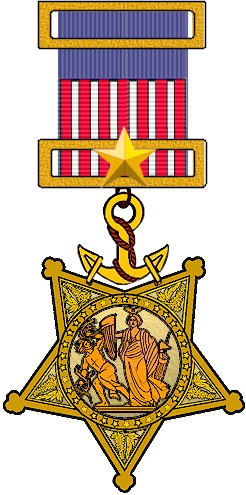
For his conduct on August 5, 1864, Quartermaster Thomas H. Cripps was awarded the Medal of Honor. His recognition was recorded in General Order No. 45 on December 31, 1864. The award specifically honored his skill and courage as captain of a gun aboard USS Richmond while the ship fought Confederate forts, gunboats, and the ironclad Tennessee. His persistence under sustained enemy fire placed him among the many sailors whose actions made Mobile Bay one of the most heavily decorated naval engagements of the Civil War.
The Medal of Honor itself was still a new decoration. Created during the Civil War, it became the highest military award of the United States, and many of its earliest Navy recipients were sailors who distinguished themselves in dangerous shipboard combat. Cripps earned his place among them not through command rank, but through steadfast performance at his fighting station while his ship was being struck by enemy fire.
His wartime service was broader than the single action for which he received the Medal of Honor. From the struggle for New Orleans and operations along the Mississippi to the decisive battle in Mobile Bay, Cripps participated in naval campaigns that steadily reduced Confederate access to major waterways and ports. His service aboard Brooklyn and Richmond placed him within the Union Navy’s larger strategy of blockade, river control, and direct assault against Confederate coastal defenses.
That Civil War naval service was later encompassed by the Navy Civil War Campaign Medal. The decoration was established in 1908 to recognize qualifying Navy and Marine Corps service during the Civil War. Cripps had died before the medal was created, so it was not a decoration he personally wore during his lifetime. Instead, it represents the later formal commemoration of the wartime naval service in which he had taken part.
After the war, Cripps returned to his native Philadelphia and lived there for the remainder of his life. He survived long enough to see the Civil War become part of an earlier generation’s history and to witness the United States Navy undergo enormous technological and organizational change from the wooden and steam warships of his own service era.
Thomas H. Cripps died in Philadelphia on December 4, 1906, at the age of sixty-six. He was buried at The Woodlands Cemetery in Philadelphia.
His legacy remains centered on the morning of August 5, 1864. With USS Richmond under heavy Confederate fire and men falling around him, Cripps stayed at his gun and continued fighting for roughly two hours. That sustained courage during the Battle of Mobile Bay earned him the Medal of Honor and secured his place among the Union Navy sailors whose service helped shape the outcome of the American Civil War.
Become the named supporter for this profile and edit the tribute biography and portrait (Owner account required). Proceeds help keep the archive online.
$25 USD / year — annual sponsorship renewal. Keeps the page online and, where enabled, the family anniversary remembrance emails active.