★
Loading archive…
Loading archive…
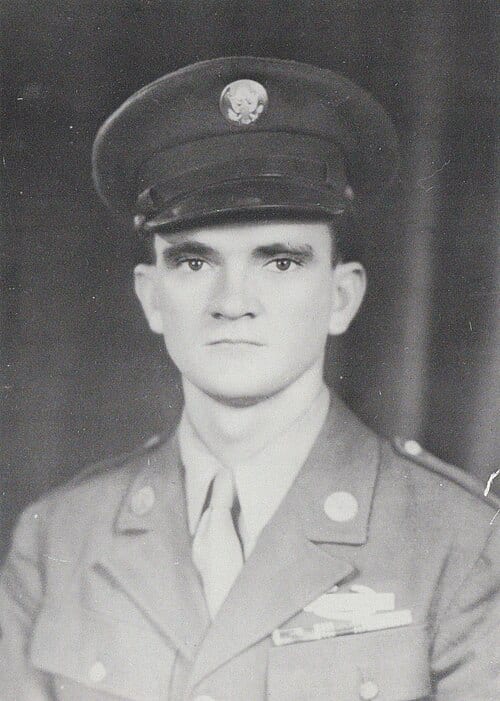
Corporal, U.S. Army
Support & adopt this hero ↓
He held his post for four hours despite severe combat wounds
Thomas Eugene Atkins, usually known as Gene, was born at Campobello, South Carolina, on 5 February 1921. He grew up in a sharecropping family and left school while young to help with farm work. Picking cotton also brought him into contact with Vivian, the daughter of a neighbouring sharecropper, whom he would marry after the war. He entered the Army in December 1942, trained at Fort McClellan and sailed for Australia in May 1943. Assigned to Company A, 127th Infantry Regiment, 32nd Infantry Division, he fought in New Guinea and on Leyte before the Luzon campaign. He was wounded on Leyte on 16 December 1944, nearly three months before his Medal of Honor action.
On the night of 9–10 March 1945 his platoon occupied a position beside the Villa Verde Trail on Luzon. Atkins and two other soldiers held an outpost on a ridge beyond the main defensive perimeter. At about three in the morning, Japanese troops attacked with small arms, grenades and explosive charges. Both companions were killed and Atkins was severely wounded, but he continued defending the position.
The official Medal of Honor citation describes four hours of resistance. Atkins kept firing as the attackers pressed close enough to establish a machine gun roughly twenty yards away. By seven o'clock thirteen enemy soldiers lay dead in front of his post. He had fired about four hundred rounds through three rifles before all became unusable. During a pause he returned to the platoon to obtain another weapon and ammunition, intending to go back to the outpost.
His comrades persuaded him to accept treatment. Even then he killed an enemy soldier who appeared inside the perimeter. A few minutes later, while awaiting evacuation on a litter, he saw another group approaching behind the American position. He raised himself and fired until they withdrew. The citation credited his defence of the outpost with helping the platoon maintain its line.
President Harry Truman presented his Medal of Honor at the White House on 12 October 1945. Atkins married Vivian, and their journey to the ceremony also became their honeymoon. Back home, neighbours organized a subscription that provided the couple with a sixty-two-acre farm, a house and equipment, allowing him to return to agriculture. He left the Army with the rank of corporal. Atkins died at Inman, South Carolina, on 15 September 1999 and was buried in Fellowship Baptist Church Cemetery.
Medal of Honor citation:
He fought gallantly on the Villa Verde Trail, Luzon, Philippine Islands. With two companions he occupied a position on a ridge outside the perimeter defense established by the 1st Platoon on a high hill. At about 3 a.m., two companies of Japanese attacked with rifle and machinegun fire, grenades, TNT charges, and land mines, severely wounding Pfc. Tom Atkins and killing his two companions. Despite the intense hostile fire and pain from his deep wound, he held his ground and returned heavy fire. After the attack was repulsed, he remained in his precarious position to repel any subsequent assaults instead of returning to the American lines for medical treatment. An enemy machinegun, set up within 20 yards of his foxhole, vainly attempted to drive him off or silence his gun. The Japanese repeatedly made fierce attacks, but for four hours, Pfc. Tom Atkins determinedly remained in his foxhole, bearing the brunt of each assault and maintaining steady and accurate fire until each charge was repulsed. At 7 a.m., 13 enemy dead lay in front of his position; he had fired 400 rounds, all he and his two dead companions possessed, and had used three rifles until each had jammed too badly for further operation. He withdrew during a lull to secure a rifle and more ammunition, and was persuaded to remain for medical treatment. While waiting, he saw a Japanese within the perimeter and, seizing a nearby rifle, killed him. A few minutes later, while lying on a litter, he discovered an enemy group moving up behind the platoon's lines. Despite his severe wound, he sat up, delivered heavy rifle fire against the group and forced them to withdraw. Pfc. Tom Atkins' superb bravery and his fearless determination to hold his post against the main force of repeated enemy attacks, even though painfully wounded, were major factors in enabling his comrades to maintain their lines against a numerically superior enemy force.
Become the named supporter for this profile and edit the tribute biography and portrait (Owner account required). Proceeds help keep the archive online.
$25 USD / year — annual sponsorship renewal. Keeps the page online and, where enabled, the family anniversary remembrance emails active.