★
Loading archive…
Loading archive…

He Went Back Through Fire for His Fallen Commander
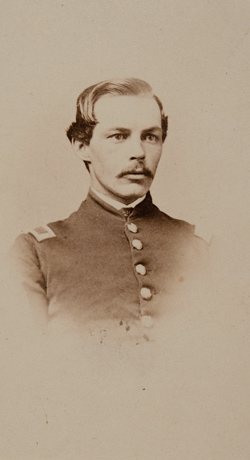
Thomas Foulds Ellsworth entered the American Civil War as an enlisted soldier and eventually emerged from it as a commissioned officer whose courage at Honey Hill earned him the Medal of Honor. His military career was marked by steady advancement, battlefield wounds, and service in two Massachusetts regiments during some of the war’s hardest fighting.
Ellsworth first served in the 2nd Massachusetts Infantry, entering the Army in 1862 as a private. The regiment had already developed a reputation for demanding service in the Eastern Theater, and Ellsworth’s time with it placed him directly in the path of major Civil War campaigns. Over time, his performance brought increased responsibility, and he rose from the enlisted ranks.
One of the defining early moments of his service came during the Gettysburg Campaign. On July 3, 1863, Ellsworth was wounded at Gettysburg while serving with the 2nd Massachusetts Infantry. The injury did not end his military career. He recovered, remained in service, and continued advancing, eventually attaining the rank of corporal before being selected for a commission.
His next important assignment took him to the 55th Massachusetts Infantry. The regiment was one of the Union Army’s African American infantry regiments, with Black enlisted soldiers serving under commissioned officers. Ellsworth joined the organization as a second lieutenant and became part of a force that would operate extensively along the South Atlantic coast.
Service with the 55th Massachusetts brought him into a very different theater of war from Gettysburg. Instead of the great campaigns of Pennsylvania and Virginia, Ellsworth now served in operations across coastal South Carolina and surrounding areas, where Union forces sought to disrupt Confederate communications, secure strategic positions, and weaken the defenses protecting Charleston and the interior.
His responsibilities increased rapidly. On June 20, 1864, Ellsworth was promoted to first lieutenant. By the end of that year, he was serving with Company I of the 55th Massachusetts Infantry and preparing for the operation that would define his military legacy.
On November 30, 1864, Union forces advanced toward Honey Hill, South Carolina. The expedition was intended to threaten the Charleston and Savannah Railroad, an important Confederate transportation route. Confederate defenders, however, occupied strong positions and were prepared to contest the Union advance.
The Battle of Honey Hill became a difficult and costly engagement. Union troops repeatedly advanced against entrenched Confederate positions while artillery and rifle fire swept the approaches. The terrain, defensive works, and determined resistance made the attack exceptionally dangerous.
Ellsworth entered the fighting as a first lieutenant with the 55th Massachusetts. During the battle, his commanding officer, Alfred S. Hartwell, was severely wounded and left in immediate danger on the field.
Under heavy enemy fire, Ellsworth moved to his wounded commander and helped remove him from the battlefield. He exposed himself to the same fire that had already struck Hartwell, choosing to remain in danger long enough to bring the injured officer away from the fighting.
The act was not a distant command decision or a moment of symbolic leadership. Ellsworth physically entered a dangerous part of the battlefield to assist a badly wounded superior when enemy fire still threatened anyone attempting a rescue. His willingness to act under those conditions became the event for which he would later receive the nation’s highest military decoration.
Honey Hill did not end in the Union breakthrough commanders had hoped to achieve. The Confederate position held, and Union forces eventually withdrew after suffering significant casualties. For the soldiers of the 55th Massachusetts, the battle became another demonstration of the regiment’s willingness to fight under extremely difficult conditions.
For Ellsworth, the day also marked the end of one stage of his career. On December 1, 1864, the day after the Battle of Honey Hill, he was promoted to captain. This distinction is important to his military record: he performed his Medal of Honor action while serving as a first lieutenant, but Captain became the highest documented rank of his wartime service.
Ellsworth continued serving with the 55th Massachusetts through the closing period of the Civil War. His career had by then taken him from private to corporal, then through the commissioned ranks of second lieutenant and first lieutenant, and finally to captain. That progression reflected a military record extending far beyond the single action for which he would eventually become best known.
Recognition for Honey Hill did not come immediately. More than thirty years after the battle, Ellsworth was formally awarded the Medal of Honor. The decoration was presented on November 18, 1895, recognizing his courage in rescuing his wounded commanding officer under enemy fire on November 30, 1864.
The long delay between the action and the award was not unusual among Civil War Medal of Honor recipients. Many wartime acts were reviewed and recognized years or even decades after the conflict. Ellsworth therefore became part of a generation of veterans whose battlefield service received formal national recognition long after they had returned to civilian life.
His broader Civil War service is also represented by the Army Civil War Campaign Medal. Established in 1907, the medal recognized qualifying United States Army service performed during the Civil War. Unlike the Medal of Honor, which commemorated Ellsworth’s specific act of courage at Honey Hill, the campaign medal represents the wider military service that carried him through enlistment, Gettysburg, a battlefield wound, promotion, and later operations with the 55th Massachusetts Infantry.
Thomas Foulds Ellsworth’s legacy rests on more than rank or decoration. He began the war as an enlisted private, endured a wound at Gettysburg, earned a commission, accepted increasing responsibility, and ultimately became a captain. Yet the moment that secured his place in military history came when another officer lay wounded under enemy fire and Ellsworth chose to go back for him. Decades later, the Medal of Honor ensured that the courage displayed at Honey Hill would remain part of the permanent record of the American Civil War.
Become the named supporter for this profile and edit the tribute biography and portrait (Owner account required). Proceeds help keep the archive online.
$25 USD / year — annual sponsorship renewal. Keeps the page online and, where enabled, the family anniversary remembrance emails active.