★
Loading archive…
Loading archive…

He Volunteered for Vicksburg’s Deadliest Charge
Thomas Guinn was born on March 5, 1836, in Clinton County, Ohio. When the American Civil War divided the nation, he entered the United States Army and served as a private in Company D of the 47th Ohio Infantry. His wartime service eventually carried him into the Vicksburg Campaign, where one extraordinarily dangerous volunteer assault would earn him the Medal of Honor.
The 47th Ohio Infantry became part of the Union armies operating in the Western Theater, where control of the Mississippi River was one of the war’s most important strategic objectives. By 1863, Vicksburg, Mississippi, remained a powerful Confederate stronghold overlooking the river. Its capture would help reopen the Mississippi to Union traffic and split the Confederacy geographically.
Major General Ulysses S. Grant’s forces maneuvered through Mississippi in the spring of 1863, defeating Confederate armies and driving toward Vicksburg. After Union troops reached the city’s defensive perimeter, Grant attempted to break through the fortifications before settling into a prolonged siege.
One of the most dangerous assaults came on May 22, 1863.
Before the main attack, volunteers were requested for an advance storming party. Their assignment placed them directly at the front of the assault against the Confederate works. The mission was recognized from the beginning as extremely hazardous. These men would have to advance across exposed ground toward strongly defended fortifications while facing concentrated enemy fire.
Thomas Guinn volunteered.
The storming party advanced toward the Confederate defenses near the Stockade Redan as the larger Union attack began. The men faced rifle and artillery fire from defenders occupying protected positions. Their task required them to move ahead of the main assault force and approach defensive obstacles under some of the most dangerous conditions imaginable on the battlefield.
Guinn survived the attack, but the Union assault failed to break the Confederate line. The strength of Vicksburg’s defenses and the heavy resistance convinced Grant that further direct attacks would produce unacceptable losses. The Union army therefore began systematic siege operations around the city.
Guinn’s Medal of Honor citation would later summarize his action in only a few words: gallantry in the charge of the volunteer storming party. The brevity of the citation should not obscure what the duty represented. He had voluntarily placed himself among the soldiers assigned to move first against an entrenched enemy position during one of the most dangerous assaults of the Vicksburg Campaign.
The failure of the May 22 assault did not mean the campaign had failed. Union troops tightened their grip around Vicksburg, cutting supply routes and maintaining constant military pressure on the Confederate garrison. After weeks of siege, Confederate Lieutenant General John C. Pemberton surrendered Vicksburg to Grant on July 4, 1863.
The victory had enormous strategic consequences. With Vicksburg in Union hands, the Mississippi River increasingly came under Federal control, and the Confederacy was effectively divided between its eastern and western regions. Guinn’s charge on May 22 formed part of the costly military effort that preceded that decisive result.
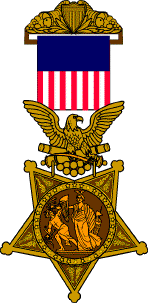
Recognition of his courage came many years later. On August 21, 1894, Thomas Guinn was awarded the Medal of Honor for his gallantry during the volunteer storming party at Vicksburg.
The Medal of Honor had originated during the Civil War. Congress authorized the Army Medal of Honor in 1862 as a means of recognizing soldiers who distinguished themselves through exceptional conduct. During the conflict and in the decades afterward, many Civil War actions were reviewed and honored. Guinn belonged to the large group of veterans whose wartime bravery received formal national recognition long after the battlefield had fallen silent.
His Medal of Honor therefore commemorated a specific moment: May 22, 1863, when a private soldier volunteered to take his place at the front of an assault against one of the Confederacy’s strongest fortified positions.
Guinn’s broader wartime service is also represented by the Army Civil War Campaign Medal. Established by the United States Army in 1907, the decoration recognized qualifying military service performed during the Civil War. Unlike the Medal of Honor, which honored his individual gallantry at Vicksburg, the campaign medal represents the wider period of Army service in which that action occurred.
The Civil War Campaign Medal was created more than four decades after the fighting ended, at a time when the United States was developing a more formal system of campaign decorations. Its establishment provided official recognition for veterans whose service had taken place before many modern American military medals existed. Guinn was still living when the medal was established in 1907.
After the war, Guinn returned to civilian life in Ohio. His wartime record remained connected permanently with the 47th Ohio Infantry and the Vicksburg Campaign, while the Medal of Honor ensured that his participation in the volunteer storming party would not be forgotten.
Thomas Guinn died on September 12, 1908, in New Westville, Ohio. He was buried in Springlawn Cemetery in New Paris, Ohio.
His legacy rests on a decision made decades earlier on the battlefield at Vicksburg. He was a private, not a senior commander, and his official citation does not credit him with capturing a flag, rescuing a wounded officer, or performing some other elaborate individual feat. What it records is already significant enough: when volunteers were needed for an exceptionally dangerous storming party, Thomas Guinn stepped forward and took part in the charge.
That act placed him among the soldiers whose courage became part of the history of the Vicksburg Campaign. More than thirty years later, the Medal of Honor formally preserved that moment of gallantry, ensuring that the willingness of an ordinary infantryman to face extraordinary danger would remain part of the permanent record of the American Civil War.
Become the named supporter for this profile and edit the tribute biography and portrait (Owner account required). Proceeds help keep the archive online.
$25 USD / year — annual sponsorship renewal. Keeps the page online and, where enabled, the family anniversary remembrance emails active.