★
Loading archive…
Loading archive…
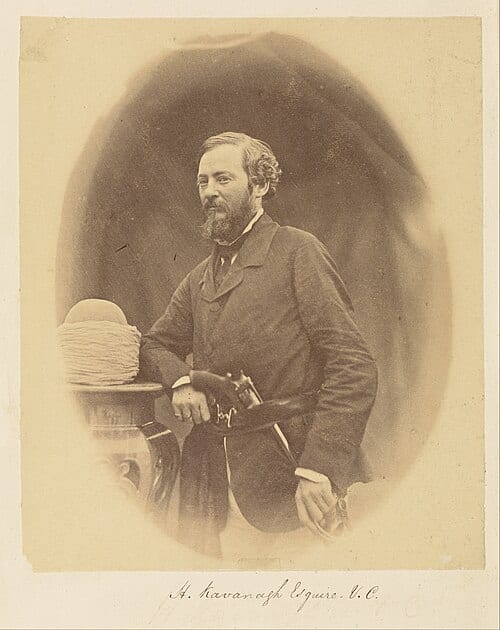
Civilian, Bengal Civil Service, British Army
Support & adopt this hero ↓What would make a civilian risk his life by disguising himself, slipping through enemy-held streets and crossing dangerous territory to reach a besieged army's rescuers? In November 1857, Thomas Henry Kavanagh answered that question with one of the most remarkable acts of courage in the history of the Victoria Cross. His daring journey during the Siege of Lucknow would make him famous as "Lucknow Kavanagh" and establish his place among Britain's extraordinary civilian gallantry recipients.
Born on 15 July 1821 in Mullingar, County Westmeath, Ireland, Kavanagh entered the East India Company's civil service in 1839. By the time the Indian Rebellion erupted in 1857, he was working in Lucknow, where the Residency became the centre of a prolonged siege. Surrounded by hostile forces, its defenders and civilian inhabitants faced artillery fire, shortages and the constant threat of assault.
On 9 November 1857, Kavanagh volunteered for an extraordinary mission. Disguised as a local irregular soldier, he left the Residency with Misr Kanouji Lal, an Indian scout whose knowledge and courage were essential to the undertaking. Together they navigated hostile streets, crossed the River Gumti, avoided armed patrols and made their way towards the British relief army. Discovery could have meant death. Yet they successfully reached the approaching forces of Sir Colin Campbell, allowing Kavanagh to deliver vital intelligence and assist the advance towards the besieged garrison.
For this exceptional act of bravery, Thomas Henry Kavanagh received the Victoria Cross. His award was announced in The London Gazette on 8 July 1859, Issue 22283, page 2629. The original citation praised his "chivalrous gallantry and devotion." A subsequent correction published in The London Gazette on 4 May 1860, Issue 22382, page 1705, confirmed that his courageous action had taken place on 9 November 1857, rather than 8 November as originally stated.
Kavanagh was personally invested with the Victoria Cross by Queen Victoria at Windsor Castle on 4 January 1860. His gallantry was particularly remarkable because he was not a commissioned soldier but a civilian employed in the Bengal Civil Service.
His service during the Indian Rebellion is also associated with the Indian Mutiny Medal 1857–1858. The contemporary civilian medal roll records the clasps Relief of Lucknow, Defence of Lucknow and Lucknow, while a portrait painted in 1860 depicts him wearing the campaign medal with three clasps. However, the roll entry was crossed through, and the final issue of the medal and all three clasps has not been conclusively established. This historical uncertainty is documented in specialist research published by Noonans in September 2022.
Following the rebellion, Kavanagh continued his career in Indian civil administration, eventually serving as Deputy Commissioner at Pratapgarh in Oudh. His published account, How I Won the Victoria Cross, helped preserve the remarkable story of his journey through Lucknow. He died in Gibraltar on 13 November 1882 and was buried in North Front Cemetery.
Thomas Henry Kavanagh's legacy demonstrates that extraordinary courage does not require military rank. His willingness to face almost certain death, together with the indispensable assistance of Kanouji Lal, helped a desperate garrison receive the support it needed. More than a century and a half later, his Victoria Cross remains a testament to selfless determination, resourcefulness and exceptional personal bravery.
Become the named supporter for this profile and edit the tribute biography and portrait (Owner account required). Proceeds help keep the archive online.
$25 USD / year — annual sponsorship renewal. Keeps the page online and, where enabled, the family anniversary remembrance emails active.