★
Loading archive…
Loading archive…

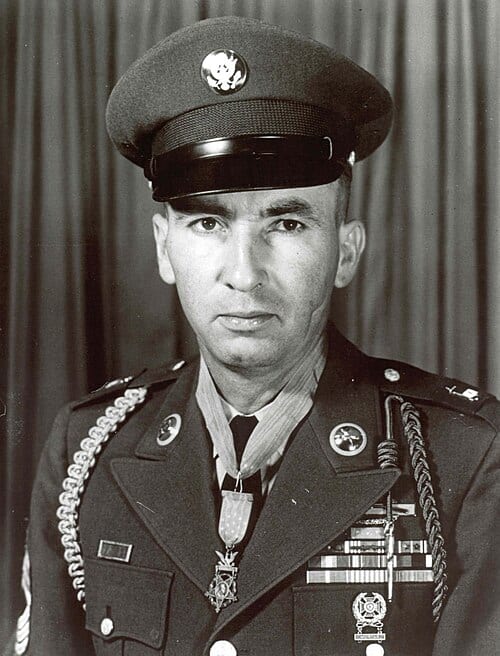
What does it take for one soldier to stand against overwhelming enemy forces, refuse to retreat when his ammunition runs out, and save the surviving members of his company? On 30 October 1944, Private Wilburn Kirby Ross answered that question with extraordinary courage. Armed with a light machine gun near St. Jacques, France, he held his ground through repeated German counterattacks and earned a place among America's most remarkable World War II Medal of Honor recipients.
Born on 12 May 1922 in Strunk, Kentucky, Ross grew up working on a farm before becoming a coal miner and shipyard welder. Drafted into the United States Army in November 1942, he trained as an infantryman and machine gunner. Assigned to Company G, 2nd Battalion, 30th Infantry Regiment, 3rd Infantry Division, he entered combat in North Africa before participating in campaigns across Sicily, Italy and southern France.
Ross experienced the deadly fighting around Monte Cassino, endured the harsh conditions of the Anzio beachhead and participated in the Allied advance toward Rome. He subsequently landed in southern France during Operation Dragoon. Wounded several times during World War II, he repeatedly returned to his unit and continued fighting.
His defining moment came near St. Jacques, France, on 30 October 1944. His company had suffered devastating losses while attacking entrenched German mountain troops. Of the original 88 men, 55 had become casualties. Understanding the danger facing the survivors, Ross positioned his light machine gun ahead of the remaining riflemen, directly in the path of an approaching German counterattack.
What followed was an extraordinary demonstration of battlefield determination. Under machine-gun fire and exploding grenades, Ross held off repeated assaults while his comrades struggled to maintain their ammunition supplies. When he exhausted his own ammunition and was advised to withdraw, he chose to stay because more ammunition was expected.
Fresh ammunition arrived as the final assault threatened to overwhelm the American position. Ross immediately resumed firing, breaking the German attack. His official Medal of Honor citation credited him with killing or wounding at least 58 enemy soldiers during more than five hours of continuous fighting. He remained at his position for a total of 36 hours, helping prevent the destruction of his company's survivors.
For these actions, Ross received the Medal of Honor under War Department General Orders No. 30, dated 14 April 1945. The medal was formally presented on 23 April 1945 at Nuremberg, Germany. His military honours also included the Bronze Star Medal and multiple Purple Hearts. A surviving award-card transcription records his third Purple Heart oak leaf cluster under General Orders No. 100, Headquarters Tokyo Army Hospital, dated 17 August 1950.
Ross's military career continued after World War II. Reenlisting in the Army, he served with the 2nd Infantry Division during the Korean War. In August 1950, he was severely wounded by enemy machine-gun fire during the defense of the Pusan Perimeter. After receiving medical treatment in Japan and the United States, he continued his military career and eventually retired as a Master Sergeant in 1964.
His service also received international recognition. In 2010, France presented Ross with the Legion of Honor for his contribution to the liberation of French territory during World War II. The honour recognized his participation in Operation Dragoon and the broader Allied struggle to liberate Europe.
Ross later settled in DuPont, Washington, where he remained active in veterans' activities and the preservation of military history. In 2013, he was among the World War II Medal of Honor recipients commemorated on United States postage stamps. He died on 9 May 2017, three days before his 95th birthday, and was buried at Tahoma National Cemetery.
Wilburn Kirby Ross's legacy is more than the extraordinary story of a machine gunner who refused to surrender his position. It is the story of a Kentucky farm boy who became a decorated American soldier, survived two wars and demonstrated the power of individual courage. When retreat offered a chance of survival, Ross chose to remain with his fellow soldiers. His actions continue to represent the highest traditions of American military service.
Medal of Honor citation
For conspicuous gallantry and intrepidity at the risk of life above and beyond the call of duty near St. Jacques, France. At 11:30 A.M. on 30 October 1944, after his company had lost 55 out of 88 men in an attack on an entrenched, full-strength German company of elite mountain troops, Pvt. Ross placed his light machine gun 10 yards in advance of the foremost supporting riflemen in order to absorb the initial impact of an enemy counterattack. With machine-gun and small-arms fire striking the earth near him, he fired with deadly effect on the assaulting force and repelled it. Despite the hail of automatic fire and the explosion of rifle grenades within a stone's throw of his position, he continued to man his machine gun alone, holding off six more German attacks. When the eighth assault was launched, most of his supporting riflemen were out of ammunition. They took positions in echelon behind Pvt. Ross and crawled up, during the attack, to extract a few rounds of ammunition from his machine-gun ammunition belt. Pvt. Ross fought on virtually without assistance and, despite the fact that enemy grenadiers crawled to within four yards of his position in an effort to kill him with hand grenades, he again directed accurate and deadly fire on the hostile force and hurled it back. After expending his last rounds, Pvt. Ross was advised to withdraw to the company command post, together with eight surviving riflemen, but, as more ammunition was expected, he declined to do so. The Germans launched their last all-out attack, converging their fire on Pvt. Ross in a desperate attempt to destroy the machine gun which stood between them and a decisive breakthrough. As his supporting riflemen fixed bayonets for a last-ditch stand, fresh ammunition arrived and was brought to Pvt. Ross just as the advance assault elements were about to swarm over his position. He opened murderous fire on the oncoming enemy, killed 40 and wounded 10 of the attacking force, broke the assault singlehandedly, and forced the Germans to withdraw. Having killed or wounded at least 58 Germans in more than five hours of continuous combat and saved the remnants of his company from destruction, Pvt. Ross remained at his post that night and the following day for a total of 36 hours. His actions throughout this engagement were an inspiration to his comrades and maintained the high traditions of the military service.
Become the named supporter for this profile and edit the tribute biography and portrait (Owner account required). Proceeds help keep the archive online.
$25 USD / year — annual sponsorship renewal. Keeps the page online and, where enabled, the family anniversary remembrance emails active.