★
Loading archive…
Loading archive…
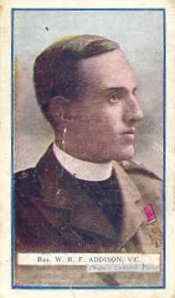
Chaplain to the Forces, 2nd Class, British Army
Support & adopt this hero ↓He carried no weapon into battle, yet his courage earned Britain's highest award for gallantry. As bullets tore across the battlefield, Reverend William Robert Fountaine Addison walked into danger to save wounded soldiers. His extraordinary bravery during the First World War would earn him the Victoria Cross and establish him among Britain's most remarkable military chaplains.
Born on 18 September 1883 and raised in the Odiham area of Hampshire, William Addison studied at Robert May's Grammar School and Salisbury Theological College. After an unusual period working in a Canadian logging camp, he was ordained in 1913 and became a curate at St Edmund's Church, Salisbury. When the First World War erupted, he volunteered for the British Army Chaplains' Department, determined to serve soldiers facing the horrors of war.
After serving at Gallipoli in 1915, Addison joined the 13th Division in Mesopotamia, present-day Iraq. On 9 April 1916, during the fierce fighting at Sanna-i-Yat, he demonstrated extraordinary bravery as a temporary Chaplain to the Forces, 4th Class, attached to the 38th Infantry Brigade.
Under intense rifle and machine-gun fire, Addison rushed forward to rescue wounded soldiers lying exposed to the enemy. He carried one man into the shelter of a trench, dressed the wounds of several others and helped them reach safety. Refusing to be intimidated by the continuing fire, he inspired stretcher-bearers to venture forward and recover additional casualties.
For this remarkable act of courage, Addison received the Victoria Cross. His official citation, published in The London Gazette on 26 September 1916, Issue 29765, page 9417, praised his "utter disregard of personal danger" and his determination to save wounded men. King George V personally invested him with the Victoria Cross at Buckingham Palace on 3 August 1917.
His exceptional wartime service earned three Mentions in Despatches, recognised by the bronze oak-leaf emblem on his Victory Medal. His First World War service was also recognised by the 1914–15 Star and British War Medal. His distinguished service in the Mesopotamian campaign brought an additional international honour, the Imperial Russian Order of St George, 4th Class. This decoration was officially announced in The London Gazette on 15 May 1917, Issue 30070, page 4725, with unrestricted permission to wear it.
But Addison's commitment to service did not end with the Armistice. He continued his military chaplaincy in Britain and overseas, including appointments in Malta, Khartoum and Shanghai. Rising to Chaplain to the Forces, 2nd Class, he served as Senior Chaplain before retiring in 1938. His long service also included recognition through the King George VI Coronation Medal of 1937.
When the Second World War began in 1939, Addison returned to military service. He again served as a senior chaplain and later became Deputy Assistant Chaplain-General in South Wales. His service during this second global conflict was recognised by the War Medal 1939–1945. He subsequently received the Queen Elizabeth II Coronation Medal in 1953.
Beyond his military responsibilities, Addison remained devoted to the Church, serving as Rector of Coltishall with Great Hautbois in Norfolk and later as Rural Dean of Ingworth. He died on 7 January 1962 at St Leonards-on-Sea, Sussex, aged 78, and was buried at Brookwood Cemetery in Surrey.
William Robert Fountaine Addison's legacy is a powerful reminder that heroism is not measured by the enemies defeated, but also by the lives saved. On the battlefield at Sanna-i-Yat, an unarmed chaplain proved that compassion, selflessness and the determination to protect others could represent courage in its highest form.
Become the named supporter for this profile and edit the tribute biography and portrait (Owner account required). Proceeds help keep the archive online.
$25 USD / year — annual sponsorship renewal. Keeps the page online and, where enabled, the family anniversary remembrance emails active.