★
Loading archive…
Loading archive…
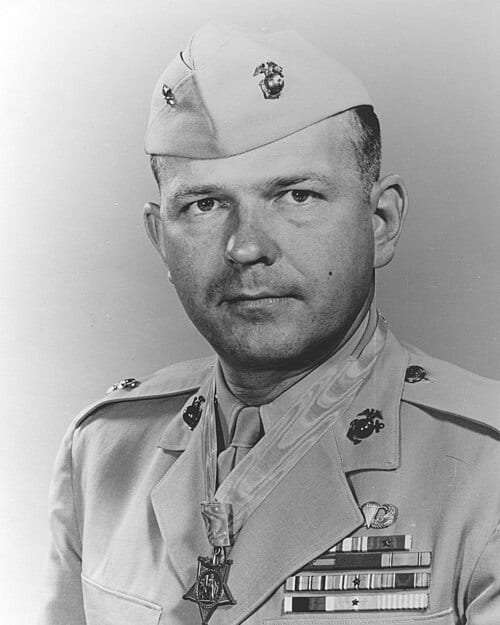
Colonel, U.S. Marine Corps
Support & adopt this hero ↓
He held a frozen pass, protecting the Marines’ escape route.
William Earl Barber grew up on a farm near Dehart, Kentucky, and enlisted in the Marine Corps in 1940. He went to war in the Pacific during World War II and fought on Iwo Jima. Despite his own wounds, Barber rescued two wounded Marines from enemy territory. After evacuation and recovery, he returned to command his company during the final two weeks of the operation. He received the Silver Star and Purple Heart. He remained in the Corps after the war and, by the time he was sent to Korea in 1950, was a captain commanding Company F, 2nd Battalion, 7th Marines, 1st Marine Division.
During the Chosin Reservoir campaign, Company F was ordered to defend Toktong Pass, a steep, three-mile mountain route essential to the division’s supply and withdrawal. The company occupied Fox Hill, an isolated position cut off from the Marines at Yudam-ni. From November 28 to December 2, Chinese forces attacked repeatedly in bitter cold. Two relief efforts had already been driven back. Barber could have tried to withdraw east, but he understood that abandoning the pass would break contact with thousands of Marines trapped farther west, imperil their route to Hagaru-ri, and leave his wounded behind. He requested permission to hold and rely on airdrops for supplies. The order to stand fast was granted.
Wounded in the leg, Barber kept command, often carried along his lines on a stretcher as he directed the defense and encouraged his men. Company F fought for five days and six nights, enduring repeated assaults in subzero weather. The company’s stand secured the pass long enough for the surrounded regiments to fight their way out and link up with Barber’s force. When Company F was relieved, only 82 of the 220 men who had begun the defense could walk away. The Medal of Honor citation credited Barber’s faith, courage, valor, and fortitude as decisive to the division’s withdrawal from the Chosin Reservoir sector.
Barber received the Medal of Honor from President Harry S. Truman on August 20, 1952. He later served in Vietnam as a psychological operations officer and retired as a colonel in 1970 after a 30-year Marine career. He died at home in Irvine, California, on April 19, 2002, aged 82, and was buried with full military honors at Arlington National Cemetery.
MEDAL OF HONOR CITATION
For conspicuous gallantry and intrepidity at the risk of his life above and beyond the call of duty as commanding officer of Company F in action against enemy aggressor forces. Assigned to defend a 3-mile mountain pass along the division's main supply line and commanding the only route of approach in the march from Yudam-ni to Hagaru-ri, Capt. Barber took position with his battle-weary troops and, before nightfall, had dug in and set up a defense along the frozen, snow-covered hillside. When a force of estimated regimental strength savagely attacked during the night, inflicting heavy casualties and finally surrounding his position following a bitterly fought 7-hour conflict, Capt. Barber, after repulsing the enemy, gave assurance that he could hold if supplied by airdrops and requested permission to stand fast when orders were received by radio to fight his way back to a relieving force after 2 reinforcing units had been driven back under fierce resistance in their attempts to reach the isolated troops. Aware that leaving the position would sever contact with the 8,000 marines trapped at Yudam-ni and jeopardize their chances of joining the 3,000 more awaiting their arrival in Hagaru-ri for the continued drive to the sea, he chose to risk loss of his command rather than sacrifice more men if the enemy seized control and forced a renewed battle to regain the position, or abandon his many wounded who were unable to walk. Although severely wounded in the leg in the early morning of the 29th, Capt. Barber continued to maintain personal control, often moving up and down the lines on a stretcher to direct the defense and consistently encouraging and inspiring his men to supreme efforts despite the staggering opposition. Waging desperate battle throughout 5 days and 6 nights of repeated onslaughts launched by the fanatical aggressors, he and his heroic command accounted for approximately 1,000 enemy dead in this epic stand in bitter subzero weather, and when the company was relieved only 82 of his original 220 men were able to walk away from the position so valiantly defended against insuperable odds. His profound faith and courage, great personal valor, and unwavering fortitude were decisive factors in the successful withdrawal of the division from the deathtrap in the Chosin Reservoir sector and reflect the highest credit upon Capt. Barber, his intrepid officers and men, and the U.S. Naval Service.
Become the named supporter for this profile and edit the tribute biography and portrait (Owner account required). Proceeds help keep the archive online.
$25 USD / year — annual sponsorship renewal. Keeps the page online and, where enabled, the family anniversary remembrance emails active.