★
Loading archive…
Loading archive…
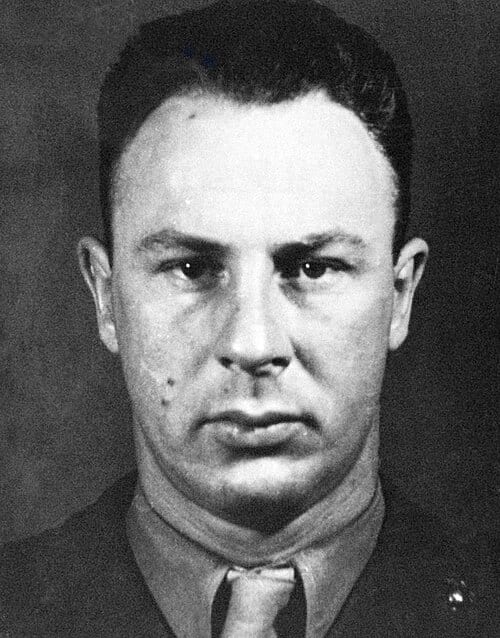
Staff Sergeant, U.S. Marine Corps
Support & adopt this hero ↓
How much can one Marine endure before he finally leaves the battlefield? For Staff Sergeant William Gordon Windrich, the answer was extraordinary. Wounded repeatedly, surrounded by enemy forces and facing the bitter cold of a Korean winter, he continued leading his men, rescuing wounded Marines and directing the defence until he gave his life near Yudam-ni, North Korea, on 2 December 1950. His extraordinary courage earned him the Medal of Honor, the United States' highest military decoration.
Born on 14 May 1921 in Chicago, Illinois, William Gordon Windrich attended public schools in Hammond, Indiana. He enlisted in the Marine Corps Reserve on 6 June 1938 and entered active duty in November 1940. During World War II, he served 20 months overseas in the South Pacific as a machine gunner and saw combat during the Battle of Tarawa. Following his discharge in November 1945, he reenlisted in the regular Marine Corps in February 1946. His postwar service included participation in the atomic bomb tests at Bikini Atoll aboard USS Mount McKinley, duties at the Naval Gun Factory and Marine Corps Headquarters in Washington, D.C., and service in China.
When the Korean War began, Windrich was serving on military police duty at Camp Pendleton, California. He deployed with the 1st Marine Brigade and became one of the early Marines to see combat in Korea. Serving with Company I, 3rd Battalion, 5th Marines, 1st Marine Division, he participated in the amphibious landing at Inchon and the capture of Seoul before entering the brutal Chosin Reservoir campaign.
His defining act of heroism came on the night of 1 December 1950 near Yudam-ni. When enemy forces launched a fierce counterattack against his company's position, Windrich organized a squad and led an assault against the attacking force, directing effective fire to cover the withdrawal of his fellow Marines. A grenade wounded him in the head, but he refused medical attention. Learning that several of his men had fallen, he organized volunteers and returned to the frozen hillside to evacuate the wounded and dying. After repositioning his remaining troops, he continued fighting when the enemy attacked again. Wounded in the leg and unable to stand, he nevertheless encouraged his men, directed their fire and supervised the establishment of defensive positions. The official Medal of Honor citation records that he continued until the bitter cold, severe pain and loss of blood overcame him. He died on the morning of 2 December 1950.
For this extraordinary sacrifice, Windrich was posthumously awarded the Medal of Honor, presented to his widow by Secretary of the Navy Daniel A. Kimball on 8 February 1952. His official service record also recognizes his Purple Heart, two Presidential Unit Citations, the Good Conduct Medal, American Defense Service Medal, American Campaign Medal, Asiatic-Pacific Campaign Medal with one bronze star, World War II Victory Medal, China Service Medal, National Defense Service Medal, Korean Service Medal with three bronze stars, United Nations Service Medal and two Republic of Korea Presidential Unit Citations.
Staff Sergeant William Gordon Windrich was laid to rest at Arlington National Cemetery. His story is more than an account of battlefield bravery. It is a testament to leadership, loyalty and an extraordinary commitment to fellow Marines. Even after being wounded and unable to stand, he refused to abandon his men. His final actions remain a powerful example of the courage and selflessness that define the United States Marine Corps.
Become the named supporter for this profile and edit the tribute biography and portrait (Owner account required). Proceeds help keep the archive online.
$25 USD / year — annual sponsorship renewal. Keeps the page online and, where enabled, the family anniversary remembrance emails active.