★
Loading archive…
Loading archive…
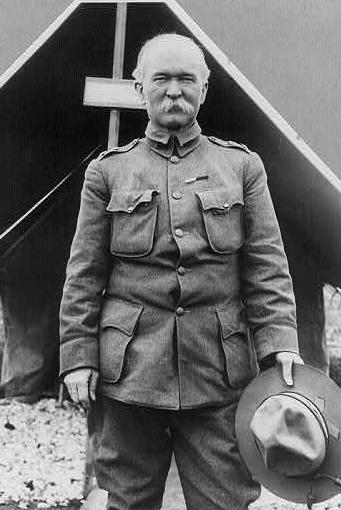
Major general, U.S. Army
Support & adopt this hero ↓
Under Heavy Fire, He Rescued the Wounded Pasted text
William Giles Harding Carter was born on November 19, 1851, in Nashville, Tennessee. His connection with military life began unusually early. During the American Civil War, while still a youth, he served as a mounted messenger, an experience that preceded a professional Army career spanning the frontier era, the transformation of the modern United States Army, and the First World War. He later attended the Kentucky Military Institute before entering the United States Military Academy at West Point in 1868.
Carter graduated from West Point on June 13, 1873, and was commissioned a Second Lieutenant in the 8th U.S. Infantry. His early assignments took him to frontier posts in Wyoming, Nebraska, and the western territories. In November 1874 he transferred to the 6th U.S. Cavalry, beginning the cavalry service that would define the first major phase of his career. He served at posts across Arizona Territory and participated in scouting and field operations during a period of sustained conflict between the United States Army and Apache groups.
On April 14, 1879, Carter was promoted to First Lieutenant. He also became regimental quartermaster of the 6th Cavalry, combining administrative responsibility with active frontier service. By 1881 he was stationed in Arizona, where tensions around the White Mountain Apache reservation were escalating.
The defining act of Carter’s early military career occurred on August 30, 1881, at Cibicu Creek in Arizona Territory. Serving as a First Lieutenant with the 6th U.S. Cavalry, he entered an area under heavy fire to rescue wounded men. With the voluntary assistance of two soldiers, Carter successfully brought the wounded out of danger. The surviving official citation is concise and does not embellish the event: it recognizes him for rescuing the wounded from under heavy fire.
The action placed Carter directly in the danger faced by the soldiers he was attempting to save. His conduct was not a command-room decision or a later interpretation of an entire campaign; it was a specific battlefield act in which he personally exposed himself while assisting wounded men during combat.
More than ten years later, on October 17, 1891, Carter received the Medal of Honor for his actions at Cibicu Creek. The decoration formally recognized the courage he had shown as a young cavalry lieutenant in 1881. He received the award during his lifetime, and no additional device or clasp was attached to it.
Carter’s career continued long after the action that earned him the Medal of Honor. He remained in cavalry service and was promoted to Captain in 1889. His assignments combined troop command, frontier duty, professional military education, and staff responsibilities. At Fort Leavenworth in the 1890s, he served as an assistant instructor in the Cavalry Department of the Infantry and Cavalry School, an institution that played an increasingly important role in developing professional Army officers.
During this period Carter also emerged as a serious military writer and thinker. His work Horses, Saddles and Bridles became an important professional study of cavalry equipment and horsemanship. His writing reflected the experience of an officer who had spent years in mounted service but was also increasingly concerned with the larger organization, training, and future development of the Army.
In 1897 Carter moved into senior staff service as an Assistant Adjutant General with the rank of Major. He was promoted to Lieutenant Colonel in 1898 and Colonel in 1902. These years coincided with one of the most important periods of Army reform in American history. Following the Spanish-American War, Secretary of War Elihu Root pursued sweeping reforms intended to modernize military administration, education, planning, and command structure.
Carter became one of Root’s most important professional military advisers. His experience in both line and staff assignments made him particularly valuable in efforts to reorganize the Army. He played a major role in developing the legislation that created the Army General Staff system and participated in the early War College Board. His work helped move the Army away from a fragmented nineteenth-century bureau structure toward a more centralized system of professional planning and staff coordination.
On July 15, 1902, Carter was promoted to Brigadier General. His responsibilities soon took him overseas. He commanded the Department of the Visayas in the Philippines in 1904 and 1905 and later directed troops involved in operations on Samar. He subsequently commanded the Department of the Lakes and the Department of the Missouri before returning to senior command in the Philippines.
Carter reached the rank of Major General on November 13, 1909, the highest verified rank of his career. In 1910 he briefly served as Acting Chief of Staff of the Army and continued working in senior positions involving national military planning. The following year he commanded a large concentration of troops at San Antonio, Texas, during a period of concern along the Mexican border.
His later commands reflected the Army’s transition toward larger, more modern formations. Carter commanded the Central Division and later the 2nd Division during operations and training in Texas. From March 1914 until November 1915, he commanded the Hawaiian Department, one of the Army’s strategically important Pacific commands.
Carter retired from active service on November 19, 1915, upon reaching the statutory retirement age. Retirement did not end his contribution to national defense. In 1916 he assisted the Senate Military Committee during work connected with the National Defense Act, continuing the legislative and organizational work that had occupied much of his senior career.
When the United States entered the First World War, Carter was recalled to active duty despite being in his mid-sixties. Beginning in August 1917, he commanded the Central Department from Chicago, an enormous administrative command covering fifteen states. The rapid expansion of the wartime Army created immense organizational demands as recruits, supplies, equipment, and newly formed units had to be moved into camps and cantonments across the country.
Under Carter’s direction, approximately 150,000 troops were prepared and moved to training locations. His responsibilities required coordinating a complex mobilization at a time when the Army was expanding at unprecedented speed. From August 26, 1917, through March 13, 1918, his handling of the Central Department’s many difficult problems was recognized for exceptional judgment, tact, and skill.
For this World War I service, Carter received the Army Distinguished Service Medal under War Department General Orders No. 124 in 1919. The award recognized his work in a position of major responsibility rather than battlefield action. It complemented the Medal of Honor he had earned decades earlier, marking two very different forms of military achievement: personal courage under fire as a young cavalry officer and distinguished senior leadership during national wartime mobilization.
Carter was relieved from active duty in June 1918 after a military association that had stretched from his West Point years into the First World War era. Few officers of his generation had careers that bridged such different periods of American military history. He had entered an Army built around small frontier garrisons and cavalry patrols and lived to help shape an institution capable of mobilizing forces for modern global warfare.
His influence also continued through his writing. Among his works were The American Army, Old Army Sketches, From Yorktown to Santiago with the Sixth U.S. Cavalry, and a biography of Lieutenant General Adna R. Chaffee. His books preserved aspects of nineteenth-century Army life while also addressing organization, preparedness, and military professionalism.
William Giles Harding Carter died on May 24, 1925, in Washington, D.C., at the age of seventy-three. He was buried at Arlington National Cemetery.
His legacy rests on two distinct but connected achievements. At Cibicu Creek in 1881, a First Lieutenant entered heavy fire to help rescue wounded men, an act that earned the Medal of Honor. More than three decades later, as a Major General recalled for World War I, he managed the difficult work of preparing and moving tens of thousands of soldiers for a national war effort, earning the Army Distinguished Service Medal.
Between those moments, Carter helped reshape the organization and professional culture of the United States Army. His career carried him from frontier cavalry operations to the creation of the General Staff, from regimental duty to major departmental and division commands, and from personal battlefield courage to strategic-level service during World War I.
Become the named supporter for this profile and edit the tribute biography and portrait (Owner account required). Proceeds help keep the archive online.
$25 USD / year — annual sponsorship renewal. Keeps the page online and, where enabled, the family anniversary remembrance emails active.