★
Loading archive…
Loading archive…
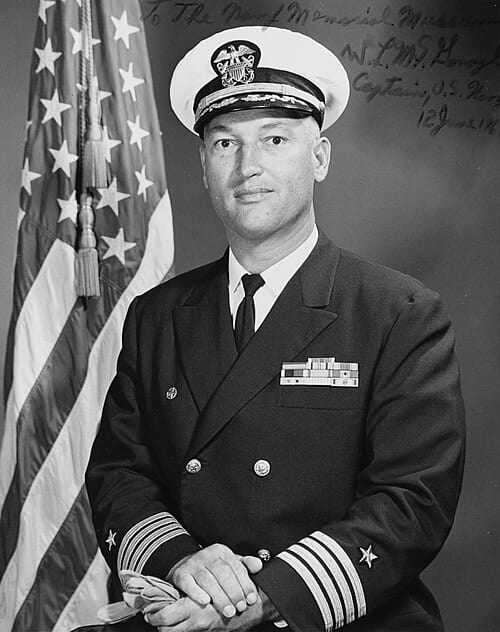
Captain, U.S. Navy
Support & adopt this hero ↓
What does a commander do when his ship is burning, flooding, badly damaged, and under attack, while he himself is seriously wounded? Captain William Loren McGonagle stayed at his station. For more than 17 hours, he continued to command USS Liberty, directing her defense, controlling damage, caring for the wounded, and refusing evacuation until he was certain his crew was being cared for.
William Loren McGonagle was a distinguished United States Navy officer whose career spanned World War II, the Korean War, and the turbulent Middle East of the 1960s. Born on 19 November 1925, he entered the Navy during World War II and later developed a career as a highly experienced surface ship officer. His wartime service included the V-12 officer training program, followed by assignments that eventually took him into combat during the Korean War.
During the Korean War, McGonagle served aboard USS Kite, participating in dangerous combat minesweeping operations in Korean waters. Minesweepers operated under the constant threat of mines, shore batteries, aircraft, and enemy vessels, and McGonagle's service during this period contributed to the combat record that earned him the Korean Service Medal and United Nations Service Medal. His broader wartime service was also recognized through the American Campaign Medal, World War II Victory Medal, China Service Medal, Navy Occupation Service Medal with Europe and Asia clasps, and later the National Defense Service Medal.
But the defining chapter of McGonagle's life came on 8 June 1967. As commanding officer of USS Liberty, he was operating in international waters in the Eastern Mediterranean during the Six-Day War when the ship came under a devastating attack by Israeli aircraft and torpedo boats. McGonagle was severely wounded, yet he refused to abandon command. From his damaged bridge, he directed evasive action, coordinated the ship's defense, supervised firefighting and damage control, and worked to save his wounded sailors while the vessel fought to survive.
For extraordinary heroism during the attack, McGonagle was awarded the Medal of Honor. The citation recognized his conspicuous gallantry and intrepidity at the risk of his life above and beyond the call of duty. His wounds also resulted in the award of the Purple Heart, while his participation in the USS Liberty engagement was recognized by the Combat Action Ribbon. USS Liberty's extraordinary performance under attack was additionally recognized by the Presidential Unit Citation, giving McGonagle a second qualifying Presidential Unit Citation from his naval service, following his earlier entitlement through USS Kite.
McGonagle's record also reflects the breadth of his Cold War service. His service in the Taiwan area brought the Armed Forces Expeditionary Medal, while his Korean War service was recognized by the Republic of Korea Presidential Unit Citation. Together, these honors reflect a career that crossed multiple operational environments and placed him repeatedly in demanding naval assignments.
After decades of service, William Loren McGonagle retired from the Navy as a Captain in 1974. He died on 3 March 1999. His legacy rests not simply on the number of medals displayed on his ribbon rack, but on the decision that defined his career: when USS Liberty was under attack and his crew needed a commander, McGonagle remained at his post. His Medal of Honor stands as a lasting testament to that courage, leadership, and devotion to the sailors under his command.
Become the named supporter for this profile and edit the tribute biography and portrait (Owner account required). Proceeds help keep the archive online.
$25 USD / year — annual sponsorship renewal. Keeps the page online and, where enabled, the family anniversary remembrance emails active.