★
Loading archive…
Loading archive…
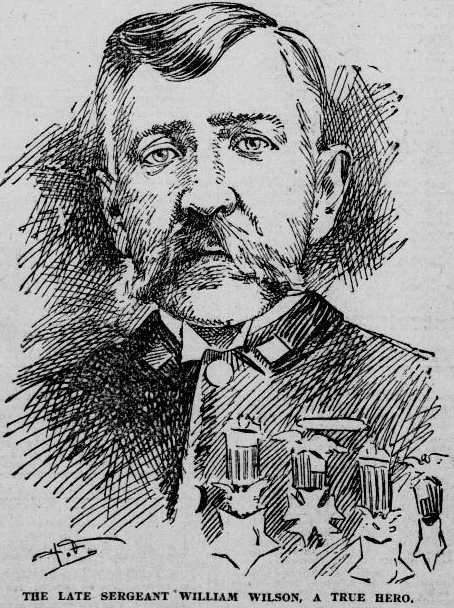
Sergeant, U.S. Army
Support & adopt this hero ↓
Twice Honoured for Courage on the Texas Frontier
Sergeant William Wilson earned two Medals of Honor for separate actions in Texas in 1872. Serving with Company I, 4th U.S. Cavalry, he received the United States’ highest military decoration for his part in a pursuit at Colorado Valley and for distinguished conduct in fighting at the Red River six months later.
Born in Philadelphia, Wilson served in the U.S. Army during the Indian Campaigns. His cavalry service took him to the southwestern frontier, where mounted troops operated across vast distances in pursuit of raiders and cattle thieves.
On 28 March 1872, Wilson took part in his company’s pursuit of a band of cattle thieves from New Mexico into Colorado Valley, Texas. His first Medal of Honor was issued on 27 April 1872. The official citation states:
“In pursuit of a band of cattle thieves from New Mexico.”
On 29 September 1872, Wilson again distinguished himself in action, this time at the Red River, Texas. His conduct earned a second Medal of Honor, awarded on 30 December 1873. The official citation states:
“Distinguished conduct in action with Indians.”
The citations are brief, but they record two separate acts that placed Wilson among the small number of double Medal of Honor recipients. Both awards identify him as a sergeant in Company I, 4th U.S. Cavalry.
Wilson continued his Army career after the Texas actions. He died at the Presidio of San Francisco on 22 December 1895 and was buried in San Francisco National Cemetery. His two Medals of Honor preserve the legacy of a cavalry soldier whose service on the Texas frontier brought him the nation’s highest recognition for valor twice in a single year.
Become the named supporter for this profile and edit the tribute biography and portrait (Owner account required). Proceeds help keep the archive online.
$25 USD / year — annual sponsorship renewal. Keeps the page online and, where enabled, the family anniversary remembrance emails active.