★
Loading archive…
Loading archive…
Private First Class, U.S. Army
Support & adopt this hero ↓
He scouted under fire and died helping his wounded commander
Willy F. James Jr. was born in Kansas City, Missouri, on 18 March 1920. His father died while he was young, and he grew up as the only child of his widowed mother. Drafted into the Army in September 1942, he married Valcenie before leaving home. They had little time together before his service took him overseas.
For much of his first two years in uniform, James served in the supply and support work to which the segregated Army assigned many Black soldiers. Late in 1944, mounting infantry losses led the Army to seek volunteers from those units for combat training. James volunteered and completed the accelerated programme in France. Recognized for leadership and marksmanship, he became a scout with the 413th Infantry Regiment, 104th Infantry Division.
He joined the regiment's Black replacement platoon in March 1945. The men reached Cologne and crossed the Rhine as the division advanced into Germany. James helped lead a rifle squad in fighting near Paderborn before the regiment reached the Weser River.
On 7 April, Company G crossed the Weser near Lippoldsberg to establish a bridgehead. James went ahead to locate German positions and was pinned down in open ground for more than an hour. He continued observing the weapons firing at him, then crossed the exposed ground again to report what he had learned. His information enabled the platoon to revise its plan of attack.
The official Medal of Honor citation describes how he volunteered to lead a squad against a key house. While directing the advance, he saw his platoon commander fall wounded. James appointed another man to lead the squad and went to help the officer, exposing himself to the fire that killed him. The citation credits his reconnaissance and leadership with helping secure and expand the bridgehead.
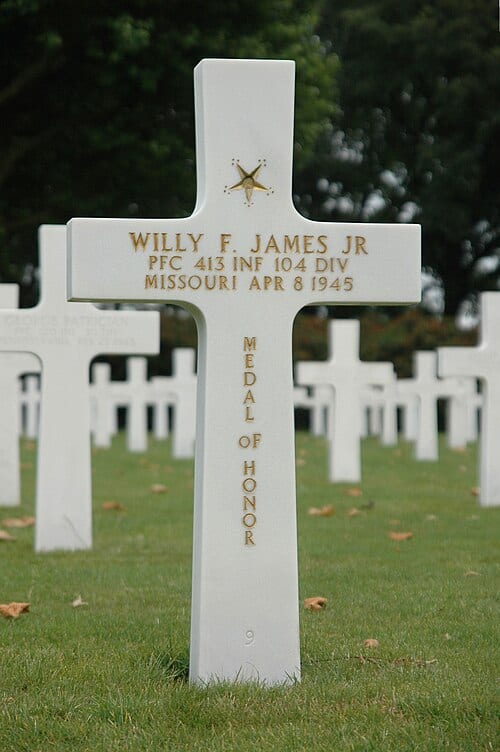
James was twenty-five and was buried in Netherlands American Cemetery at Margraten. Valcenie received his posthumous Distinguished Service Cross in September 1945. Decades later an investigation into racial discrimination in wartime awards led to a reassessment of his actions. President Bill Clinton presented her with the upgraded Medal of Honor at the White House on 13 January 1997, alongside recognition of six other Black Second World War soldiers. The portrait she commissioned after his death preserved his likeness, while the later award finally acknowledged the full significance of his final combat service.
Medal of Honor citation
For conspicuous gallantry and intrepidity at the risk of his life above and beyond the call of duty: Private First Class Willy F. James, Jr. distinguished himself by extraordinary heroism at the risk of his own life on 7 April 1945 in the Weser River Valley, in the vicinity of Lippoldsberg, Germany. On 7 April 1945, Company G, 413 Infantry, fought its way across the Weser River in order to establish a crucial bridgehead.
The company then launched a fierce attack against the town of Lippoldsberg, possession of which was vital to securing and expanding the important bridgehead. Private First Class James was first scout of the lead squad in the assault platoon. The mission of the unit was to seize and secure a group of houses on the edge of town, a foothold from which the unit could launch an attack on the rest of the town. Far out in front, Private First Class James was the first to draw enemy fire.
His platoon leader came forward to investigate, but poor visibility made it difficult for Private First Class James to point out enemy positions with any accuracy. Private First Class James volunteered to go forward to fully reconnoiter the enemy situation. Furious crossfire from enemy snipers and machine guns finally pinned down Private First Class James after making his way forward approximately 200 yards across open terrain.
Lying in an exposed position for more than an hour, Private First Class James intrepidly observed the enemy's positions which were given away by the fire Private First Class James was daringly drawing upon himself. Then, with utter indifference to his personal safety, in a storm of enemy small arms fire, Private First Class James made his way back more than 300 yards across open terrain under enemy observation to his platoon positions, and gave a full, detailed report on the enemy disposition.
The unit worked out a new plan of maneuver based on Private First Class James' information. The gallant soldier volunteered to lead a squad in an assault on the key house in the group that formed the platoon objective. He made his way forward, leading his squad in the assault on the strongly held enemy positions in the building and designating targets accurately and continuously as he moved along. While doing so, Private First Class James saw his platoon leader shot down by enemy snipers.
Hastily designating and coolly orienting a leader in his place, Private First Class James instantly went to the aid of his platoon leader, exposing himself recklessly to the incessant enemy fire. As he was making his way across open ground, Private First Class James was killed by a burst from an enemy machine gun. Private First Class James' extraordinary heroic action in the face of withering enemy fire provided the disposition of enemy troops to his platoon.
Inspired to the utmost by Private First Class James' self-sacrifice, the platoon sustained the momentum of the assault and successfully accomplished its mission with a minimum of casualties. Private First Class James contributed very definitely to the success of his battalion in the vitally important combat operation of establishing and expanding a bridgehead over the Weser River.
His fearless, self-assigned actions, far above and beyond the normal call of duty, exemplify the finest traditions of the American combat soldier and reflect with highest credit upon Private First Class James and the Armed Forces of the United States.
Become the named supporter for this profile and edit the tribute biography and portrait (Owner account required). Proceeds help keep the archive online.
$25 USD / year — annual sponsorship renewal. Keeps the page online and, where enabled, the family anniversary remembrance emails active.