★
Loading archive…
Loading archive…

Before Lawrence Peter “Yogi” Berra became one of the greatest catchers in baseball history, a 10-time World Series champion, and one of America’s most recognizable sports figures, he served as a United States Navy sailor in some of the most dangerous amphibious operations of the Second World War.
Berra was born in St. Louis, Missouri, on May 12, 1925, the son of Italian immigrants Pietro and Paolina Berra. He grew up in the city’s Italian-American community and developed into an outstanding baseball player while still young. His professional career had barely begun, however, when the United States was drawn fully into the Second World War.
Berra entered the U.S. Navy in 1943 at the age of 18 and trained for amphibious operations. He became part of the crews operating Landing Craft Support vessels, small craft intended to provide close-range fire support during landings. Although Berra would ultimately leave the Navy with the rank of Seaman Second Class, his wartime service placed him directly in the path of enemy fire during two major Allied invasions of occupied Europe.
On June 6, 1944, nineteen-year-old Berra took part in the D-Day landings in Normandy. His vessel operated offshore as Allied troops fought their way onto the French beaches. The small craft supported the invasion by firing rockets and machine guns toward German defensive positions. Berra later recalled that the scale of the battle was difficult to comprehend at the time, and that the young sailors aboard simply concentrated on carrying out the tasks assigned to them.
His combat service did not end in Normandy. Berra subsequently participated in Operation Dragoon, the Allied invasion of southern France in August 1944. During fighting connected with the operation, he was wounded in the left hand by enemy fire while his crew was engaging a German machine-gun position. He was credited with the Purple Heart for the wound, although accounts indicate that the physical medal was not presented to him during his lifetime and that his family later sought the documentation relating to the award.
Berra’s documented wartime decorations include the Purple Heart, American Campaign Medal, European-African-Middle Eastern Campaign Medal, and World War II Victory Medal. His European-African-Middle Eastern Campaign Medal reflects participation in two credited campaigns and is represented with two bronze service stars.
The United States Navy Memorial also credits Berra with a Distinguished Unit Citation. The precise unit citation and original award order connecting his particular craft or unit to that distinction has not yet been firmly established in the surviving documentation reviewed for this record. It should therefore be treated as an institutionally attributed award pending confirmation from the original Navy unit-award order.
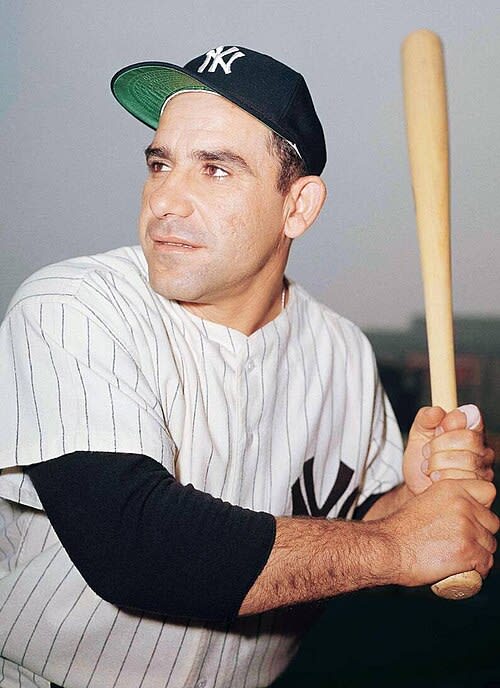
After the war, Berra returned to baseball and began one of the most remarkable careers in Major League history. Playing primarily for the New York Yankees, he appeared in 19 major-league seasons and became one of the defining catchers of his era. He was selected as an All-Star 18 times, won three American League Most Valuable Player Awards, and earned 10 World Series championship rings as a player, a Major League record.
Berra’s value extended beyond statistics. He became known for his durability, leadership, defensive skill, power at the plate, and extraordinary ability to handle pitchers. In 1972 he was elected to the National Baseball Hall of Fame.
His personality made him nearly as famous as his playing career. Berra became celebrated for the humorous and sometimes surprisingly perceptive sayings that came to be known as “Yogi-isms.” Expressions attributed to him entered American popular culture, and his unpretentious manner helped make him one of baseball’s most enduring and recognizable personalities.
Despite his fame, Berra remained closely connected to the veterans’ community and rarely presented his wartime service as something extraordinary. Like many members of his generation, he tended to speak of his service in terms of the men around him rather than himself. The United States Navy later repeatedly highlighted his participation in the Normandy invasion and honored his continuing example of service with the Navy Memorial’s Lone Sailor Award.
Yogi Berra died on September 22, 2015, at the age of 90.
Two months after his death, President Barack Obama awarded him the Presidential Medal of Freedom, the highest civilian honour of the United States. Berra’s son Larry accepted the award on his behalf at the White House. The decoration recognized a life that had extended far beyond baseball and included military service, civic contribution, and a remarkable place in American culture.
Another national tribute followed on June 24, 2021, when the United States Postal Service issued a Yogi Berra Forever stamp.
Berra’s life connected two significant chapters of twentieth-century American history. He was a young Navy sailor who went to war before becoming famous, participating in the invasion of Normandy and later being wounded during the campaign in southern France. He then returned home and became one of the most accomplished players in the history of professional baseball.
From a small Navy support craft off the coast of France to Yankee Stadium and the Baseball Hall of Fame, Yogi Berra’s story was one of service, resilience, achievement, and remarkable longevity. His 10 World Series championships secured his place in baseball history, while his wartime service ensured that his legacy extended well beyond the game.
Become the named supporter for this profile and edit the tribute biography and portrait (Owner account required). Proceeds help keep the archive online.
$25 USD / year — annual sponsorship renewal. Keeps the page online and, where enabled, the family anniversary remembrance emails active.