★
Loading archive…
Loading archive…
Staff Sergeant, U.S. Army
Support & adopt this hero ↓
One Soldier. One Rifle. Two Hours Against the Enemy.
What does courage look like when an entire battalion is threatened, enemy bullets are striking inches away, and there is nowhere safe to hide? On 1 February 1944, during World War II's brutal Anzio campaign in Italy, a 20-year-old American soldier named Alton Warren Knappenberger answered that question with extraordinary bravery.
Born on 31 December 1923 in Coopersburg, Pennsylvania, Knappenberger grew up in a working-class family, learning to hunt and helping support his household through farm work. Drafted into the United States Army in 1943, he joined Company C, 1st Battalion, 30th Infantry Regiment, 3rd Infantry Division. He landed at Anzio on 22 January 1944, unaware that just ten days later his actions would earn him America's highest military decoration, the Medal of Honor.
Near Cisterna di Littoria, a powerful German counterattack threatened to overwhelm his battalion. As machine-gun fire, artillery shells, and enemy infantry swept across the battlefield, Private First Class Knappenberger crawled onto an exposed knoll with a Browning Automatic Rifle. What followed became one of the remarkable individual defensive actions of the Italian campaign.
With bullets striking within six inches of his position, he disabled an enemy machine-gun emplacement approximately 85 yards away. When two German soldiers approached within 20 yards and hurled grenades, he killed both with a single burst. He then silenced another machine gun and wounded a crewman operating a 20 mm antiaircraft weapon.
But the enemy kept advancing. Under relentless artillery and tank fire, with shells exploding within 15 yards, Knappenberger refused to abandon his position. When his ammunition ran out, he crawled forward through enemy fire, recovered ammunition from a fallen soldier, and returned to repel another German assault. Only after exhausting his ammunition again did he withdraw to his company.
His resistance disrupted the German attack for more than two hours. In a battle where every minute mattered, one young infantryman had helped prevent an overwhelming enemy force from advancing.
For this extraordinary action, Knappenberger received the Medal of Honor under War Department General Orders No. 41, dated 26 May 1944. His official citation documented his destruction of enemy positions, resistance under intense fire, and determination to continue fighting despite overwhelming danger. Lieutenant General Mark W. Clark personally presented the decoration in Rome on 8 June 1944.
His recorded wartime honours also included the Bronze Star Medal, Army Good Conduct Medal, American Campaign Medal, European–African–Middle Eastern Campaign Medal, and World War II Victory Medal. He eventually attained the rank of Staff Sergeant.
Yet perhaps the most remarkable part of Knappenberger's story came after the fighting ended. Despite becoming a national hero, he never sought fame. Returning to Pennsylvania, he lived a largely private life, working in manufacturing, trucking and road paving. When asked about his battlefield heroism, he offered a simple explanation: "I just did what I had to do."
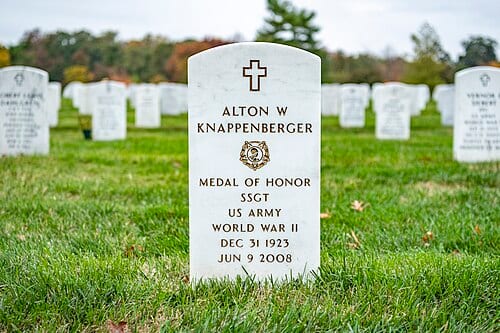
Alton Warren Knappenberger died on 9 June 2008, aged 84, and was laid to rest with military honours at Arlington National Cemetery.
His legacy is not merely the story of a soldier who held back a German attack. It is the story of an ordinary young man who, when confronted with extraordinary danger, refused to give way. For more than two hours on a battlefield in Italy, his courage helped change the fate of the men around him.
Become the named supporter for this profile and edit the tribute biography and portrait (Owner account required). Proceeds help keep the archive online.
$25 USD / year — annual sponsorship renewal. Keeps the page online and, where enabled, the family anniversary remembrance emails active.