★
Loading archive…
Loading archive…
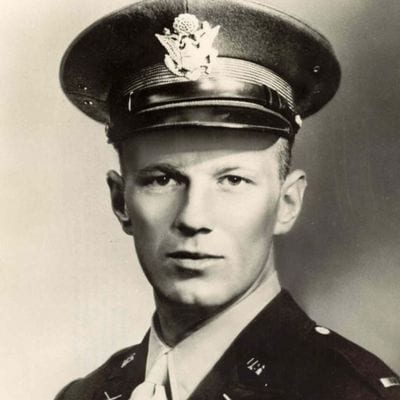
First Lieutenant, U.S. Army
Support & adopt this hero ↓
With only three hand grenades and his platoon pinned down by intense German machine-gun and rifle fire, First Lieutenant Arnold L. Bjorklund made a decision that would become one of the remarkable acts of American infantry heroism in World War II. On 13 September 1943, near Altavilla, Italy, he personally attacked and destroyed three German defensive positions on Hill 424, allowing his men to advance and secure their objective. His extraordinary courage earned him the Medal of Honor, the highest military decoration of the United States.
Arnold L. Bjorklund was born on 14 April 1918 in Clinton, Washington. His family later moved to Seattle, where he attended Ballard High School. He entered the United States Army from Seattle on 20 February 1941 and completed basic and advanced infantry training before being selected for Officer Candidate School at Fort Benning, Georgia. Commissioned a Second Lieutenant in July 1942, he eventually became a First Lieutenant and platoon leader in Company I, 142nd Infantry Regiment, 36th Infantry Division.
The defining moment of his military career came during the Allied invasion of mainland Italy. Following the 36th Infantry Division's landing at Salerno on 9 September 1943, American troops encountered determined German resistance around Altavilla. On 13 September, Bjorklund's platoon was advancing up Hill 424 when concentrated enemy fire brought its movement to a halt. Ordering his men to provide covering fire, he crawled forward under intense fire and destroyed the first German machine-gun position with a grenade. He then attacked a second machine-gun emplacement approximately 20 yards away, destroying it and killing its crew. When a heavy German mortar subsequently stopped the advance, Bjorklund used his third and final grenade to destroy that position as well. His actions enabled the platoon to capture its objective.
The War Department formally announced his Medal of Honor in General Orders No. 73, dated 6 September 1944. President Franklin D. Roosevelt personally presented the medal to Bjorklund at the White House on 30 August 1944. The official citation recognized his conspicuous gallantry and intrepidity at the risk of his life above and beyond the call of duty. His achievement remains a powerful example of battlefield leadership, initiative and personal courage.
Bjorklund continued serving with his unit after the Hill 424 action but was seriously wounded several days later, reportedly sustaining sixteen wounds to his feet and right arm. He was evacuated for medical treatment and spent approximately eight months recovering at McCaw General Hospital in Walla Walla, Washington. During his hospitalization, he met Darl Sawyer, the sister of a fellow serviceman. Following his medical discharge from the Army on 6 March 1945, they married in April 1945.
The August 1980 issue of the 36th Division Association's official publication, The T-Patcher, also recorded Bjorklund as a recipient of the Bronze Star Medal, Purple Heart and Italy's Cross of Valor. These additional honours are documented in the association's historical publication, although their individual award citations have not yet been located. His wartime service also supports entitlement to the American Defense Service Medal, American Campaign Medal, European-African-Middle Eastern Campaign Medal with a bronze service star and Arrowhead Device, and World War II Victory Medal.
After leaving military service, Bjorklund returned to civilian life and joined Pacific Resin Company, a manufacturer of adhesives used in plywood production. Through years of dedicated work, he advanced to assistant plant manager and eventually became plant superintendent at the company's Portland, Oregon, facility. He and his family later settled in Vancouver, Washington.
Arnold L. Bjorklund died on 28 November 1979, aged 61. He was laid to rest at Willamette National Cemetery in Portland, Oregon. His legacy is remembered through his Medal of Honor citation and the history of the 36th Infantry Division. On Hill 424, he demonstrated that extraordinary leadership is not simply about giving orders, but about accepting personal responsibility when the lives of others depend upon decisive action. His courage in the Italian campaign remains an enduring chapter in the history of the United States Army and its Medal of Honor recipients.
Become the named supporter for this profile and edit the tribute biography and portrait (Owner account required). Proceeds help keep the archive online.
$25 USD / year — annual sponsorship renewal. Keeps the page online and, where enabled, the family anniversary remembrance emails active.