★
Loading archive…
Loading archive…
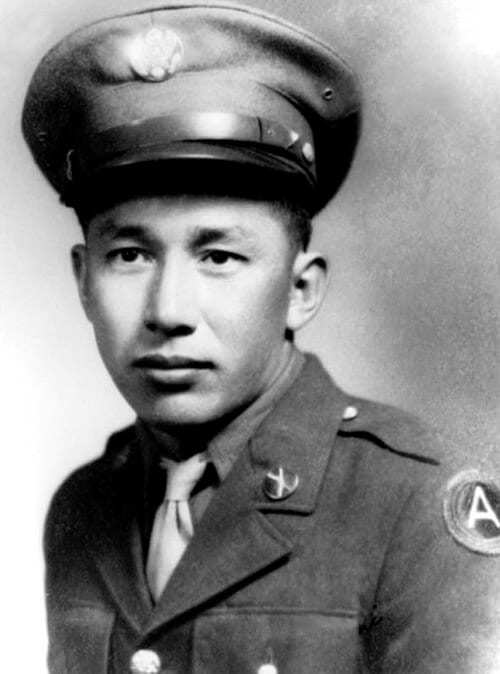
Private First Class, U.S. Army
Support & adopt this hero ↓
What makes a soldier charge directly into enemy machine-gun fire when every instinct demands retreat? For Barney Fushimi Hajiro, the answer was simple: his comrades needed him. In October 1944, this Japanese American soldier from Hawaii transformed a desperate battlefield assault into an extraordinary demonstration of courage. His actions earned him the Medal of Honor, but the recognition he deserved would take more than half a century to arrive.
Born on September 16, 1916, in Puunene, Maui, Hawaii, Hajiro grew up in a struggling family of Japanese immigrants. He left school early to help support his family, working in agricultural fields before moving to Honolulu. After entering the U.S. Army in February 1942, he initially performed labor duties without being issued a weapon because of restrictions imposed on Japanese American soldiers. Determined to serve his country in combat, he volunteered for the legendary 442nd Regimental Combat Team, whose motto, "Go for Broke," would become synonymous with extraordinary sacrifice.
Serving in Company I, 3rd Battalion, 442nd Regimental Combat Team, Hajiro fought through the Rome-Arno Campaign in Italy before advancing into the Vosges Mountains of France. There, during ten unforgettable days in October 1944, his courage would be tested repeatedly.
On October 19, near Bruyères, Hajiro exposed himself to German fire while supporting an Allied assault, using his Browning Automatic Rifle to engage enemy positions and kill or wound two snipers. Three days later, he and another soldier ambushed an 18-man German patrol, killing two, wounding one, and capturing the survivors. Both actions formed part of the extraordinary heroism later recognized in his Medal of Honor citation.
But his greatest test came on October 29, 1944.
During the fierce fighting to rescue the surrounded "Lost Battalion" of the 141st Infantry Regiment, German machine guns pinned down Hajiro's comrades on a wooded slope known as Suicide Hill. Rather than remain under cover, he charged approximately 100 yards uphill through intense enemy fire. Advancing ahead of his fellow soldiers, he drew hostile fire, identified concealed positions, destroyed two machine-gun nests, and killed two enemy snipers. His fearless assault helped inspire the attack that broke the German resistance.
Hajiro suffered four bullet wounds during the fighting, leaving him seriously injured and ending his combat service. His Purple Heart with oak leaf cluster records two awards for wounds sustained in military service.
Initially recognized with the Distinguished Service Cross, Hajiro's extraordinary heroism was eventually reconsidered after a review of racial discrimination in military award decisions. On June 21, 2000, President Bill Clinton presented him with the Medal of Honor at the White House, acknowledging the courage he had displayed nearly 56 years earlier.
His military service also brought recognition through the Bronze Star Medal, Army Good Conduct Medal, American Campaign Medal, European-African-Middle Eastern Campaign Medal with two campaign stars, and World War II Victory Medal. His battalion's distinguished actions near Biffontaine earned a Presidential Unit Citation. International recognition followed when Britain awarded him the Military Medal for his bravery during the October 1944 fighting in France, presented in Honolulu on November 1, 1948. France later honoured his contribution to its liberation with the Légion d'honneur on October 14, 2004.
After the war, Hajiro returned to Hawaii and built a civilian career in security, eventually retiring from Pearl Harbor Naval Base. Despite his remarkable achievements, he remained deeply conscious that battlefield victories belonged to entire units, not individuals alone.
Barney Fushimi Hajiro died on January 21, 2011, at the age of 94. He was laid to rest with full military honours at the National Memorial Cemetery of the Pacific in Honolulu.
His legacy reaches far beyond the Medal of Honor. From the sugar fields of Maui to the blood-soaked slopes of Suicide Hill, Hajiro demonstrated that courage is measured not by rank, reputation, or recognition, but by the willingness to risk everything for others. His story remains an enduring testament to Japanese American patriotism, battlefield brotherhood, and the determination to serve a nation even when that nation has failed to offer equal treatment.
Official Medal of Honor citation
“For conspicuous gallantry and intrepidity at risk of his life above and beyond the call of duty. Private Barney F. Hajiro distinguished himself by extraordinary heroism in action on 19, 22, and 29 October 1944, in the vicinity of Bruyeres and Biffontaine, eastern France.
Private Hajiro, while acting as a sentry on top of an embankment on 19 October 1944, in the vicinity of Bruyeres, France, rendered assistance to allied troops attacking a house 200 yards away by exposing himself to enemy fire and directing fire at an enemy strong point. He assisted the unit on his right by firing his automatic rifle and killing or wounding two enemy snipers.
On 22 October 1944, he and one comrade took up an outpost security position about 50 yards to the right front of their platoon, concealed themselves, and ambushed an 18-man heavily armed, enemy patrol, killing two, wounding one, and taking the remainder as prisoners. On 29 October 1944, in a wooded area in the vicinity of Biffontaine, France, Private Hajiro initiated an attack up the slope of a hill referred to as "Suicide Hill" by running forward approximately 100 yards under fire. He then advanced ahead of his comrades about 10 yards, drawing fire and spotting camouflaged machine gun nests. He fearlessly met fire with fire and single-handedly destroyed two machine gun nests and killed two enemy snipers. As a result of Private Hajiro's heroic actions, the attack was successful. Private Hajiro's extraordinary heroism and devotion to duty are in keeping with the highest traditions of military service and reflect great credit upon him, his unit, and the United States Army.”
Become the named supporter for this profile and edit the tribute biography and portrait (Owner account required). Proceeds help keep the archive online.
$25 USD / year — annual sponsorship renewal. Keeps the page online and, where enabled, the family anniversary remembrance emails active.