★
Loading archive…
Loading archive…
Sergeant, British Army
Support & adopt this hero ↓
Swimming across the deep river to seize an enemy machine gun
Arthur Walter Evans, a British recipient of the Victoria Cross and Distinguished Conduct Medal, was born at Seaforth, near Liverpool, on April 8, 1891. He served briefly as a Royal Navy stoker before joining the King's Liverpool Regiment in May 1914. He reached France that August and fought in the early campaigns. Wounded in 1915, he subsequently served with the Lincolnshire Regiment under the name Walter Simpson and returned to the front after further wounds and gas exposure.
On September 2, 1918, southwest of Étaing, his patrol found a German machine-gun post across a river too deep to ford. Evans volunteered to swim over, approached the post from behind, killed two defenders and compelled four others to surrender. When his patrol officer was wounded during the continuing reconnaissance, he covered the withdrawal across exposed ground under heavy fire. The Victoria Cross was initially announced under his assumed name; the official record was corrected in March 1919.
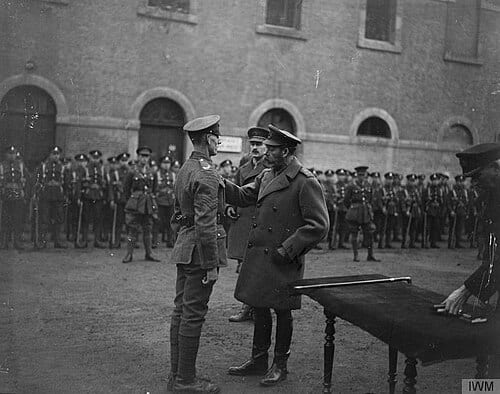
His Distinguished Conduct Medal recognized a separate fighting patrol near Cambrai on October 6–7, 1918. In command of a platoon, he rushed an enemy strongpoint and secured a prisoner whose information proved valuable. King George V presented his VC in France in December 1918.
After the war he lived in New Zealand and then Australia, serving in their military forces. He reached sergeant in the Australian Tank Corps, but poor health ended his service. He died in Sydney on November 1, 1936. Arthur Sullivan VC accompanied his ashes to England for burial in the family grave at Park Cemetery, Lytham St Annes.
**Victoria Cross citation**
“For most conspicuous bravery and initiative when with a daylight patrol sent out to reconnoitre and to gain touch with a neighbouring division. When on the west bank of a river an enemy machine-gun post was sighted on the east bank. The river being too deep to ford, Sjt. Simpson volunteered to swim across, and having done so crept up alone in rear of the machine-gun post. He shot the sentry and also a second enemy who ran out; he then turned out and caused four more enemy to surrender.
A crossing over the river was subsequently found, and the officer and one man of his patrol joined him, and reconnaissance was continued along the river bank. After proceeding some distance machine-gun and rifle fire was opened on the patrol and the officer was wounded. In spite of the fact that no cover was available, Sjt. Simpson succeeded in covering the withdrawal of the wounded officer under most dangerous and difficult conditions and under heavy fire.
The success of the patrol, which cleared up a machine-gun post on the flank of the attacking troops of a neighbouring division and obtained an identification was greatly due to the very gallant conduct of Sjt. Simpson.”
Become the named supporter for this profile and edit the tribute biography and portrait (Owner account required). Proceeds help keep the archive online.
$25 USD / year — annual sponsorship renewal. Keeps the page online and, where enabled, the family anniversary remembrance emails active.