★
Loading archive…
Loading archive…

Defended the aid station to let his wounded comrades escape.
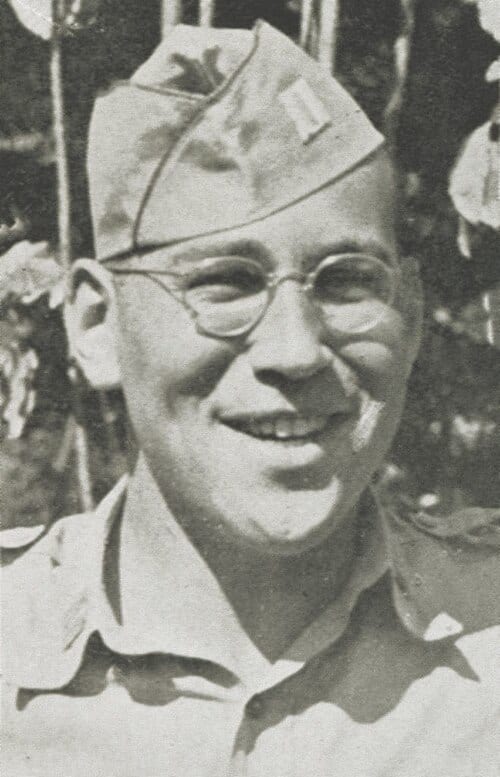
Benjamin Lewis Salomon was born in Milwaukee, Wisconsin, on 1 September 1914. He graduated from Shorewood High School and attended Marquette University before moving to California to continue his education at the University of Southern California. After graduating from USC's dental college in 1937, he entered civilian dental practice.
Drafted into the United States Army in 1940, Salomon initially served as an infantry private rather than a dentist. With the 102nd Infantry Regiment he qualified as an expert with both rifle and pistol, became a sergeant and led a machine-gun section. He wanted to remain in the infantry, but the Army needed his professional skills. On 14 August 1942 he was commissioned a first lieutenant in the Dental Corps at Schofield Barracks, Hawaii.
Following hospital duty, he became dental officer of the 105th Infantry Regiment, 27th Infantry Division, in May 1943. He combined morning dental appointments with afternoon field training alongside the infantrymen. His experience made him a valued instructor in infantry tactics as well as a capable dental officer.
Promoted to captain before his first combat deployment, Salomon landed on Saipan with the regiment in June 1944. When the 2nd Battalion's surgeon was wounded, he volunteered to replace him. He treated casualties through the battalion's costly fighting on the Nafutan peninsula and its subsequent advance north toward Tanapag.
On 7 July 1944, thousands of Japanese troops attacked the regiment's 1st and 2nd Battalions. Salomon's small aid-station tent quickly filled with wounded soldiers as the defensive perimeter collapsed. He shot an attacker who was bayoneting a casualty, then fought other Japanese soldiers entering through the doorway and beneath the canvas walls. With his patients in immediate danger, he ordered the wounded and medical attendants to withdraw toward the regimental aid station while he covered their escape.
Salomon took a rifle and went outside. After the soldiers serving a machine gun were killed, he manned it himself and continued resisting the assault. He died at his post that day, aged 29. When American troops recovered the position, his body was found at the gun with 98 dead enemy soldiers in front of it. His life and military career ended in the action for which he was later honoured.
Recognition was delayed for decades by rejected recommendations, missing evidence and award time limits. A renewed submission and congressional waiver finally led to the posthumous Medal of Honor. President George W. Bush presented it on 1 May 2002 to Dr. Robert West, representing USC's dental school.
Official Medal of Honor citation
for conspicuous gallantry and intrepidity at the risk of his life above and beyond the call of duty:
Captain Ben L. Salomon was serving at Saipan, in the Marianas Islands on July 7, 1944, as the Surgeon for the 2d Battalion, 105th Infantry Regiment, 27th Infantry Division. The Regiment's 1st and 2d Battalions were attacked by an overwhelming force estimated between 3,000 and 5,000 Japanese soldiers. It was one of the largest attacks attempted in the Pacific Theater during World War II. Although both units fought furiously, the enemy soon penetrated the Battalions' combined perimeter and inflicted overwhelming casualties. In the first minutes of the attack, approximately 30 wounded soldiers walked, crawled, or were carried into Captain Salomon's aid station, and the small tent soon filled with wounded men. As the perimeter began to be overrun, it became increasingly difficult for Captain Salomon to work on the wounded. He then saw a Japanese soldier bayoneting one of the wounded soldiers lying near the tent. Firing from a squatting position, Captain Salomon quickly killed the enemy soldier. Then, as he turned his attention back to the wounded, two more Japanese soldiers appeared in the front entrance of the tent. As these enemy soldiers were killed, four more crawled under the tent walls. Rushing them, Captain Salomon kicked the knife out of the hand of one, shot another, and bayoneted a third. Captain Salomon butted the fourth enemy soldier in the stomach and a wounded comrade then shot and killed the enemy soldier. Realizing the gravity of the situation, Captain Salomon ordered the wounded to make their way as best they could back to the regimental aid station, while he attempted to hold off the enemy until they were clear. Captain Salomon then grabbed a rifle from one of the wounded and rushed out of the tent. After four men were killed while manning a machine gun, Captain Salomon took control of it. When his body was later found, 98 dead enemy soldiers were piled in front of his position. Captain Salomon’s extraordinary heroism and devotion to duty are in keeping with the highest traditions of military service and reflect great credit upon himself, his unit, and the United States Army.
Become the named supporter for this profile and edit the tribute biography and portrait (Owner account required). Proceeds help keep the archive online.
$25 USD / year — annual sponsorship renewal. Keeps the page online and, where enabled, the family anniversary remembrance emails active.