★
Loading archive…
Loading archive…
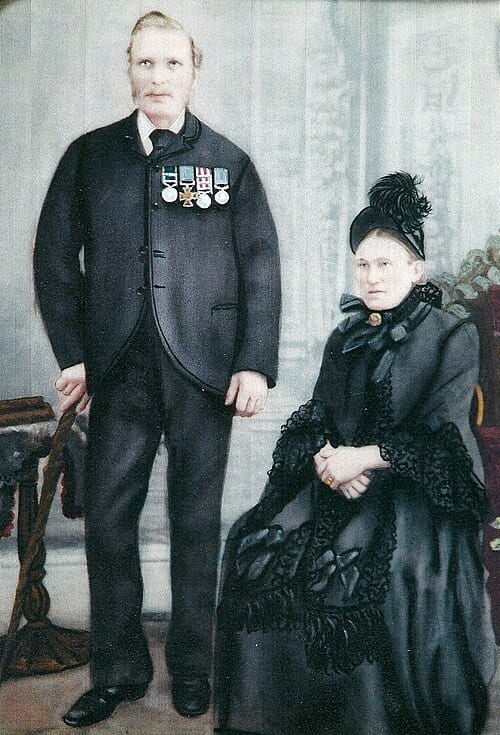
Sergeant, British Army
Support & adopt this hero ↓
When enemy fire tore through his gun crew and left almost every man dead or wounded, Sergeant Bernard Diamond refused to surrender his position. Amid the chaos of the Indian Rebellion of 1857, he and Gunner Richard FitzGerald continued loading and firing their artillery piece under relentless musketry. Their extraordinary determination cleared the road for the advancing British force and earned both men the Victoria Cross, Britain's highest award for gallantry.
Born in Portglenone, County Antrim, Ireland, in 1827, Bernard Diamond enlisted in the Bengal Horse Artillery in 1847. His early military career took him into the Second Anglo-Sikh War, where he served during the hard-fought campaigns at Chillianwala and Goojerat. These experiences prepared him for the demanding service that followed during the Indian Rebellion of 1857.
Diamond's defining moment came on 28 September 1857 near Bulandshahr, where he and FitzGerald were serving one of two artillery guns pushed forward with the Delhi Field Force. Under intense enemy musketry, their gun crew suffered devastating casualties. Rather than abandon the weapon, the two artillerymen continued working it despite the danger, maintaining their fire until the enemy was driven from the road. Their actions helped clear the way for the advancing cavalry and infantry and demonstrated remarkable courage under fire.
For this extraordinary act of bravery, Bernard Diamond was awarded the Victoria Cross. His award was officially announced in The London Gazette on 27 April 1858, making him one of the distinguished recipients of the Victoria Cross during the Indian Rebellion.
His service did not end at Bulandshahr. Diamond continued with the Delhi Field Force and participated in further operations, including the fighting at Agra and the campaign for the relief and capture of Lucknow. His military decorations also recognised his earlier service in the Punjab campaigns and his long and faithful service in the British Army.
The physical cost of his military career was considerable. Diamond sustained wounds during the campaigns, including a serious head injury that eventually left him blind in one eye. After nearly two decades of service, he was discharged on medical grounds in 1866.
In 1875, Diamond emigrated to New Zealand with his family, seeking a new life far from the battlefields where he had earned his place in military history. He eventually settled in the Wellington region and spent his remaining years there. He died in Masterton in January 1892.
Today, Bernard Diamond is remembered as a Victoria Cross recipient whose courage was demonstrated not through a single dramatic gesture, but through an extraordinary refusal to give up when almost everything around him had been lost. His story stands as a testament to the determination of the men who served the Bengal Horse Artillery during the nineteenth century and to the remarkable bravery displayed at Bulandshahr in 1857.
Become the named supporter for this profile and edit the tribute biography and portrait (Owner account required). Proceeds help keep the archive online.
$25 USD / year — annual sponsorship renewal. Keeps the page online and, where enabled, the family anniversary remembrance emails active.