★
Loading archive…
Loading archive…
Ordinary Seaman, U.S. Navy
Support & adopt this hero ↓
What would you do if your small wooden boat were approaching an armoured Confederate warship, surrounded by enemy fire, with almost no chance of escape? On the night of 27 October 1864, Ordinary Seaman Bernard Harley took part in precisely such a mission. His courage during one of the most daring naval operations of the American Civil War helped destroy the formidable Confederate ironclad CSS Albemarle and earned him the United States Medal of Honor.
Born in 1842 in Brooklyn, Kings County, New York, Bernard Harley entered the United States Navy during one of the most turbulent periods in American history. Serving as an Ordinary Seaman, he belonged to the generation of enlisted sailors whose discipline, technical skill and courage helped sustain the Union Navy throughout the Civil War. His military service would ultimately become associated with one of the most celebrated small-boat attacks in American naval history.
THE MISSION TO DESTROY CSS ALBEMARLE
By 1864, the Confederate ironclad CSS Albemarle had become a serious threat to Union naval operations in North Carolina. Its powerful armour and guns had made conventional naval attacks extremely difficult. The ironclad had helped Confederate forces regain Plymouth and had demonstrated its strength by sinking the Union gunboat USS Southfield.
Recognising the danger posed by the Confederate vessel, Lieutenant William Barker Cushing developed an audacious plan to destroy it at its anchorage. Rather than engage the ironclad in another conventional battle, he assembled a small volunteer crew aboard U.S. Picket Boat No. 1, a steam launch equipped with a spar torpedo.
Bernard Harley was among the sailors assigned to this exceptionally dangerous expedition.
On the night of 27 October 1864, Cushing and his crew moved up the Roanoke River towards Plymouth. Their objective was clear: reach the Confederate ironclad, overcome its defensive barriers and detonate the explosive charge directly beneath its hull.
The mission demanded extraordinary courage. The launch had to approach an armoured warship at close range while navigating defended waters and facing the possibility of devastating enemy fire. As the crew neared their target, Confederate defenders detected the approaching vessel and opened fire. A floating barrier of logs protecting the Albemarle presented another obstacle.
Yet the Union sailors pressed forward.
The small launch forced its way across the obstruction, allowing Cushing to position the spar torpedo beneath the ironclad. The explosive charge detonated against the vessel's hull, causing a devastating breach. CSS Albemarle sank into the Roanoke River, eliminating one of the Confederacy's most dangerous naval assets.
The Union launch was destroyed during the attack, and the expedition's crew suffered severe losses. The destruction of the ironclad became a defining achievement of Union naval operations in North Carolina.
THE MEDAL OF HONOR
For his participation in the destruction of CSS Albemarle, Bernard Harley received the Medal of Honor, the highest military decoration awarded by the United States.
His recognition was associated with General Order No. 45, dated 31 December 1864. On 15 March 1865, Harley was formally presented with his Medal of Honor at the Washington Navy Yard by Commodore Montgomery.
His award was not posthumous. It recognised his service as an Ordinary Seaman aboard U.S. Picket Boat No. 1 during the daring attack near Plymouth, North Carolina.
Harley's distinction belongs to the earliest generation of American sailors to receive the Navy Medal of Honor. His story represents the extraordinary contribution of ordinary enlisted personnel to operations that shaped the outcome of the Civil War.
A LEGACY BEYOND THE BATTLE
The destruction of CSS Albemarle had consequences extending far beyond the sinking of a single Confederate warship. Its loss significantly weakened Confederate naval power in the region and improved the freedom of action available to Union forces operating around Plymouth and the North Carolina sounds.
For Bernard Harley, however, the significance of the mission was personal as well as historical. He was not a senior naval commander or a celebrated fleet officer. He was an Ordinary Seaman who participated in an operation that demanded exceptional determination and courage.
The Navy Civil War Campaign Medal, established in 1908, also recognises qualifying naval service during the conflict. As Harley died before its establishment, this represents retrospective recognition of his Civil War service rather than a medal he personally wore during his lifetime.
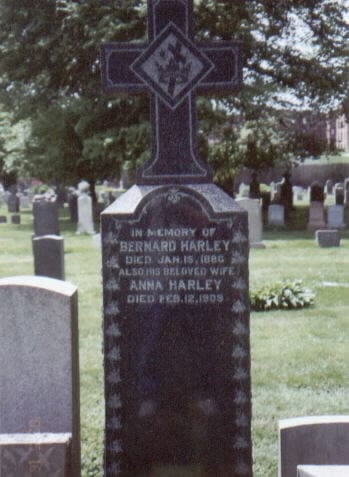
Bernard Harley died on 15 January 1886 and was buried at Holy Cross Cemetery in Brooklyn, New York. Although surviving details of his civilian life remain limited, his place in American military history is firmly connected to the destruction of CSS Albemarle.
His story deserves to be remembered not simply because he received the Medal of Honor, but because he was one of the enlisted sailors who helped make an extraordinary naval operation possible. On a dark October night in 1864, a small Union launch challenged a powerful Confederate ironclad. The mission succeeded, the Albemarle was destroyed, and Bernard Harley became part of one of the most remarkable chapters in the history of American naval warfare.
Become the named supporter for this profile and edit the tribute biography and portrait (Owner account required). Proceeds help keep the archive online.
$25 USD / year — annual sponsorship renewal. Keeps the page online and, where enabled, the family anniversary remembrance emails active.