★
Loading archive…
Loading archive…
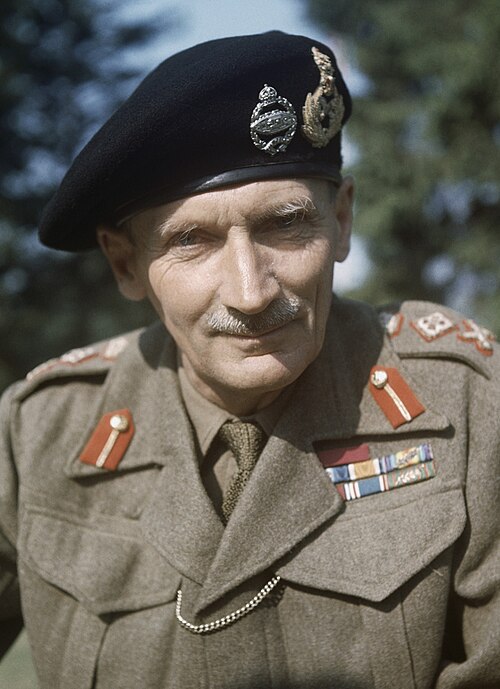
Field marshal, British Army
Support & adopt this hero ↓
Bernard Law Montgomery — The Field Marshal Who Helped Defeat Hitler
Few commanders in modern military history inspire as much debate, admiration, and fascination as Field Marshal Bernard Law Montgomery—better known simply as “Monty.” Brilliant, stubborn, intensely disciplined, and often controversial, Montgomery became one of the most recognizable Allied commanders of the Second World War. To his men, he was the general who restored confidence to a battered army; to his enemies, he was a relentless strategist whose battlefield planning helped turn the tide against Nazi Germany.
Born on 17 November 1887 in Kennington, London, Bernard Law Montgomery was the son of an Anglican bishop and spent much of his childhood in Tasmania, Australia, before returning to England for formal education. He attended St Paul’s School and later the Royal Military College, Sandhurst, where he received his commission into the Royal Warwickshire Regiment in 1908. Even as a young officer, Montgomery displayed the fierce self-belief and uncompromising standards that would define his career. Bernard Law Montgomery
Montgomery first saw major combat during the First World War, where he was severely wounded in October 1914 near Méteren, France. Shot through the lung and knee during fighting against German forces, he was initially expected to die. He survived only because darkness halted enemy advance before German troops reached his position. The experience profoundly shaped him. He developed a lifelong obsession with preparation, logistics, and minimizing unnecessary casualties—principles that later became central to his command style. For his gallantry in WWI, he received the Distinguished Service Order (DSO) and built a reputation as an exceptional staff officer.
The outbreak of the Second World War transformed Montgomery from a respected officer into a global military figure. After commanding British formations during the retreat from France and later in Britain’s defensive preparations, he was appointed commander of the British Eighth Army in August 1942, at one of the darkest moments of the North African campaign. Morale was low, Axis forces under Erwin Rommel were advancing, and defeat seemed possible.
Montgomery changed everything.
He immediately reorganized the army, improved training, tightened discipline, and instilled a clear doctrine: no retreat, no reckless offensives, only carefully planned battle. His greatest early triumph came at the Second Battle of El Alamein in October–November 1942, where Allied forces decisively defeated Rommel’s Afrika Korps. Winston Churchill famously captured the significance of the victory:
“Before Alamein we never had a victory. After Alamein we never had a defeat.”
El Alamein made Montgomery a household name and marked one of the decisive turning points of the war. His leadership in North Africa earned him enduring fame and helped secure the Allied push into Italy and eventually mainland Europe.
In 1944, Montgomery played a central role in planning and executing the Normandy landings (D-Day), commanding all Allied ground forces during the initial invasion phase. His methodical style often clashed with American commanders—especially George S. Patton and Dwight D. Eisenhower—yet his contribution to the liberation of Western Europe was enormous. Though his bold Operation Market Garden later failed to secure a rapid crossing into Germany, Montgomery remained one of the most influential Allied commanders until the war’s end.
His achievements brought an extraordinary collection of honours. Britain awarded him the prestigious Order of the Garter (KG) and Knight Grand Cross of the Order of the Bath (GCB). Foreign governments also honored him extensively, including the American Legion of Merit, U.S. Distinguished Service Medal, Silver Star, France’s Légion d’honneur, the Soviet Order of Suvorov and Order of Kutuzov, Poland’s Virtuti Militari, Czechoslovakia’s Order of the White Lion, and the Dutch Order of Orange-Nassau. His ribbon rack became one of the most internationally decorated of any Allied commander.
After the war, Montgomery served as Chief of the Imperial General Staff and later as Deputy Supreme Commander of NATO, helping shape postwar Western defense strategy during the early Cold War. Though often controversial for his outspoken opinions and difficult personality, few doubted his military intellect or his influence on modern warfare. NATO
Montgomery retired from active service in 1958 and spent his later years writing memoirs and defending his wartime decisions. He died on 24 March 1976, aged 88.
Bernard Montgomery remains one of history’s most studied commanders—not because he was universally loved, but because he was impossible to ignore. He believed victory belonged not to the boldest commander, but to the one who prepared best, conserved strength, and struck decisively at the right moment.
In the story of the Allied victory over Hitler, Monty stands as the architect of discipline, patience, and calculated victory.
Become the named supporter for this profile and edit the tribute biography and portrait (Owner account required). Proceeds help keep the archive online.
$25 USD / year — annual sponsorship renewal. Keeps the page online and, where enabled, the family anniversary remembrance emails active.