★
Loading archive…
Loading archive…

STAR
Catalog pts
0
Precedence
#148
Tier
5
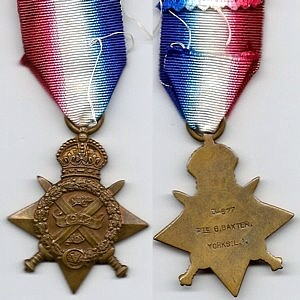
1914 Star
Afghanistan Medal (Australia) ribbon
Army Gold Medals and Cross 1806-1814 RIBBON BAR
Summary
The 1914 Star, colloquially known as the Mons Star, is a British First World War campaign medal for service in France or Belgium between 5 August and 22 November 1914.
The 1914 Star was principally an Army award, although some Royal Navy personnel who served ashore at Antwerp during the qualifying period received the medal. A few women who served in France and Belgium as nurses or auxiliaries during the qualifying period were also awarded the medal, such as Beatrice Cutler.
The majority of recipients were officers and men of the pre-war British army, specifically the British Expeditionary Force, also known as the Old Contemptibles, who landed in France soon after the outbreak of the War and who took part in the Retreat from Mons, hence the medal's nickname "Mons Star". Approximately 1,000 were awarded to members of the Royal Flying Corps, of whom 300 received the clasp.
There were 160 awarded to members of the 2nd Canadian Stationary Hospital who served with the British Expeditionary Force, whose deployment commenced on 6 November 1914. A more significant quantity were awarded to the Indian Army contingent, comprising the I Corps (British India) and the Indian Cavalry Corps. A total of 11,487 were issued by the Admiralty, with 435 issued to the Royal Naval Air Service.
The 1914 Star was never awarded singly. Recipients also received the British War Medal and Victory Medal, but did not qualify for the very similar 1914–15 Star since no person could receive both Stars. The only difference is that the later award bears '1914–15' on the central scroll instead of '1914'; the ribbon is the same. These three medals, with either Star included, were sometimes irreverently referred to as "Pip, Squeak and Wilfred", after three comic strip characters, a dog, a penguin and a rabbit, which were popular in the immediate post-war era.
^ a b Cite error: The named reference Hayward was invoked but never defined (see the help page).
^ Dorling 1956, p. 80.
^ "The King's Own Royal Regiment Museum, (Lancaster), 1914 Star". Retrieved 26 April 2018.
^ a b Mussell 2014, p. 177
^ Cite error: The named reference Canada was invoked but never defined (see the help page).
^ Fevyer & Wilson 1995, p. 5.
^ Cite error: The named reference Award was invoked but never defined (see the help page).
^ "Pip, Squeak and Wilfred". First World War.com. Archived from the original on 11 May 2008. Retrieved 26 June 2008.
^ Baker, Chris. "The British campaign medals for the Great War". Retrieved 27 October 2020 – via The Long, Long Trail.

Bernard Cyril Freyberg
Lieutenant-general

John Standish Surtees Prendergast Vereker
Field marshal

James Thomas Byford McCudden
Major
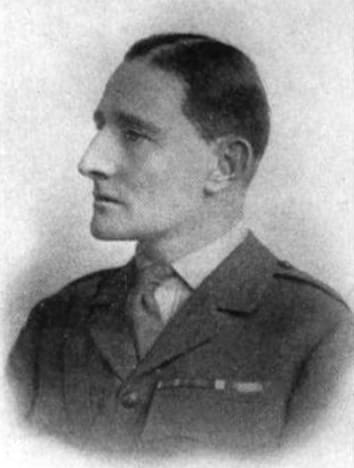
Richard Annesley West
Lieutenant Colonel

George Stuart Henderson
Captain

Alfred Oliver Pollard
Captain

Richard Bell Davies
Vice-Admiral

Billy Congreve
Major

George Grogan
Brigadier-General

Frank Crowther Roberts
Major-General

Cyril Gordon Martin
Brigadier

Alexander Gore Arkwright Hore-Ruthven
Brigadier General

Lewis Pugh Evans
Brigadier-General
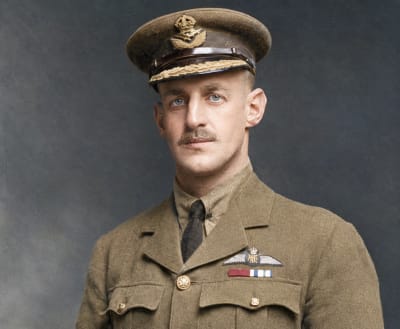
Lionel Wilmot Brabazon Rees
Group Captain

Henry Tandey
Lance Corporal

John Harold Rhodes
Lance Sergeant

Sir John Smyth, 1st Baronet
Brigadier

William Logan (Deserter)
Sergeant

John Stanhope Collings-Wells
Lieutenant Colonel

Alexander Edward Murray
Major