★
Loading archive…
Loading archive…
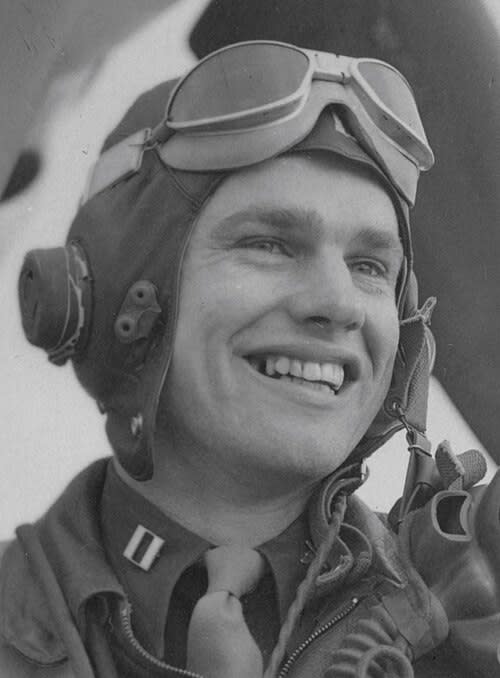
Colonel (retirement rank – 1972) Brigadier General (honorary promotion – 2022), U.S. Air Force
Support & adopt this hero ↓
World War II Triple Ace, Test Pilot and Combat Commander
Few American aviators could say they fought the Luftwaffe in a P-51 Mustang, helped test the first generations of jet fighters, and then returned to combat more than two decades later in an F-105 Thunderchief. Brigadier General Clarence Emil “Bud” Anderson did all three. A World War II triple ace, experimental test pilot and combat commander, Anderson built a military aviation career that stretched from the skies over Nazi Germany to the Cold War flight-test world and the Vietnam War. By the time of his death on 17 May 2024 at the age of 102, the U.S. Air Force recognized him as the last surviving American triple ace of the Second World War.
Clarence Emil Anderson was born in Oakland, California, on 13 January 1922 and grew up on a farm near Newcastle. Aviation caught his imagination early. While attending college, he learned to fly through the Civilian Pilot Training Program and earned his private pilot's license in 1941. In January 1942, only weeks after the United States entered the Second World War, Anderson entered the U.S. Army Aviation Cadet Program. On 29 September 1942, he received his pilot wings and was commissioned as a second lieutenant in the United States Army Air Forces.
His path to combat eventually led to the 363rd Fighter Squadron, 357th Fighter Group, Eighth Air Force, one of the most celebrated American fighter organizations of the European air war. Based at RAF Leiston in England and known as the “Yoxford Boys,” the 357th flew P-51 Mustangs deep into enemy territory, protecting B-17 Flying Fortresses and B-24 Liberators while seeking out Luftwaffe fighters. Anderson flew four different Mustangs during his European service. Three carried the name that became inseparable from his reputation: Old Crow.
The young fighter pilot quickly proved that he possessed an unusual combination of eyesight, judgment and aggression. Across two combat tours, Anderson flew 116 combat missions and was officially credited with 16.25 aerial victories, consisting of 16 individual victories and one quarter share in another. That score made him a triple ace and one of the leading fighter pilots of the 357th Fighter Group. His combat record was made even more remarkable by the fact that the Mustangs he flew were not recorded as having been hit by enemy aircraft fire, and he completed his missions without having to abort because of mechanical trouble or combat damage.
The numbers tell only part of the story. Anderson fought in an air war in which a bomber escort mission could place hundreds of aircraft into the same battlespace and where a few seconds of hesitation could decide whether a pilot returned to England. He escorted American heavy bombers into the heart of Germany, fought Messerschmitt Bf 109s and Focke-Wulf Fw 190s, and survived an operational environment that claimed many of the men with whom he had trained and flown. By the end of his European service, Old Crow had become one of the best-known P-51 Mustangs of the Eighth Air Force.
Anderson's war record brought an extraordinary series of military decorations. Over the course of his career, he received two Legions of Merit, five Distinguished Flying Crosses, the Bronze Star Medal and sixteen Air Medals. His service was also recognized internationally by France through the Legion of Honour and the Croix de Guerre. Official U.S. Air Force accounts continued to cite these decorations when commemorating his career and final burial.
For many fighter pilots, the end of the Second World War would have marked the climax of a career. For Anderson, it became the beginning of another demanding chapter. When the United States Air Force became an independent service in 1947, he remained in uniform and entered the rapidly changing world of experimental flight testing. From 1948 to 1953, he worked in fighter flight testing at Wright-Patterson Air Force Base, eventually becoming Chief of the Fighter Flight Test Section. There he evaluated early jet fighters and participated in experimental programs at a time when aviation was moving from propeller-driven combat aircraft toward the jet and supersonic age.
Anderson later served at the Air Force Flight Test Center at Edwards Air Force Base, one of the central locations in the development of postwar American military aviation. From 1957 into the 1960s he held senior flight-test positions, including Chief of Flight Test Operations and Deputy Director of Flight Test. His work placed him among the pilots and engineers exploring new aircraft, new technologies and increasingly demanding performance limits. Over his lifetime he would fly more than 130 different aircraft types, ranging from World War II fighters to some of the most advanced jets of the Cold War era.
Yet Anderson was never only a test pilot. He repeatedly returned to operational leadership. In post-Armistice Korea he commanded an F-86 Sabre fighter-bomber squadron. The timing is important: his Korean assignment came after the 1953 armistice, so it should not be described as Korean War combat service. He later commanded the 18th Tactical Fighter Wing at Kadena Air Base, adding senior tactical command experience to a career already distinguished by combat and flight testing.
Then, more than twenty-five years after fighting over Europe, Anderson went back to war.
In June 1970 he assumed command of the 355th Tactical Fighter Wing at Takhli Royal Thai Air Force Base. The wing was operating the formidable Republic F-105 Thunderchief during the final phase of its combat service in Southeast Asia. Anderson did not limit himself to commanding from the ground. At the age of 48, the former P-51 ace flew 25 combat missions in the F-105, striking enemy supply lines associated with the Ho Chi Minh Trail. Air Force historical records confirm that Anderson commanded the 355th from 22 June until its inactivation on 10 December 1970.
The contrast was extraordinary. In the Second World War Anderson had fought German fighters from the cockpit of a piston-engined Mustang. In Vietnam he flew a supersonic jet designed for an entirely different era of warfare. Few military aviators accumulated meaningful combat experience across such a dramatic technological divide.
Anderson retired from active duty as a colonel in March 1972, closing a military career of approximately thirty years. By then he had accumulated more than 7,500 flying hours, including more than 480 combat hours, and had flown more than 130 types of aircraft. His career had included service as a fighter pilot, triple ace, experimental test pilot, flight-test leader, squadron commander and tactical fighter wing commander.
Retirement from the Air Force did not separate Anderson from aviation. He joined McDonnell Aircraft and worked in flight-test management at Edwards Air Force Base, continuing to contribute to military aircraft development from the industry side of the flight-test community. He also became an important living link to the generation of pilots who had fought the air war over Europe, sharing his experiences through public appearances, aviation events and his memoir, To Fly and Fight: Memoirs of a Triple Ace.
Recognition continued long after he left active service. In 2008, Clarence E. “Bud” Anderson was enshrined in the National Aviation Hall of Fame, honoring not only his achievements as a World War II fighter ace but also his contributions to experimental flight testing and military aviation leadership. He was later inducted into the International Air & Space Hall of Fame in 2013.
One of the most remarkable honors of his life came a decade and a half later. On 2 December 2022, at the Aerospace Museum of California, Air Force Chief of Staff General Charles Q. Brown Jr. presided over a ceremony granting the 100-year-old retired colonel an honorary promotion to brigadier general. Anderson had retired from active duty as a colonel, and the later brigadier general rank was specifically honorary, bestowed in recognition of his exceptional place in the history of American air power.
Brigadier General Clarence E. “Bud” Anderson died on 17 May 2024, aged 102. Nearly two years later, on 30 March 2026, he received full military funeral honors and was interred at Arlington National Cemetery. The U.S. Air Force remembered him not simply as a decorated fighter pilot, but as the last surviving American triple ace of World War II and a figure whose career connected multiple generations of military aviation.
From the cockpit of Old Crow over Europe to experimental jets at Wright-Patterson and Edwards, from an F-86 squadron in postwar Korea to an F-105 Thunderchief over Southeast Asia, Bud Anderson witnessed and helped shape one of the most transformative periods in the history of military flight. His 16.25 aerial victories, 116 World War II combat missions, five Distinguished Flying Crosses, sixteen Air Medals and three decades of service are remarkable in their own right. Taken together with his work as a test pilot and commander, they explain why Clarence E. “Bud” Anderson remains one of the defining American fighter pilots of the twentieth century.
Become the named supporter for this profile and edit the tribute biography and portrait (Owner account required). Proceeds help keep the archive online.
$25 USD / year — annual sponsorship renewal. Keeps the page online and, where enabled, the family anniversary remembrance emails active.