★
Loading archive…
Loading archive…
Boatswain's Mate, U.S. Navy
Support & adopt this hero ↓
The Gun Captain Who Defied Enemy Fire at Mobile Bay
Charles Deakin, also recorded as Charles Deykin, was a United States Navy sailor who received the Medal of Honor for his remarkable courage during the American Civil War. Serving as a boatswain's mate aboard USS Richmond, he distinguished himself during the Battle of Mobile Bay on August 5, 1864. Despite intense Confederate fire, damage to his ship, and casualties among the crew, Deakin continued operating his gun with skill and determination throughout a fierce two-hour engagement.
Born in New York City in 1837, Deakin later lived in Philadelphia, Pennsylvania, where he entered naval service. Historical records preserve his name under both Charles Deakin and Charles Deykin, with the latter spelling appearing in his contemporary death notice. Little is documented about his childhood, family background, education, or activities before joining the Navy.
During the Civil War, Deakin served aboard USS Richmond, a steam-powered warship that participated in Union naval operations against Confederate positions. He held the rating of boatswain's mate, a position associated with seamanship and shipboard responsibilities. His combat duties also included serving as captain of a naval gun, placing him in direct responsibility for its operation during engagements.
In April 1862, Deakin participated in the naval actions against Fort Jackson and Fort St. Philip, two Confederate fortifications defending the approaches to New Orleans, Louisiana. These operations formed part of the Union naval campaign that led to the capture of New Orleans. His participation in the fighting is specifically acknowledged in his Medal of Honor citation.
Deakin's most distinguished military action occurred on August 5, 1864, during the Battle of Mobile Bay, Alabama. USS Richmond joined the Union naval force attacking Confederate defenses, including Fort Morgan and Confederate gunboats operating within the bay.
During the engagement, Union warships faced heavy artillery fire from Confederate fortifications and naval vessels. Among the Confederate ships was the ironclad ram CSS Tennessee, which engaged the attacking fleet in an effort to resist the Union advance.
Deakin served as captain of a gun aboard USS Richmond as the battle intensified. Confederate fire struck the vessel, causing damage and killing or wounding members of the crew. Despite these dangerous conditions, he remained at his gun and continued performing his responsibilities.
The official Medal of Honor citation recognized that Deakin fought his gun with skill and courage throughout the furious two-hour battle. His performance came during an engagement that resulted in the surrender of CSS Tennessee and significant damage to Confederate batteries at Fort Morgan.
His actions demonstrated steadfastness under enemy fire at a time when his ship was sustaining damage and casualties. Rather than abandoning his assigned duties, Deakin continued operating his weapon throughout the fighting, fulfilling his responsibilities during one of the Union Navy's major engagements of the Civil War.
For his conduct at Mobile Bay, Charles Deakin was awarded the Medal of Honor under General Order No. 45, dated December 31, 1864. The recognition acknowledged his individual bravery as a gun captain aboard USS Richmond during the August engagement, as well as recording his earlier participation in the actions at Fort Jackson and Fort St. Philip.
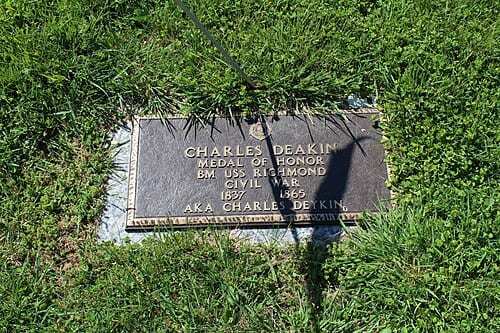
Deakin's military recognition came during his lifetime, but he survived the war for only a short period. On October 4, 1865, he died in Philadelphia, Pennsylvania, from a hemorrhage of the lungs. Historical accounts identify the residence where he died as the home of Margaret Densmore, widow of fellow naval Medal of Honor recipient William Densmore.
His death notice, published in The Philadelphia Inquirer on October 6, 1865, recorded his name as Charles Deykin and identified him as a former boatswain's mate of USS Richmond. The notice also invited relatives, friends, and former shipmates to attend his funeral.
Deakin was buried on October 6, 1865, at Lafayette Cemetery in Philadelphia. The cemetery later closed, and its interments were transferred to Evergreen Memorial Park in Bensalem, Pennsylvania, during the twentieth century. The burial grounds subsequently became associated with Rosedale Memorial Park Cemetery, where his memorial is recorded today.
Charles Deakin's legacy is defined by his courageous naval service during the American Civil War, particularly his conduct at the Battle of Mobile Bay. His participation in the actions against Fort Jackson and Fort St. Philip and his later bravery aboard USS Richmond established his place in the history of Union naval operations.
Although his life ended in 1865, his Medal of Honor preserves the record of a sailor who continued performing his combat duties despite enemy fire, damage to his ship, and casualties around him. Charles Deakin remains remembered for the courage and determination he demonstrated at his gun during the Battle of Mobile Bay on August 5, 1864.
Become the named supporter for this profile and edit the tribute biography and portrait (Owner account required). Proceeds help keep the archive online.
$25 USD / year — annual sponsorship renewal. Keeps the page online and, where enabled, the family anniversary remembrance emails active.