★
Loading archive…
Loading archive…
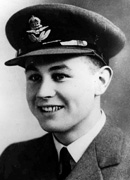
Flying Officer, Royal Air Force
Support & adopt this hero ↓
He flew his damaged bomber home to save three surviving men.
Cyril Joe Barton was born on 5 June 1921 at Elveden in Suffolk, England, the son of Frederick J. Barton and Ethel M. Barton. He was educated at Kingston College in Surrey and later became an apprentice draughtsman at an aircraft factory in Tolworth. Aviation was therefore already part of his working life when the Second World War transformed the demands placed upon young men of his generation.
On 16 April 1941, Barton enlisted in the Royal Air Force Volunteer Reserve. He progressed through his early training and was sent to the United States in January 1942 for pilot instruction. His training took him through flying schools in Georgia and Alabama, where he learned to handle increasingly advanced aircraft. On 10 November 1942 he qualified as a Sergeant Pilot and returned to Britain to continue preparing for operational service.
In January 1944, Barton and his crew transferred to the newly formed No. 578 Squadron. Operating Halifax bombers, the squadron became part of Bomber Command’s continuing offensive against Germany. Barton’s responsibility was not only to fly the aircraft but to command its crew through long missions in which a single mechanical failure, navigation error or fighter attack could become fatal.
On 26 March 1944, he was promoted to Flying Officer. Only four days later, on the night of 30 March, he took off as captain and pilot of Halifax LK797 for an attack on Nuremberg. The operation would become one of the most costly nights in the history of RAF Bomber Command.
Approximately seventy miles from the target, Barton’s Halifax was attacked by a Junkers Ju 88 night fighter. The first burst of enemy fire destroyed the aircraft’s intercommunication system. A second fighter, a Messerschmitt 210, joined the attack, and one of the Halifax’s engines was damaged. Its defensive guns were put out of action, leaving the crew unable to return the enemy fire effectively.
The situation deteriorated rapidly. With communications inside the aircraft disabled, a signal was misunderstood during the confusion of the attack. The navigator, air bomber and wireless operator believed they had been ordered to abandon the aircraft and parachuted out. Barton was suddenly left without his navigation team while still approaching the target in a badly damaged bomber.
The return journey presented an even greater challenge. The propeller of the damaged engine eventually flew off, while two fuel tanks had been damaged and were leaking. Barton had no navigator to guide him, his communications were crippled, and strong headwinds complicated the long flight back across heavily defended enemy territory.
By then, however, the Halifax was almost out of fuel. Before Barton could find a suitable place to land, the port engines stopped. The bomber was now too low for the remaining crew to abandon it safely. Barton ordered the three men still aboard to take up their crash positions and attempted to bring the aircraft down.
With only one engine still operating, he tried to avoid the houses beneath his flight path near Ryhope in County Durham. The Halifax crashed during the attempted landing on 31 March 1944. Barton was killed, aged twenty-two, but the three crew members who had remained aboard survived.
Despite losing his navigational team, he continued to the target and released his bombs.
The Victoria Cross was announced in June 1944. Barton could not receive it himself, and on 5 December 1944 his parents attended Buckingham Palace, where King George VI presented them with their son’s decoration.
Official Victoria Cross citation
On the night of 30th March, 1944, Pilot Officer Barton was captain and pilot of a Halifax aircraft detailed to attack Nuremberg When some 70 miles short of the target, the aircraft was attacked by a Junkers 88 The first burst of fire from the enemy made the intercommunication system useless One engine was damaged when a Messerschmitt 210 joined the fight The bomber’s machine guns were out of action and the gunners were unable to return the fire 2 Fighters continued to attack the aircraft as it approached the target area and, in the confusion caused by the failure of the communications system at the height of the battle, a signal was misinterpreted and the navigator, air bomber and wireless operator left the aircraft by parachute 3 Pilot Officer Barton faced a situation of dire peril His aircraft was damaged, his navigational team had gone and he could not communicate with the remainder of the crew If he continued his mission, he would be at the mercy of hostile fighters when silhouetted against the fires in the target area and if he survived, he would have to make a 4½ hours journey home on three engines across heavily-defended territory Determined to press home his attack at all costs, he flew on and, reaching the target, released the bombs himself 4 As Pilot Officer Barton turned for home the propeller of the damaged engine, which was vibrating badly, flew off It was also discovered that two of the petrol tanks had suffered damage and were leaking Pilot Officer Barton held his course and, without navigational aids and in spite of strong head winds, successfully avoided the most dangerous defence areas on his route Eventually he crossed the English coast only 90 miles north of his base 5 By this time the petrol supply was nearly exhausted Before a suitable landing place could be found, the port engines stopped The aircraft was now too low to be abandoned successfully Pilot Officer Barton therefore ordered the three remaining members of his crew to take up their crash stations Then, with only one engine working, he made a gallant attempt to land clear of the houses over which he was flying The aircraft finally crashed and Pilot Officer Barton lost his life, but his three comrades survived 6 Pilot Officer Barton had previously taken part in 4 attacks on Berlin and 14 other operational missions On one of these, two members of his crew were wounded during a determined effort to locate the target despite appalling weather conditions In gallantly completing his last mission in the face of almost impossible odds, this officer displayed unsurpassed courage and devotion to duty This Citation as printed in the Gazette is devoid of full stops.
Fifth Supplement to The London Gazette of 23 June 1944. 27 June 1944, Numb. 36584, p. 3041
Become the named supporter for this profile and edit the tribute biography and portrait (Owner account required). Proceeds help keep the archive online.
$25 USD / year — annual sponsorship renewal. Keeps the page online and, where enabled, the family anniversary remembrance emails active.