★
Loading archive…
Loading archive…
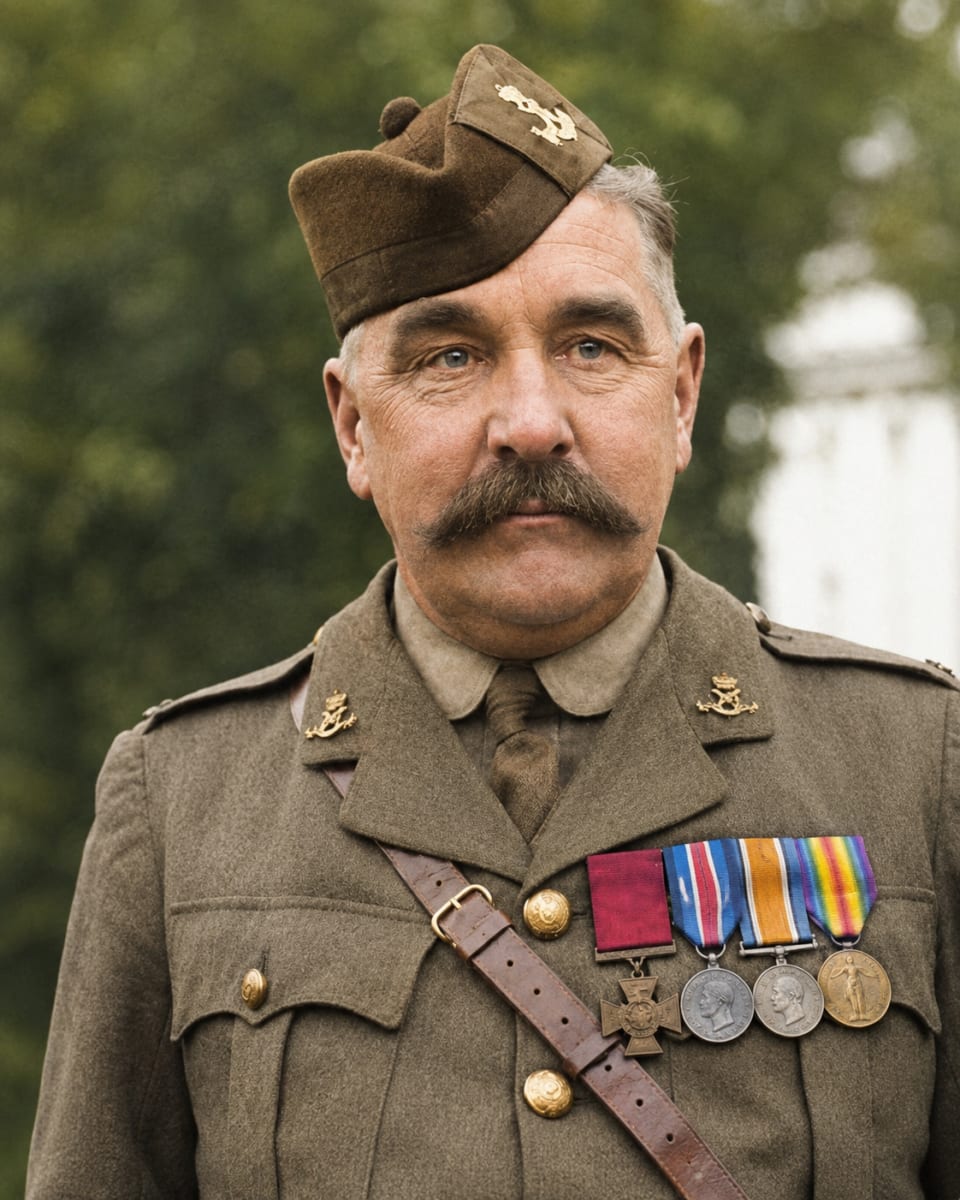
WW2 LtCol, Canadian Army
Support & adopt this hero ↓
Few Canadian officers of the First World War could claim a record like Cyrus Wesley Peck. He was wounded in battle, Mentioned in Despatches five times, awarded the Distinguished Service Order and a Bar, elected to Parliament while still serving overseas, and finally earned the Victoria Cross by walking deliberately into a battlefield swept by machine gun, sniper and artillery fire. On 2 September 1918, at the Drocourt-Quéant Line, Peck became one of seven Canadians awarded the Victoria Cross for actions on the same day. His story is not simply one of gallantry. It is the story of a soldier who repeatedly placed himself wherever the fighting was most dangerous and expected himself to face the same risks as the men he commanded.
Cyrus Wesley Peck was born on 26 April 1871 at Hopewell Hill, New Brunswick, and moved west with his family while still young. By the outbreak of the First World War he had already accumulated militia experience and was living in British Columbia. In November 1914 he joined the 30th Battalion of the Canadian Expeditionary Force as an officer, sailed for England in February 1915, and was promoted to major that April. He soon transferred to the 16th Battalion, Canadian Scottish, beginning the association that would define his wartime career. Within weeks he was wounded in both legs during the fighting at Festubert. He recovered, returned to France, and continued serving at the front rather than allowing his wounds to end his active service. By November 1916 he had succeeded to command of the 16th Battalion, eventually holding the rank of lieutenant-colonel.
Peck's courage was already being recognized long before his Victoria Cross. He was Mentioned in Despatches five times, with wartime notices associated with London Gazette issues 29623, 29890, 30107, 30706 and a final despatch at the end of 1918. His Distinguished Service Order was gazetted on 4 June 1917 in The London Gazette, issue 30111, for distinguished service in the field. As was common with many honours appearing in major wartime honours lists, Peck's original DSO entry did not carry a separate narrative citation explaining one particular action. The official Gazette nevertheless records him among the Canadian officers appointed to the Distinguished Service Order.
Then came the action that placed Cyrus Wesley Peck permanently among Canada's greatest battlefield leaders. On 2 September 1918 near Cagnicourt, France, the 16th Battalion was attacking the formidable Drocourt-Quéant Line. After taking its first objective, the battalion's advance was stopped by German machine guns. Peck did not remain at headquarters waiting for reports. He moved forward himself across exposed ground under machine gun and sniper fire to determine exactly what was holding his men back. He returned, reorganized the battalion, protected its flanks, and then went forward again through intense artillery and machine gun fire to locate advancing tanks and personally direct them toward the enemy positions. His intervention allowed the attack to regain momentum and helped another Canadian infantry battalion continue the advance.
The official Victoria Cross citation, published in The London Gazette, No. 31012, on 15 November 1918, opened by recognizing Peck's "most conspicuous bravery and skilful leading when in attack under intense fire." It emphasized his personal reconnaissance under heavy fire, his reorganization of the battalion, his direction of the tanks, and the courage and leadership that contributed substantially to the success of the brigade attack. The wording is significant because Peck's Victoria Cross was not awarded for one sudden act lasting only seconds. His citation describes a sustained sequence of command decisions made while repeatedly exposing himself to enemy fire.
His record did not stop with the Victoria Cross. Peck received a Bar to the Distinguished Service Order, gazetted in London Gazette No. 31119 in January 1919. The citation described how, during an attack conducted in heavy mist and after severe fighting, he led his battalion almost three miles to its final objective. It particularly noted that he personally led an attack against machine gun positions protecting enemy artillery, resulting in the capture of the guns, some of which were of 8 inch calibre. In the words of the citation, he displayed "fine courage and leadership." The Bar meant that Peck had now been recognized with the Distinguished Service Order for a second time, in addition to holding the Victoria Cross.
Remarkably, while commanding soldiers in France, Peck was also elected to the Canadian House of Commons. In the 1917 wartime election he became Member of Parliament for Skeena, British Columbia, while still overseas. When the war ended he returned to Canada with a record that included two wounds, five Mentions in Despatches, the DSO and Bar and the Victoria Cross. His final First World War medal entitlement also included the 1914-15 Star, British War Medal 1914-1920 and Victory Medal with the Mention in Despatches emblem. In later life his group was completed by the King George V Silver Jubilee Medal 1935, King George VI Coronation Medal 1937 and Queen Elizabeth II Coronation Medal 1953. The Victoria Cross and George Cross Association records this complete group and also notes that Peck was eventually transferred to the Reserve of Officers as a colonel.
Peck's public service continued long after the guns fell silent. After leaving federal politics, he was elected to the British Columbia Legislative Assembly in 1924 and again in 1928, later served in veterans related public administration, and became a member of the Canadian Pension Commission. He also served as an aide-de-camp to Governors General Lord Byng and Lord Tweedsmuir. Yet the strongest thread running through his life remained his connection to the soldiers of the Canadian Scottish. His wartime diaries covering 1915 to 1919 survive in Library and Archives Canada, providing an unusually direct documentary record of the experiences of a decorated Canadian battalion commander.
Cyrus Wesley Peck died on 27 September 1956, but the legacy of the Canadian Victoria Cross recipient did not disappear with him. His Victoria Cross and medal group were eventually transferred to the Canadian War Museum, preserving the physical evidence of an extraordinary military career. What makes Peck memorable is not simply the number of honours beside his name. It is what the citations reveal about the man behind them. When his battalion was stopped, he went forward. When the battlefield was unclear, he reconnoitred it himself. When machine guns blocked the advance, he led men against them. Cyrus Wesley Peck's reputation was built not on commanding from safety, but on repeatedly sharing the danger faced by the soldiers under his command.
Become the named supporter for this profile and edit the tribute biography and portrait (Owner account required). Proceeds help keep the archive online.
$25 USD / year — annual sponsorship renewal. Keeps the page online and, where enabled, the family anniversary remembrance emails active.