★
Loading archive…
Loading archive…
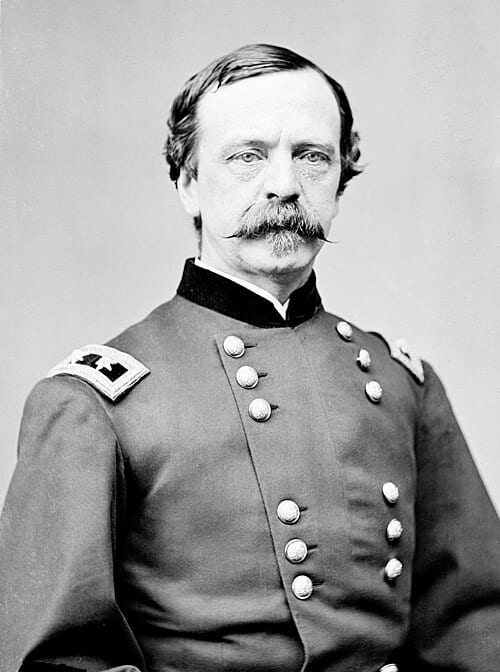
Major general, U.S. Army
Support & adopt this hero ↓
Gallantry Under Fire at the Battle of Gettysburg
Daniel Edgar Sickles (October 20, 1819 – May 3, 1914) was an American politician, Union Army major general, diplomat, and recipient of the United States Medal of Honor. He distinguished himself during the Battle of Gettysburg on July 2, 1863, when he continued encouraging his troops against advancing Confederate forces despite suffering a devastating battlefield wound. His conduct earned him the Medal of Honor on October 30, 1897.
Born in New York City, Sickles pursued an early career in printing and law. He attended New York University, studied law, and was admitted to the bar in 1846. He entered politics and served in the New York State Assembly in 1847, later holding positions as corporation attorney of New York City, secretary of the American legation in London, and member of the New York State Senate.
Sickles was elected to the United States House of Representatives in 1856 and served in Congress from 1857 to 1861. His early political career was marked by considerable controversy. In 1859, he fatally shot Philip Barton Key II in Washington, D.C., following allegations of an affair with his wife. Sickles was tried for murder but acquitted after his defense argued temporary insanity.
When the American Civil War began in April 1861, Sickles supported the Union war effort and helped organize volunteer troops from New York. He served as a colonel of New York volunteers and became associated with the Excelsior Brigade, a formation composed of New York infantry regiments.
Despite lacking formal professional military training, Sickles advanced rapidly through the Union command structure. He received a commission as Brigadier General of Volunteers and subsequently attained the rank of Major General. His military responsibilities expanded as the Army of the Potomac conducted operations against Confederate forces in Virginia.
Sickles participated in the Peninsula Campaign of 1862, including the fighting around Williamsburg and the operations approaching Richmond. During the following months, his command continued serving in the eastern theater as Union armies struggled to defeat General Robert E. Lee's Army of Northern Virginia.
By 1863, Sickles commanded the III Corps of the Army of the Potomac. His troops participated in the Chancellorsville Campaign in May 1863, where Union forces suffered defeat despite their numerical advantage.
His most consequential military service occurred during the Battle of Gettysburg, fought from July 1 to July 3, 1863, in Pennsylvania. The battle developed after Confederate forces invaded the North and encountered Union troops near the town of Gettysburg.
On July 2, Major General George G. Meade, commanding the Army of the Potomac, positioned Union troops along a defensive line extending southward from Cemetery Hill toward the Round Tops. Sickles commanded the III Corps, which occupied an important section of the Union left flank.
Concerned about the terrain assigned to his corps, Sickles advanced his troops from their intended defensive position near Cemetery Ridge toward higher ground around the Peach Orchard along the Emmitsburg Road.
This movement placed his soldiers forward of the principal Union line, creating an exposed salient and opening a gap between portions of the Federal defenses. The decision remains one of the most controversial command actions of the Battle of Gettysburg.
During the afternoon, Confederate troops commanded by Lieutenant General James Longstreet launched a major assault against the Union left. Fierce fighting developed around the Peach Orchard, Wheatfield, Devil's Den, and nearby defensive positions.
Sickles's III Corps came under intense pressure as Confederate infantry and artillery attacked its extended line. The Peach Orchard position became particularly vulnerable, and Confederate advances eventually overwhelmed several Union formations.
Throughout the engagement, Sickles remained actively involved in directing his troops and contesting the enemy's advance. While near the Trostle farm, he was struck in his right leg by a Confederate artillery projectile, inflicting a severe injury.
Despite the seriousness of his wound, Sickles continued encouraging his soldiers. Contemporary and subsequent accounts describe him remaining composed while being removed from the battlefield, reportedly smoking a cigar to reassure his men that he remained alive.
His injured right leg was amputated above the knee, permanently ending his active battlefield command. The amputated limb was subsequently donated to the Army Medical Museum in Washington, D.C., where it became part of a collection documenting military injuries.
Although the III Corps suffered devastating casualties and was forced to abandon its forward positions, Union reinforcements helped stabilize the threatened left flank. The Army of the Potomac ultimately defeated Lee's forces at Gettysburg.
Sickles's decision to advance the III Corps remained heavily disputed. Critics argued that his unauthorized movement exposed his troops and threatened the Union defensive line, while Sickles continued defending his decision during the decades following the battle.
His Medal of Honor recognition was based specifically on his personal gallantry while resisting the Confederate advance and encouraging his troops after being severely wounded, rather than an official endorsement of his battlefield positioning.
Following Gettysburg, Sickles continued his association with the United States Army, although his disability prevented him from returning to major field command. He undertook assignments during the later Civil War and Reconstruction periods.
He retired from military service with the rank of Major General on April 14, 1869, completing a military career that had taken him from volunteer leadership to command of an army corps during one of the conflict's most significant battles.
After the war, Sickles resumed an active public career. He served as United States Minister to Spain from 1869 to 1873, representing American diplomatic interests during a period of political instability in Spain.
Returning to the United States, he remained involved in politics and public affairs. He served as chairman of the New York State Civil Service Commission from 1888 to 1889 and as sheriff of New York County in 1890.
Sickles returned to the United States House of Representatives in 1893, serving until 1895. During his later political career, he became closely associated with efforts to protect and preserve the Gettysburg battlefield.
He supported federal legislation and initiatives intended to secure historic battlefield land, preserve military positions, and establish permanent memorials to the soldiers who had fought there.
His involvement contributed to the development of Gettysburg National Military Park, which was established under federal authority in 1895. The preservation of the battlefield became one of his most significant contributions to historical remembrance.
On October 30, 1897, Sickles received the United States Army Medal of Honor for his conduct during the Battle of Gettysburg.
The official citation recognized his conspicuous gallantry in vigorously resisting the enemy's advance and continuing to encourage his troops after suffering a severe wound. At the time of the action, Sickles held the rank of Major General of United States Volunteers.
His award came more than thirty-four years after Gettysburg. The Army Medal of Honor still retained its original nineteenth-century pendant design, although its ribbon had been revised in 1896, making the 1896 Army ribbon the historically appropriate version for his 1897 award.
Sickles remained a prominent Civil War veteran and public figure during his later years. His recollections, political activities, and continuing defense of his Gettysburg decisions attracted both public attention and historical criticism.
Daniel Edgar Sickles died in New York City on May 3, 1914, at the age of ninety-four. He was buried in Arlington National Cemetery in Arlington, Virginia.
His legacy remains both distinguished and controversial. As a Union Army major general, he received the Medal of Honor for displaying exceptional personal courage while severely wounded at Gettysburg. His disputed tactical decisions continue to be studied by military historians, while his efforts to preserve the battlefield contributed to the establishment of one of America's most important Civil War historic sites.
His Medal of Honor stands as recognition of his personal gallantry on July 2, 1863, and his role in the history and preservation of Gettysburg remains a significant part of his military and public life.
Become the named supporter for this profile and edit the tribute biography and portrait (Owner account required). Proceeds help keep the archive online.
$25 USD / year — annual sponsorship renewal. Keeps the page online and, where enabled, the family anniversary remembrance emails active.