★
Loading archive…
Loading archive…
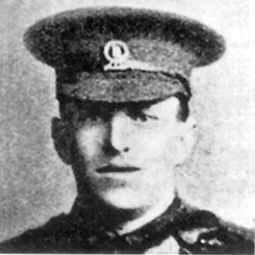
Sergeant, British Army
Support & adopt this hero ↓
He led his men through uncut wire under deadly machine fire.
On 1 October 1918, near Épinoy in northern France, Sergeant Frederick Charles Riggs led his platoon through uncut German wire under heavy fire. When flanking fire caused severe losses, he pressed on to the objective and captured a machine gun. He later turned two captured guns on the enemy, helping bring about the surrender of fifty men. When the enemy counter-attacked, Riggs urged his soldiers to hold their ground. He was killed while encouraging them to fight on.[1][2]
Riggs was born Frederick Charles Reeks at Springbourne, Bournemouth, on 28 July 1888. His mother, Mildred Reeks, worked as a domestic servant. His surname was changed to Riggs, and at about five years old he was taken in by Elizabeth Burgum, who raised him as her adopted son. He attended Malmesbury Park Council School and later worked for Pickford’s, the carrying and removals company.[1][3]
He enlisted in the 15th Hussars on 4 September 1914 and later served with the 6th Battalion, York and Lancaster Regiment. His wartime service took him to Egypt and Gallipoli before the battalion moved to France. He was seriously wounded in the head during the Somme fighting in 1916, evacuated to Britain, and later returned to the front. He received the Military Medal for an act of gallantry in 1918 before the action that brought him the Victoria Cross.[1]
At Épinoy, Riggs took command after his platoon officer was lost and led his men through wire that had not been cut. His advance was exposed to fire from the flanks, yet he reached the objective, captured a machine gun and made effective use of captured weapons. The full official citation records both the surrender of fifty German soldiers and his final effort to steady his men during a renewed attack.[1][2]
His Victoria Cross was awarded posthumously. His body was not recovered, and his name is commemorated on the Vis-en-Artois Memorial in France. In March 1919 the decoration was presented to Elizabeth Burgum, the woman who had raised him. Bournemouth also remembers him at Malmesbury Park School and in Riggs Gardens.[1][3]
Victoria Cross citation
“For most conspicuous bravery and self-sacrifice on the morning of the 1st October, 1918, near Epinoy, when, having led his platoon through strong uncut wire under severe fire, he continued straight on, and although losing heavily from flanking fire, succeeded in reaching his objective, where he rushed and captured a machine gun. He later handled two captured guns with great effect, and caused the surrender of fifty enemy. Subsequently, when the enemy again advanced in force, Sjt. Riggs cheerfully encouraged his men to resist, and whilst exhorting his men to fight on to the last, this very gallant soldier was killed.”
**Sources**
1. Victoria and George Cross Association, “Frederick Charles Riggs VC MM,” biographical profile and full Victoria Cross citation; accessed 2 October 2026. https://vcgca.org/our-people/profile/826/Frederick-Charles--RIGGS 2. The London Gazette, no. 31108, Fourth Supplement, 3 January 1919, pp. 307–308; published 6 January 1919. https://www.thegazette.co.uk/London/issue/31108/supplement/307 3. Burgum Family History Society, “Sergeant Riggs VC,” family, education, work and Bournemouth memorials. https://www.burgumfamily.co.uk/article_25.php
Become the named supporter for this profile and edit the tribute biography and portrait (Owner account required). Proceeds help keep the archive online.
$25 USD / year — annual sponsorship renewal. Keeps the page online and, where enabled, the family anniversary remembrance emails active.