★
Loading archive…
Loading archive…
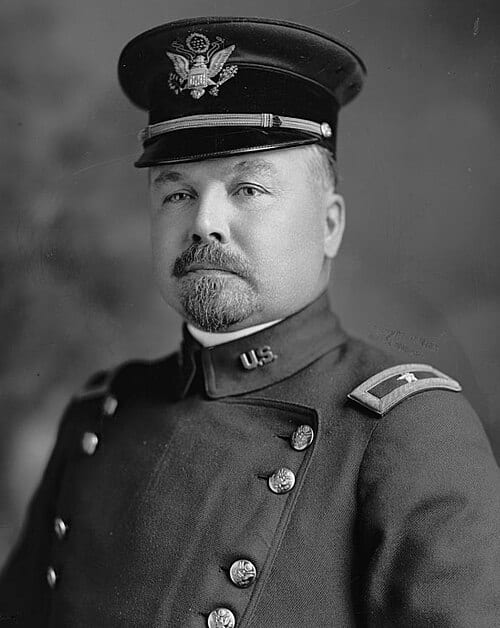
Major General, U.S. Army
Support & adopt this hero ↓
A river crossing under heavy enemy fire made Frederick Funston a national hero. A daring mission deep inside the Philippine countryside brought him face to face with one of the most important revolutionary leaders in Asian history. Yet his extraordinary military career did not end on the battlefield. From the Cuban struggle for independence to the Philippine-American War, the devastating San Francisco earthquake and the American occupation of Veracruz, Major General Frederick Funston became one of the most prominent and controversial American military leaders of his generation.
Frederick Funston was born on 9 November 1865 in New Carlisle, Ohio, and grew up near Iola, Kansas. The son of Edward H. Funston, a future Kansas political leader, he developed an early interest in exploration, journalism and the natural sciences. After attending university, he worked as a newspaper reporter before joining the United States Department of Agriculture as a botanist. His assignments took him across the Dakota Badlands, Death Valley, Yosemite and Alaska, where he gained a reputation for determination and an appetite for adventure. However, exploration was only the beginning of his remarkable journey. In 1896, drawn by the Cuban struggle against Spanish colonial rule, Funston joined the Cuban revolutionary forces. He served as an artillery officer, participated in numerous engagements and rose to the rank of lieutenant colonel. Wounded and suffering from malaria, he eventually returned to the United States in 1898.
With the outbreak of the Spanish-American War, Funston entered a new chapter of military service. On 13 May 1898, he entered the United States Army as colonel of the 20th Kansas Volunteer Infantry. His regiment, later nicknamed the Fighting Twentieth, sailed for the Philippines, where American forces became engaged in a new and increasingly bitter conflict against Filipino revolutionaries seeking independence. Funston quickly distinguished himself through aggressive leadership and personal courage. His defining moment came on 27 April 1899 during the Battle of Calumpit. Facing a heavily defended position across the Rio Grande de la Pampanga, American troops encountered intense enemy fire that threatened to halt their advance. Funston personally joined the dangerous river crossing, travelling on an improvised raft under fire and helping establish a foothold on the opposite bank. His actions contributed to the American assault and demonstrated exceptional courage under extreme conditions. For his gallantry at Calumpit, he received the Medal of Honor, the United States' highest military decoration for valor. He was also promoted to brigadier general of volunteers, marking his rapid rise from volunteer regimental commander to one of the youngest senior officers in the American Army.
Funston's reputation grew even further in 1901 through the controversial operation that resulted in the capture of Emilio Aguinaldo, president of the First Philippine Republic and the leading figure of the Filipino resistance. Rather than relying on a conventional military assault, Funston devised an elaborate deception. Accompanied by a small party of American soldiers and Macabebe scouts, his expedition travelled through hostile territory while posing as prisoners being escorted to Aguinaldo's headquarters. The deception succeeded, and on 23 March 1901 the expedition captured Aguinaldo at Palanan in Isabela. The operation became one of the most celebrated and debated episodes of the Philippine-American War. While it brought Funston widespread recognition and a commission as a brigadier general in the Regular Army, his methods and outspoken support for American expansionism also attracted criticism from opponents of imperialism, including prominent writer Mark Twain. Funston had become a national figure, but his military achievements were increasingly inseparable from the political controversies surrounding American rule in the Philippines.
His career continued through a succession of important commands and assignments. He served in several American military departments, returned to the Philippines and later commanded the Army Service Schools at Fort Leavenworth. He also played a significant role in the American intervention in Cuba in 1906, commanding the Army of Cuban Pacification during a period of political instability. One of the most defining moments of his later career came on 18 April 1906, when a devastating earthquake struck San Francisco. As commander at the Presidio, Funston immediately mobilized military forces, organized emergency relief and helped restore order as fires spread through the ruined city. He directed troops in protecting property, establishing emergency facilities and assisting thousands of displaced residents. His decision to use dynamite to create firebreaks remains a controversial aspect of the disaster response, but his rapid mobilization and leadership made him one of the central figures in the city's emergency operations. In 1913, he assumed command of the Hawaiian Department, before being transferred to the Mexican theatre. In 1914, he commanded American forces during the occupation of Veracruz, serving as military governor of the city. His performance earned him promotion to major general in the Regular Army. During the 1916 Punitive Expedition against Pancho Villa, Funston supervised American military operations along the Mexican border and oversaw the wider campaign led by Brigadier General John J. Pershing.
By the beginning of 1917, Frederick Funston stood among the most experienced and influential generals in the United States Army. His career had taken him from scientific expeditions and revolutionary warfare to major military commands across several countries. He had earned the Medal of Honor for his courage at Calumpit, gained national fame through the capture of Emilio Aguinaldo and demonstrated his leadership during one of the greatest natural disasters in American history. His life, however, ended suddenly on 19 February 1917, when he suffered a fatal heart attack at the age of fifty-one while staying at a hotel in San Antonio, Texas, near Fort Sam Houston. His death came only weeks before the United States entered the First World War, ending a career that had placed him among the leading candidates for the Army's highest wartime command. He was honoured with an extraordinary public farewell, lying in state at the Alamo and later beneath the rotunda of San Francisco City Hall before being buried at San Francisco National Cemetery. Major General Frederick Funston remains a significant figure in American military history, remembered for his extraordinary battlefield courage, daring military operations, leadership during national emergencies and the controversies that accompanied America's overseas expansion at the turn of the twentieth century.
Become the named supporter for this profile and edit the tribute biography and portrait (Owner account required). Proceeds help keep the archive online.
$25 USD / year — annual sponsorship renewal. Keeps the page online and, where enabled, the family anniversary remembrance emails active.