★
Loading archive…
Loading archive…
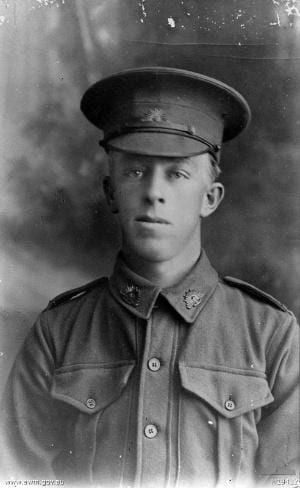
Corporal, Australian Army
Support & adopt this hero ↓
With German soldiers closing in on his battalion's exposed flank, one Australian corporal climbed onto a trench parapet and charged straight into enemy fire. When his grenades ran out, he continued fighting with his bayonet. George Julian "Snowy" Howell survived that desperate stand at Bullecourt on 6 May 1917, earning the Victoria Cross and securing his place among Australia's most courageous soldiers of the First World War.
Born on 19 November 1893 at Enfield, Sydney, George Julian Howell worked as a bricklayer before enlisting in the Australian Imperial Force on 3 June 1915. Assigned to the 1st Battalion, he served at Gallipoli before transferring to the Western Front in France. Wounded during the Battle of Pozières in July 1916, he recovered and returned to his unit, determined to continue fighting. By February 1917, he had risen to corporal.
Howell's extraordinary courage first attracted official recognition on 9 April 1917 during the capture of Demicourt. Leading a rifle-bombing section against strongly defended German positions, he repeatedly overcame machine-gun resistance through aggressive tactics and effective leadership. His Military Medal recommendation praised his courage and devotion to duty and recorded how he and his men remained at the forefront of the advance, helping their company capture its objectives. His award was announced in The London Gazette on 26 May 1917, page 5196.
Less than a month later came the action that defined his military career. On 6 May 1917, during the Second Battle of Bullecourt, a German counterattack threatened to outflank the Australian 1st Battalion. Recognising the danger, Howell acted without waiting for orders. Exposed to intense rifle and grenade fire, he climbed onto the trench parapet and advanced along it, hurling grenades at the enemy below. Supported by covering fire, he forced the Germans back. When his ammunition was exhausted, he pressed forward with his bayonet until severe wounds brought him down into the trench.
His Victoria Cross citation, published in The London Gazette on 27 June 1917, Issue 30154, page 6382, praised his "most conspicuous bravery" and recorded how his initiative inspired the battalion's successful counterattack. Howell suffered more than twenty wounds, including serious injuries to both legs, yet survived. On 21 July 1917, King George V personally presented him with both the Victoria Cross and Military Medal at Buckingham Palace.
Invalided to Australia, Howell was discharged in June 1918. His First World War service was further recognised by the 1914–15 Star, British War Medal and Victory Medal. Returning to civilian life, he married nurse Sadie Lillian Yates in 1919 and established a career in newspaper advertising. His family's wartime sacrifice was profound: his father and two brothers also served, and his brother Valentine was killed in France in May 1918.
When the Second World War began, Howell answered the call again. He served in the Australian Army, attaining the rank of staff sergeant during his first wartime appointment, before joining the United States Army Sea Transport Service in August 1944. Serving aboard tug ST-131 during the invasion of Leyte in the Philippines, he faced Japanese suicide attacks and dangerous weather while supporting Allied maritime operations. His later service was recognised through awards including the Pacific Star, War Medal 1939–1945, Australia Service Medal 1939–1945, United States Merchant Marine Pacific War Zone Medal and Merchant Marine World War II Victory Medal. His honours also included the 1937 and 1953 Coronation Medals, while a Philippine Liberation Ribbon and Merchant Marine Combat Bar are documented in his historical award records, with some foreign wear-authorisation questions remaining unresolved.
Following his wife's death in 1953, Howell settled in Western Australia near his daughter. He attended the Victoria Cross centenary celebrations in London in 1956 and remained a respected figure among Australia's decorated veterans.
George Julian "Snowy" Howell died in Perth on 23 December 1964, aged 71, and received a funeral with full military honours. His Victoria Cross and Military Medal are preserved by the Australian War Memorial. From the trenches of Gallipoli and Bullecourt to the dangerous waters of the Pacific, his life stands as a remarkable testament to courage, endurance and service across two world wars.
Become the named supporter for this profile and edit the tribute biography and portrait (Owner account required). Proceeds help keep the archive online.
$25 USD / year — annual sponsorship renewal. Keeps the page online and, where enabled, the family anniversary remembrance emails active.