★
Loading archive…
Loading archive…
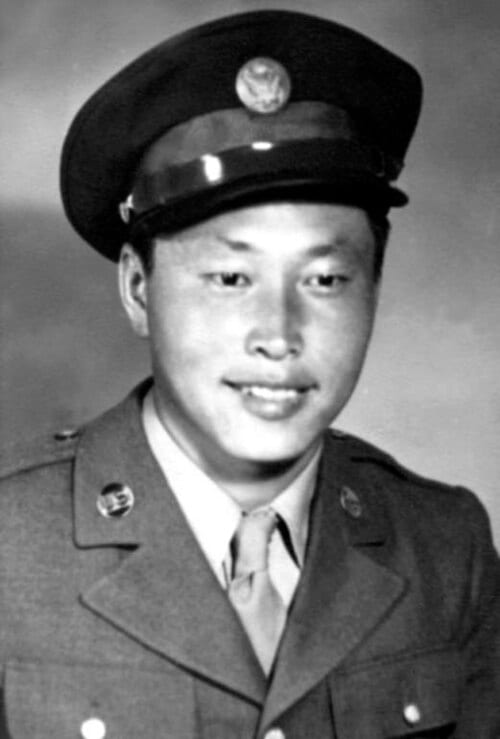
Private, U.S. Army
Support & adopt this hero ↓
When enemy fire pinned down his platoon on a French hillside, Private George T. Sakato made a decision that changed the course of the battle. He charged the German position alone, inspiring his fellow soldiers to follow. What happened next would earn him the United States' highest military decoration and establish his place among the most courageous Japanese American soldiers of World War II.
George Taro "Joe" Sakato was born on 19 February 1921 in Colton, California. Raised in a Japanese American family, he graduated from Redlands High School in 1941. Following the Japanese attack on Pearl Harbor, his family faced the threat of forced removal from California and relocated to Arizona to avoid incarceration in a government detention camp. Despite being born an American citizen, Sakato recalled that his draft classification initially identified him as 4-C, "enemy alien." He had originally hoped to become an aviator, but on 1 March 1944 he entered the United States Army at Fort Douglas, Utah. After training, he was assigned to the 3rd Platoon, Company E, 2nd Battalion, 442nd Regimental Combat Team, the renowned Japanese American formation whose soldiers became famous for their determination and motto, "Go for Broke!"
Sakato served with the 442nd in the European Theater, including the fighting in France. His defining moment came on 29 October 1944 during the battle for Hill 617 near Biffontaine in the Vosges Mountains. After his platoon had broken through two German defensive lines, intense enemy fire pinned down the advancing soldiers. Refusing to remain under fire, Sakato launched a one-man assault that inspired his comrades to charge and destroy the enemy strongpoint. When a German counterattack struck the left flank and killed his squad leader, Sakato immediately assumed command. Using his own weapons and captured German firearms, including an enemy rifle and P-38 pistol, he rallied his men and continued fighting. His official Medal of Honor citation credited him with killing 12 enemy soldiers, wounding two, personally capturing four, and helping his platoon capture another 34 prisoners. His courage and aggressive leadership transformed an impending defeat into victory.
The extraordinary heroism demonstrated on Hill 617 initially earned Sakato the Distinguished Service Cross, which was presented to him in July 1945 while he was recovering in a San Diego military hospital. However, the recognition did not end there. Following a congressionally mandated review of decorations awarded to Asian American servicemen during World War II, his Distinguished Service Cross was upgraded to the Medal of Honor. On 21 June 2000, President Bill Clinton presented Sakato with the nation's highest military decoration during a White House ceremony honoring 22 Asian American World War II veterans. The recognition came more than 55 years after his battlefield heroism. His wartime service also brought him the Purple Heart, following wounds sustained in France, and the European-African-Middle Eastern Campaign Medal and World War II Victory Medal. His 2nd Battalion, 442nd Regimental Combat Team, was additionally recognized with the Army Presidential Unit Citation under War Department General Orders No. 83, dated 6 August 1946, for its outstanding actions near Bruyères, Biffontaine and Massa. On 1 November 2011, Army Chief of Staff General Raymond T. Odierno personally presented Sakato with the Bronze Star Medal during a ceremony recognizing Japanese American World War II veterans whose combat awards had been delayed for decades.
After returning home, Sakato faced another challenge. Despite his remarkable military service, he encountered racial discrimination while seeking civilian employment. He eventually built a career with the United States Postal Service, serving for 27 years and spending much of that time at the Denver Stockyards Post Office. He became known for his humility, dedication and commitment to his fellow veterans. Even after receiving the Medal of Honor, he remained reluctant to describe himself as a hero, believing that the recognition belonged equally to the comrades who had sacrificed their lives.
George Taro "Joe" Sakato died on 2 December 2015 in Denver, Colorado, aged 94. His legacy continued when Congress designated the Denver Stockyards Post Office as the George Sakato Post Office Building in 2018, with its dedication ceremony held on 23 August 2019. His story represents far more than extraordinary battlefield courage. He was a Japanese American soldier who defended a nation during a war in which his own community faced discrimination and forced removal. On Hill 617, when his fellow soldiers needed someone to lead, George T. Sakato stepped forward without hesitation. His courage helped save his platoon, and his legacy remains an enduring tribute to the Nisei soldiers of the 442nd Regimental Combat Team.
Become the named supporter for this profile and edit the tribute biography and portrait (Owner account required). Proceeds help keep the archive online.
$25 USD / year — annual sponsorship renewal. Keeps the page online and, where enabled, the family anniversary remembrance emails active.