★
Loading archive…
Loading archive…
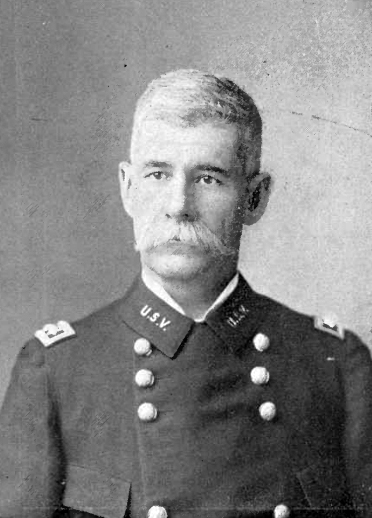
Major General, U.S. Army
Support & adopt this hero ↓
He Chased Geronimo, Then Fell in His Final Battle
Henry Ware Lawton was born on March 17, 1843, in Manhattan, Ohio. His childhood included frequent moves as his father sought work, and after the death of his mother Lawton spent part of his youth in the care of relatives and family friends. He eventually settled in Fort Wayne, Indiana, where he attended Fort Wayne Methodist Episcopal College. His education was interrupted by the outbreak of the American Civil War, a conflict that would begin a military career stretching across nearly four decades and four major periods of American warfare.
Only days after the attack on Fort Sumter in April 1861, Lawton left college and enlisted in Company E of the 9th Indiana Volunteer Infantry. He was soon selected as First Sergeant. His first period of service was brief, but it placed him in the opening campaigns of the war in western Virginia. After completing that enlistment, he returned to military service with the 30th Indiana Infantry, receiving a commission as a First Lieutenant. From that point forward he developed from a young volunteer officer into an experienced battlefield commander.
Lawton served with the 30th Indiana through some of the hardest campaigning of the Civil War. His regiment became part of the Union armies operating in the Western Theater, and Lawton steadily gained responsibility as the conflict progressed. By 1864 he was a Captain commanding Company A. The action that ultimately earned him the Medal of Honor took place during the Atlanta Campaign, one of the decisive Union operations of the war.
On August 3, 1864, near Atlanta, Georgia, Captain Lawton led a charge of skirmishers against Confederate rifle pits. His men succeeded in driving the enemy from the position, but capturing the works was only the beginning of the fight. Confederate troops launched two determined attempts to retake the ground. Lawton and his men held their position and successfully resisted both attacks. His leadership during the assault and the defense of the captured works became the defining act of personal gallantry associated with his Civil War service.
Nearly twenty-nine years later, on May 22, 1893, Henry Ware Lawton received the Medal of Honor for that action. The decoration recognized a specific act of battlefield leadership rather than simply his long record of military service. He had personally led his skirmishers against an entrenched enemy and then maintained the captured position against repeated counterattacks. His Medal of Honor in this profile stands without any additional device, clasp, star, or bar. It remained the central personal decoration associated with his extraordinary military career.
Lawton continued advancing during the final stages of the Civil War. By the end of the conflict he had risen well beyond the company-level responsibilities he had held during his Medal of Honor action. He eventually commanded the 30th Indiana and finished the war with senior field experience, including brevet recognition at colonel level. Still a very young man, he had already accumulated years of combat and command experience before reaching his mid-twenties.
After the war, Lawton briefly turned toward civilian education and the law. He studied in Fort Wayne and also attended Harvard Law School, but civilian life did not hold him for long. In 1867 he received a commission as a Second Lieutenant in the Regular Army. This decision began the second major phase of his career and placed him among the professional officers responsible for the Army's operations on the western frontier.
During the following two decades, Lawton served in a series of Indian campaigns. His assignments brought him into operations involving the Sioux, Ute, and Apache peoples. He served with infantry and cavalry organizations and gained a reputation for endurance, field discipline, and the ability to keep troops operating under harsh conditions. His frontier career eventually became most closely associated with the campaign against Geronimo and the Chiricahua Apache in 1886.
By that time Lawton was a Captain in the 4th U.S. Cavalry. Under the overall direction of General Nelson A. Miles, he was given command of a field column tasked with pursuing Geronimo's band through difficult country in Arizona and Mexico. The campaign demanded extraordinary physical endurance from soldiers and scouts as they moved through mountains, desert terrain, and severe heat. Lawton's column maintained persistent pressure over an extended pursuit. Lieutenant Charles B. Gatewood played the critical diplomatic role in contacting Geronimo and securing his agreement to surrender, while Lawton's field command formed an important part of the military pressure surrounding the campaign. The surrender in 1886 became one of the best-known episodes of Lawton's frontier service.
Lawton continued to rise through the Regular Army and became widely respected as a field officer. When war with Spain began in 1898, his long combat experience made him an obvious choice for senior command. He was appointed Brigadier General of Volunteers and sent to Cuba, where he commanded a division during the Santiago campaign. His troops participated in the advance from Daiquirí and Siboney and fought in the hard battle for El Caney on July 1, 1898.
At El Caney, Lawton's division faced a smaller but determined Spanish force defending fortified positions. The battle lasted far longer than American planners had expected, and the defenders resisted fiercely. Lawton's troops eventually broke the Spanish position and captured the village. The fighting became one of the best-known engagements of the Santiago campaign. Following the collapse of Spanish resistance in the area, Lawton also served as military governor of Santiago de Cuba, adding administrative responsibility to a career already dominated by combat command.
His service did not end with the Spanish-American War. In 1898 and 1899 he was sent to the Philippines, where American forces became involved in the Philippine-American War. Lawton commanded the 1st Division of the VIII Army Corps and first served as a Brigadier General before advancing to Major General of Volunteers, the highest rank of his military career. Once again he became known for aggressive field leadership and for remaining close to the soldiers conducting operations.
The Philippines would also become the final battlefield of his life. On December 19, 1899, during operations near San Mateo on Luzon, Lawton moved along the front while his troops were engaged with Filipino forces. Even at general-officer rank he maintained the habit of personally observing the fighting from exposed positions. During the action he assisted when a nearby officer was wounded and then returned toward the firing line to continue observing the battle.
While standing in an exposed position during the fighting, Major General Lawton was struck by enemy fire and mortally wounded. He died there on the battlefield at the age of fifty-six. His death ended a career that had begun as a teenage volunteer during the Civil War and had carried him through the Indian Wars, the Spanish-American War, and the Philippine-American War.
Henry Ware Lawton was later buried at Arlington National Cemetery. By the time of his death, he had become one of the most recognizable professional soldiers of his generation. His career linked several dramatically different periods of United States military history: Civil War volunteer armies, frontier campaigns, overseas war against Spain, and the conflict in the Philippines.
His Medal of Honor remained rooted in the action of August 3, 1864, when, as a Captain of the 30th Indiana Infantry, he led his skirmishers against Confederate rifle pits and held the captured position against repeated attacks. Yet his military story continued for another thirty-five years after that moment. He pursued Geronimo across the Southwest and Mexico, commanded troops at El Caney in Cuba, rose to Major General of Volunteers, and ultimately died under enemy fire while still exercising command in the field. Few American officers of the nineteenth century experienced such a continuous span of combat service, and Lawton's life became a remarkable bridge between the Civil War soldier and the modern overseas American Army.
Become the named supporter for this profile and edit the tribute biography and portrait (Owner account required). Proceeds help keep the archive online.
$25 USD / year — annual sponsorship renewal. Keeps the page online and, where enabled, the family anniversary remembrance emails active.