★
Loading archive…
Loading archive…
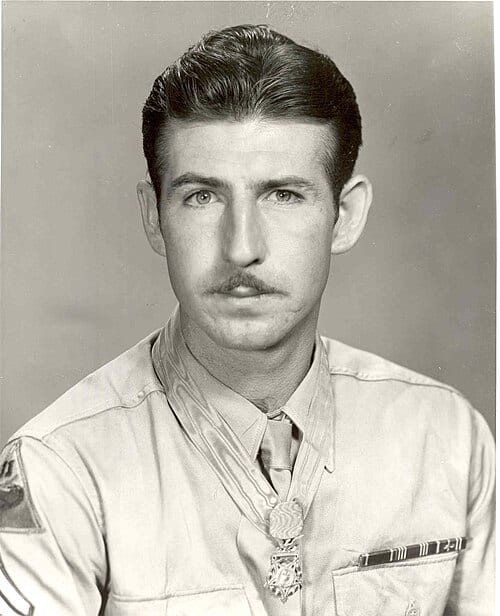
Staff Sergeant, U.S. Army
Support & adopt this hero ↓
What kind of courage drives a soldier back toward a burning tank to save his comrades, then sends him charging alone against a loaded enemy cannon? For Herbert Hoover Burr, a World War II American tank soldier and Medal of Honor recipient, extraordinary bravery was not a single moment of heroism. It was a choice he made repeatedly, even when survival seemed impossible.
Born on September 13, 1920, in St. Joseph, Missouri, Herbert Hoover Burr grew up during the Great Depression and later moved to Kansas City. Drafted into the United States Army in early 1942, he trained in armored warfare and eventually joined Company C, 41st Tank Battalion, 11th Armored Division. As the division fought across Western Europe, Burr would distinguish himself through two remarkable acts of courage that earned him America's highest and second-highest military decorations for valor.
His first extraordinary act came on January 15, 1945, during fighting in Belgium. When enemy artillery disabled his tank, Burr, then a Private First Class, climbed out under dangerous conditions and carried a wounded crewman to safety. But he refused to abandon the others. Crawling approximately 150 yards back to the burning vehicle, he attempted to rescue his remaining comrades. Discovering that they had been killed, Burr managed to move the damaged tank into cover and extinguish its flames. His actions earned the Distinguished Service Cross, awarded under Headquarters, Third U.S. Army, General Orders No. 52 (1945), whose citation recognized his extraordinary heroism and devotion to duty.
Just two months later, Burr faced an even more desperate situation.
On March 19, 1945, near Dorrmoschel, Germany, Burr was serving as a bow gunner when an enemy rocket struck his tank, severely wounding the platoon sergeant and forcing the surviving crewmen to abandon the vehicle. Deafened by the explosion but otherwise uninjured, Burr refused to retreat. Instead, he climbed into the driver's seat and continued the mission alone.
Rounding a bend, he suddenly confronted a fully manned German 88-mm antitank gun at point-blank range. With nobody to operate his tank's weapons, Burr faced a deadly choice: withdraw or attack. He accelerated directly toward the loaded cannon, catching its crew completely by surprise. His tank crushed the gun beneath its tracks, scattering the German soldiers. He then sideswiped and overturned an enemy truck before maneuvering back to friendly positions.
Yet his mission was not finished. When medical personnel could not locate his wounded platoon sergeant, Burr ran through sniper fire to guide them to the injured man. His Medal of Honor citation, published in War Department General Orders No. 73 on August 30, 1945, praised his fearless determination, exceptional skill, and courageous devotion to duty in completing his mission against overwhelming odds.
On August 23, 1945, President Harry S. Truman personally presented Burr with the Medal of Honor at the White House. His wartime service was also recognized through the American Campaign Medal, European–African–Middle Eastern Campaign Medal, and World War II Victory Medal. His bravery received international recognition as well. According to the United States Department of Defense, Burr received Britain's Distinguished Conduct Medal in 1946 and Luxembourg's Croix de Guerre in 1947.
After the war, Burr returned to civilian life in Missouri, eventually working in construction and as a painter for the federal government. Although he had confronted extraordinary danger on the battlefields of Europe, he preferred a quiet life with his family and rarely spoke about his wartime experiences. He retired in 1986 and died on February 8, 1990, aged 69. He rests in Mount Washington Cemetery in Independence, Missouri.
Herbert Hoover Burr's legacy is not defined solely by the enemy weapons he destroyed or the medals he received. It lives in the wounded soldier he carried to safety, the comrades he refused to abandon, and the impossible odds he willingly confronted. His story remains an enduring example of the courage, sacrifice, and devotion to fellow soldiers that shaped the American Army's finest traditions during World War II.
Become the named supporter for this profile and edit the tribute biography and portrait (Owner account required). Proceeds help keep the archive online.
$25 USD / year — annual sponsorship renewal. Keeps the page online and, where enabled, the family anniversary remembrance emails active.