★
Loading archive…
Loading archive…
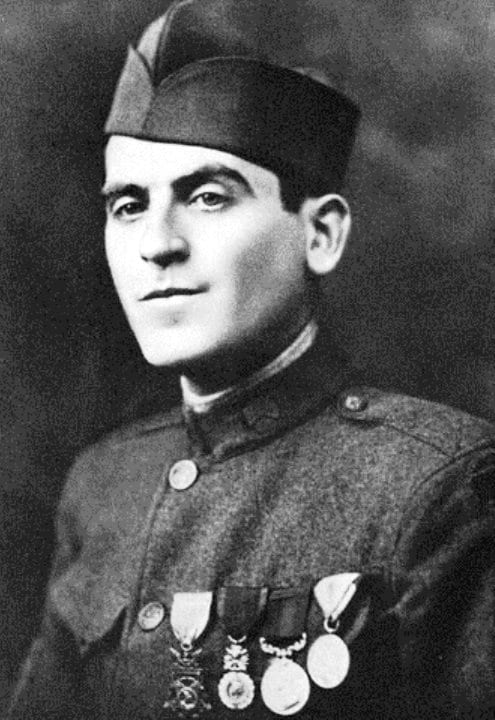
Sergeant, U.S. Army
Support & adopt this hero ↓
A German machine gun had stopped an American advance. Its fire swept across the battlefield, pinning soldiers down and threatening to halt the attack. Then two men decided to advance directly against the enemy position. One was Sergeant James Ernest “Buck” Karnes, whose extraordinary courage near Estrées, France, on 8 October 1918 earned him the Medal of Honor and an enduring place in American military history.
Born on 20 July 1889 in Arlington, Tennessee, Karnes grew up in the Knoxville area. He enlisted in the Tennessee National Guard on 10 July 1917 and served in Company D, 117th Infantry Regiment, 30th Infantry Division, famously known as the “Old Hickory” Division. Deployed to Europe during World War I, he joined the American Expeditionary Forces on the Western Front, where his regiment fought alongside British and Australian formations.
In September 1918, the 117th Infantry participated in the assault on the formidable Hindenburg Line near Bellicourt and the St. Quentin Canal. The breakthrough helped weaken one of Germany's most heavily defended positions. But Karnes's defining moment came just days later, during the Allied advance near Estrées.
On 8 October 1918, intense German machine-gun fire halted Company D. With his fellow soldiers unable to advance, Karnes and Private Calvin John Ward moved against the enemy position. Despite the danger, the two men closed on the machine-gun emplacement, killing three German defenders, capturing seven others and seizing their weapons. Their decisive action eliminated the obstacle and allowed the American advance to continue.
For this extraordinary heroism, Karnes received the Medal of Honor under War Department General Orders No. 50, dated 12 April 1919. Ward received a separate Medal of Honor for his role in the same engagement. Their shared courage became one of the most memorable episodes in the combat history of Tennessee's 30th Division.
Karnes's bravery was also recorded in a March 1919 announcement of the Distinguished Service Cross for the same action, preceding the higher Medal of Honor recognition. The Military Roll of Honor additionally credits him with the Silver Star, although its original citation remains unverified. His service qualified him for the World War I Victory Medal. The East Tennessee Veterans Memorial Association also attributes Britain's Distinguished Conduct Medal, France's Médaille militaire and Croix de Guerre, and Montenegro's Medal for Military Bravery to Karnes. The original individual foreign-award citations and exact ribbon devices remain subjects of historical research.
After the war, Karnes returned to Tennessee and worked in law enforcement in Knoxville. His courage continued to be remembered decades later, including at a White House reception for Medal of Honor recipients hosted by President John F. Kennedy in May 1963. His daughter accompanied him to the event.
James Ernest “Buck” Karnes died on 8 July 1966 and was buried at Greenwood Cemetery in Knoxville. His name is commemorated by the James E. “Buck” Karnes Bridge, reflecting Tennessee's lasting recognition of his military service.
His legacy rests above all on one remarkable decision. When enemy fire threatened to stop his company, Karnes did not remain behind cover. He moved toward the danger alongside a fellow soldier, demonstrating the courage, initiative and devotion to duty that define the Medal of Honor.
Become the named supporter for this profile and edit the tribute biography and portrait (Owner account required). Proceeds help keep the archive online.
$25 USD / year — annual sponsorship renewal. Keeps the page online and, where enabled, the family anniversary remembrance emails active.