★
Loading archive…
Loading archive…
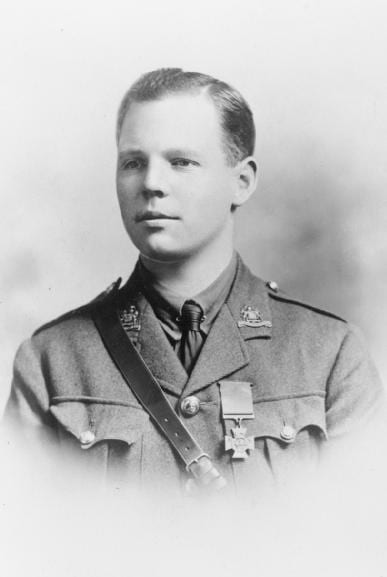
Lieutenant, British Army
Support & adopt this hero ↓
On 29 October 1914, near Festubert in France, German troops had captured part of the British line, and two attempts to recover the lost trench had already failed. Rather than accept defeat, Second Lieutenant James Edgar Leach and Sergeant John Hogan led a volunteer party into the occupied position and fought their way forward at close quarters. Their extraordinary courage restored the trench and secured Leach's place among the most distinguished Victoria Cross recipients of the First World War.
James Edgar Leach was born on 27 July 1894 at Bowerham Barracks, Lancaster, Lancashire. The son of Colour Sergeant James Leach of The King's Own (Royal Lancaster) Regiment, he grew up in a military family. He was educated at Bowerham Council School and Moston Lane Municipal School in Manchester. Before entering regular Army service, he worked as a fishmonger and subsequently as an apprentice chemist. He enlisted in the Northamptonshire Regiment in August 1910 and served with its 1st Battalion before receiving a wartime commission in October 1914.
Leach arrived in France on 13 August 1914 and served during the opening campaigns of the British Expeditionary Force. Following the Battles of the Aisne, he was promoted to Sergeant and Mentioned in Despatches. He subsequently joined the 2nd Battalion, Manchester Regiment, on the Western Front and was given command of A Company because of the shortage of officers.
His defining moment came during the fighting near Festubert on 29 October 1914. His official Victoria Cross citation, published in The London Gazette on 22 December 1914, Issue 29015, page 10920, recognised his conspicuous bravery after the enemy occupied his battalion's trench. Leach and Hogan voluntarily led the recovery, working from traverse to traverse under intense close-quarter fighting. Their party killed eight German soldiers, wounded two and captured sixteen prisoners. Both men were awarded the Victoria Cross. Leach was subsequently invested with his Cross by King George V at Buckingham Palace in February 1915.
Leach's wartime experiences came at considerable personal cost. Concussion and recurring medical problems repeatedly interrupted his service. He returned to France in April 1915 but was concussed again shortly after rejoining his battalion. He later served at the Army School of Signalling and returned to France in 1917, although he was eventually declared unfit for general service. He received temporary promotion to Captain in January 1917, while his final recorded rank was Lieutenant. On 7 August 1918, he was medically discharged from the Army. His First World War Mention in Despatches is represented by the bronze oak-leaf emblem on his Victory Medal.
In January 1921, Leach joined the Auxiliary Division of the Royal Irish Constabulary and was posted to Glengarriff, County Cork, during the Irish War of Independence. He returned to England in 1922. His subsequent civilian career included work at the Bank of England, a London stockbroking firm and the Ministry of Aircraft Production. During the Second World War, he also served as a Lieutenant in the 27th City of London (Roehampton) Battalion of the Home Guard.
His Victoria Cross status also gave him entitlement to the 1935 King George V Silver Jubilee Medal. His attributed medal group includes the Defence Medal, the 1937 King George VI Coronation Medal and the 1953 Queen Elizabeth II Coronation Medal.
Following the war, Leach worked for the Danish Bacon Company and entered local public service as a member of Hammersmith Borough Council between 1949 and 1955. He died at Shepherd's Bush, London, on 15 August 1958, and was cremated at Mortlake.
James Edgar Leach's story is a reminder that extraordinary courage is not measured by rank or circumstance, but by the willingness to act when others have been unable to succeed. His actions near Festubert helped save his battalion's position and earned him a lasting place in British military history.
Become the named supporter for this profile and edit the tribute biography and portrait (Owner account required). Proceeds help keep the archive online.
$25 USD / year — annual sponsorship renewal. Keeps the page online and, where enabled, the family anniversary remembrance emails active.