★
Loading archive…
Loading archive…
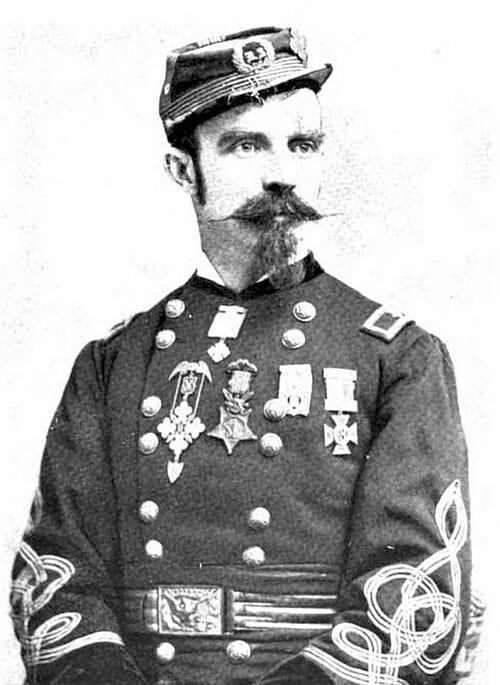
Second Lieutenant (U.S. Army, Medal of Honor action); Colonel (New Jersey National Guard); Brevet Brigadier General (honorary), U.S. Army
Support & adopt this hero ↓
James Madison Drake earned the Medal of Honor for holding an exposed Union skirmish line at Bermuda Hundred, Virginia, through an entire day and night of fighting. Yet his Civil War story includes another extraordinary chapter: five months as a Confederate prisoner, a daring escape from a moving train, and a 650-mile journey through enemy territory to reach Union lines.
Born on March 25, 1837, in Washington Valley, Somerset County, New Jersey, Drake developed an early interest in journalism and publishing. When the American Civil War began in 1861, he volunteered with the 3rd New Jersey Militia. After completing his initial service, he enlisted in Company K of the 9th New Jersey Infantry in October 1861, initially serving as a sergeant and subsequently as first sergeant. In June 1863, he was appointed Second Lieutenant of Company D.
Serving with the Ninth, Drake participated in important Union operations in North Carolina and Virginia, including Roanoke Island, New Bern and Winton. His regiment became known as the Jersey Muskrats for its ability to fight through difficult swamp terrain. During the July 1863 Winton operations, Drake was wounded in an assault against Confederate positions.
His defining moment came on May 6, 1864, at Bermuda Hundred, Virginia. As a Second Lieutenant with Company D, he commanded the advanced skirmish line and maintained his position throughout the day and night despite the dangers of the exposed forward position. His official Medal of Honor citation reads: "Commanded the skirmish line in the advance and held his position all day and during the night." In recognition of this extraordinary leadership, he received the Medal of Honor on March 3, 1873, presented personally by President Ulysses S. Grant at the White House.
Ten days after his celebrated action, Drake was captured during the Battle of Drewry's Bluff on May 16, 1864. He endured approximately five months of Confederate captivity at Richmond, Danville, Macon, Savannah and Charleston. On October 6, 1864, he escaped from a moving prisoner train near the Congaree River with three other Union officers. Their journey through hostile territory, swamps and mountains lasted six weeks. On November 16, he finally reached Union lines at Knoxville, Tennessee, after travelling approximately 650 miles. He later documented this remarkable experience in his book Fast and Loose in Dixie, published in 1880.
Following lengthy hospital treatment and furlough, Drake returned to the eastern theater in January 1865. A detailed modern regimental study records that his health prevented a return to active field service and that he declined an offered promotion to Captain before receiving a medical discharge near the end of the war.
After the Civil War, Drake remained involved in military affairs and became an influential figure in the New Jersey National Guard. He was elected Colonel of the Third Regiment and received the honorary brevet rank of Brigadier General from the New Jersey legislature. He also commanded the Elizabeth Gatling gun battery as a Captain and became associated with the Veteran Zouaves.
Beyond military service, Drake established himself as a newspaper publisher and author in Elizabeth, New Jersey. His publications included Fast and Loose in Dixie and The History of the Ninth New Jersey Veteran Volunteers, published in 1889, preserving important accounts of the regiment's service.
James Madison Drake died on November 28, 1913, in Elizabeth, New Jersey, and was buried in Evergreen Cemetery in Hillside. Remembered as a Medal of Honor recipient, Civil War officer, prisoner of war escapee, author and National Guard leader, his legacy reflects extraordinary courage, resilience and a lifelong commitment to preserving military history.
Become the named supporter for this profile and edit the tribute biography and portrait (Owner account required). Proceeds help keep the archive online.
$25 USD / year — annual sponsorship renewal. Keeps the page online and, where enabled, the family anniversary remembrance emails active.