★
Loading archive…
Loading archive…
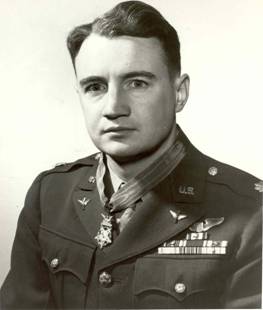
Piloted a battered bomber through attacks despite his wounds
Jay Zeamer Jr. was born on 25 July 1918 in Carlisle, Pennsylvania, and grew up in Orange, New Jersey. He received an Army Reserve commission in 1939 and graduated from the Massachusetts Institute of Technology with a civil engineering degree in 1940. He earned his pilot's wings in March 1941, served with bomber units in the United States, and deployed to the Southwest Pacific in 1942. He flew combat and reconnaissance missions and became a Captain in April 1943.
On 16 June 1943, Zeamer volunteered to pilot a photographic mapping mission over Buka in the Solomon Islands. His crew saw Japanese fighters preparing to take off, but he continued the mapping run even after their attack began. Wounds struck both arms and legs and broke one leg. For forty minutes he manoeuvred the damaged bomber so its gunners could resist the attackers. The crew destroyed at least five enemy aircraft, including one credited to Zeamer. He refused medical treatment until combat ended, then surrendered the controls while continuing to direct the flight to a base 580 miles away despite repeatedly losing consciousness. The mission provided information for the forthcoming Allied landings on Bougainville.
Promoted to Major in July 1943, Zeamer received the Medal of Honor from General Henry H. Arnold at the Pentagon on 16 January 1944. His wounds required a prolonged recovery. He became a Lieutenant Colonel in April 1944 and later served as a tactical field air inspector before his medical retirement in January 1945. He subsequently earned a master's degree in aeronautical engineering at MIT.
After the war, Zeamer worked at Pratt & Whitney in Hartford, Connecticut. He married Barbara Ferner in 1949; they had five daughters. He joined Hughes Aircraft in Los Angeles in 1952 and earned an MBA at UCLA. In 1959 he moved to Raytheon in Bedford, Massachusetts. He retired to Boothbay Harbor, Maine, in 1968, remaining active in sailing and other outdoor pursuits. He died there on 22 March 2007 and was buried at Arlington National Cemetery.
Official Medal of Honor citation: On 16 June 1943, Maj. Zeamer (then Capt.) volunteered as pilot of a bomber on an important photographic mapping mission covering the formidably defended area in the vicinity of Buka, Solomon Islands. While photographing the Buka airdrome, his crew observed about 20 enemy fighters on the field, many of them taking off. Despite the certainty of a dangerous attack by this strong force, Maj. Zeamer proceeded with his mapping run, even after the enemy attack began. In the ensuing engagement, Maj. Zeamer sustained gunshot wounds in both arms and legs, 1 leg being broken. Despite his injuries, he maneuvered the damaged plane so skillfully that his gunners were able to fight off the enemy during a running fight which lasted 40 minutes. The crew destroyed at least 5 hostile planes, of which Maj. Zeamer himself shot down 1. Although weak from loss of blood, he refused medical aid until the enemy had broken combat. He then turned over the controls, but continued to exercise command despite lapses into unconsciousness, and directed the flight to a base 580 miles away. In this voluntary action, Maj. Zeamer, with superb skill, resolution, and courage, accomplished a mission of great value.
Become the named supporter for this profile and edit the tribute biography and portrait (Owner account required). Proceeds help keep the archive online.
$25 USD / year — annual sponsorship renewal. Keeps the page online and, where enabled, the family anniversary remembrance emails active.