★
Loading archive…
Loading archive…
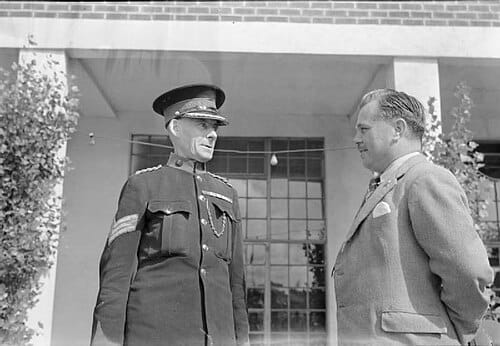
Sergeant, British Army
Support & adopt this hero ↓
Lance Corporal John Joseph Caffrey, VC (23 October 1891 – 22 February 1953) was an Irish-born British Army soldier who received the Victoria Cross for gallantry during the First World War. Born in Birr, King's County (now County Offaly), Ireland, he was the son of John Caffrey, who had served in the York and Lancaster Regiment, and Hannah Caffrey. His family relocated to Nottingham, England, during his youth, where he resided at 8 George Yard, North Street, and attended St Mary's Roman Catholic School on Derby Road. In his early adolescence, Caffrey joined the 12th Nottingham Company of the Boys' Brigade and subsequently enlisted in the 7th Battalion, Nottinghamshire and Derbyshire Regiment (Robin Hood Rifles) of the Territorial Force in early 1910. Seeking full-time military enlistment, he transferred at his own request to the 3rd Battalion, The York and Lancaster Regiment, in May 1910 and joined the 2nd Battalion in July 1910 under regimental service number 9730.
At the onset of the First World War in August 1914, Caffrey was stationed with his unit at Limerick, Ireland. Mobilized for immediate continental deployment, the 2nd Battalion embarked for France and landed at St. Nazaire on 9 September 1914. Serving within the 16th Infantry Brigade of the 6th Division, Caffrey entered active combat during operations east of Vailly-sur-Aisne later that month. On the night of 31 May 1915, his battalion moved into the trench sector near La Brique, a small hamlet situated just north of Ypres in Belgium. On 25 August 1915, Caffrey executed an act of battlefield extraction by crawling into open ground under heavy fire to retrieve a severely wounded officer, a deed that earned him the Russian Cross of St. George (4th Class).
On 16 November 1915, while holding frontline trenches near La Brique, Caffrey performed the rescue that resulted in his award of the Victoria Cross. An infantryman belonging to the West Yorkshire Regiment lay severely injured in the open, immobilized approximately three hundred to four hundred yards from the German trenches under direct enemy observation. Private Caffrey and Corporal Stirk of the Royal Army Medical Corps immediately advanced to recover him but were driven back by shrapnel fire. A short time later, they made a second attempt under close sniping and machine-gun fire, reaching the casualty and dressing his wounds. As Corporal Stirk lifted the soldier onto Caffrey's back, Stirk sustained a gunshot wound to the head. Caffrey lowered the original casualty, bandaged Corporal Stirk's head injury, and assisted him back into the safety of the British trench. Caffrey then returned across the exposed ground alone and brought in the West Yorkshire Regiment soldier, having completed three separate trips across open terrain under accurate fire.
The formal award of the Victoria Cross was promulgated in the Second Supplement to The London Gazette on 22 January 1916:
"For most conspicuous bravery on 16th November, 1915, near La Brique. A man of the West Yorkshire Regiment had been badly...sourceavery."
King George V invested Private Caffrey with the Victoria Cross at Buckingham Palace on 23 February 1916. Following his investiture, he was promoted to corporal and later attained the rank of sergeant before his discharge from military service in 1919. On 24 March 1917, he married Florence Avey at St Barnabas' Church in Cambridge. In post-war civilian life, Caffrey served with the Sunderland Fire Brigade in County Durham and later worked at Cammell Laird's Metropolitan Carriage and Wagon Company works in Nottingham until the facility closed in 1931. During the economic depression, he worked within public assistance administration.
Following the outbreak of the Second World War, Caffrey re-enlisted in the British Army in November 1939. He served as a Company Sergeant Major (CSM) in The Sherwood Foresters, executing home defense and training responsibilities. After the war, he worked as a commissionaire at Butlin's holiday camp in Filey, Yorkshire, alongside fellow Victoria Cross recipient Harry Nicholls. Caffrey died on 22 February 1953 at the Derbyshire Royal Infirmary in Derby at sixty-one years of age. He was interred at Wilford Hill Cemetery (Southern Cemetery) in Nottingham. A new headstone acknowledging his Victoria Cross was formally dedicated over his grave on 23 May 2007.
Become the named supporter for this profile and edit the tribute biography and portrait (Owner account required). Proceeds help keep the archive online.
$25 USD / year — annual sponsorship renewal. Keeps the page online and, where enabled, the family anniversary remembrance emails active.